
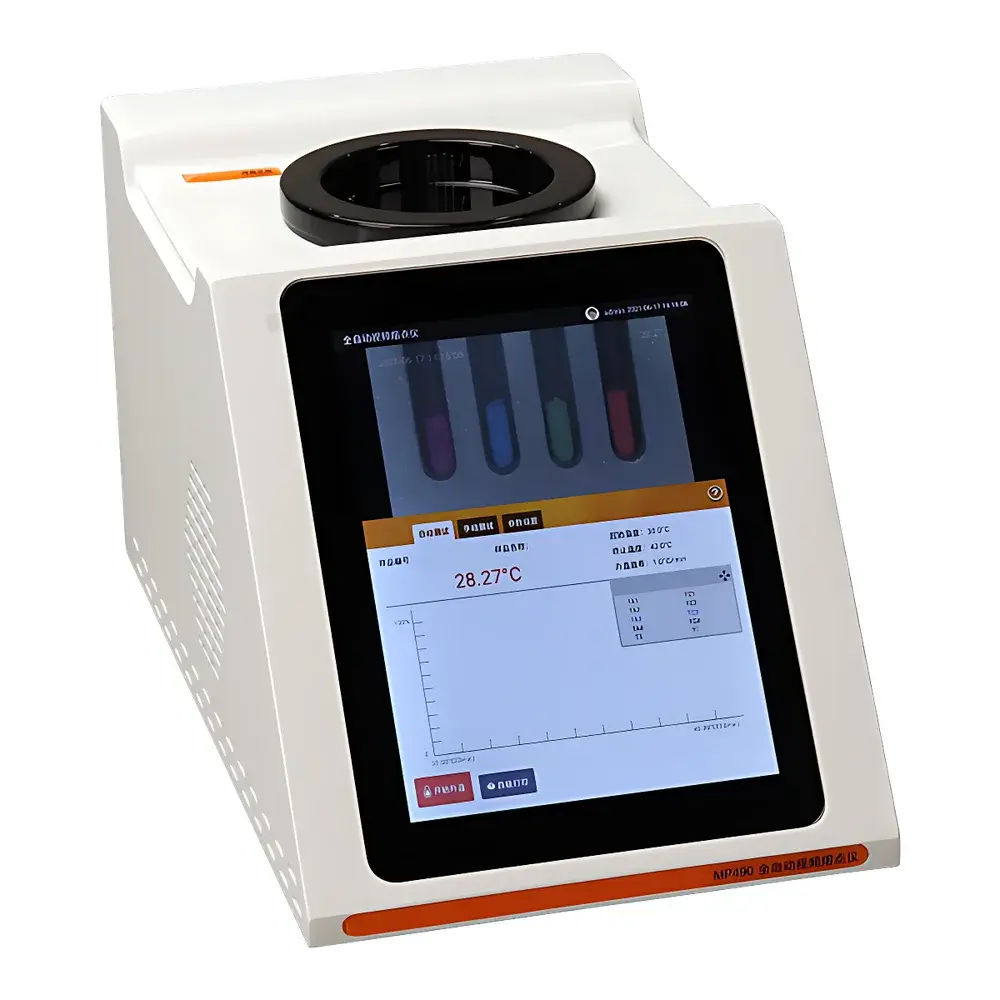
Hanon MP420 Video Melting Point Apparatus
| Brand | Hanon |
|---|---|
| Origin | Shandong, China |
| Model | MP420 |
| Temperature Range | Ambient to 300 °C |
| Heating Rate | 0.1–20 °C/min |
| Temperature Repeatability | ±0.2 °C (at 0.20 °C/min) |
| Temperature Accuracy | ±0.4 °C (<200 °C), ±0.7 °C (<300 °C) |
| Capillary Dimensions | Sealed-end, OD 1.3–1.4 mm, L 110 mm |
| Sample Capacity | 4 samples per run |
| Temperature Resolution | 0.1 °C |
| Display | 8-inch capacitive TFT touchscreen (Android OS) |
| Camera | 720p HD, 8× optical zoom |
| Data Storage | 16 GB internal (expandable via USB) |
| Compliance | FDA 21 CFR Part 11 (audit trail, user permission tiers, password policy, electronic signature support) |
Overview
The Hanon MP420 Video Melting Point Apparatus is a precision thermal analysis instrument engineered for accurate, reproducible, and visually verifiable determination of melting point, onset of decomposition, and polymorphic transitions in solid organic compounds. Unlike conventional capillary-based melting point devices relying solely on optical endpoint detection, the MP420 integrates real-time high-definition video imaging with dynamic thermal profiling to deliver both quantitative temperature data and qualitative morphological evidence. It operates on the principle of controlled heating of sealed capillary tubes under standardized atmospheric conditions, while simultaneously capturing time-synchronized video at 720p resolution with 8× optical magnification—enabling unambiguous identification of subtle visual cues such as sintering, discoloration, bubbling, or collapse that precede or accompany phase transition. Its dual-mode capability—supporting both manual observation and algorithm-driven automatic detection—ensures robustness across diverse sample types, including dark-colored, opaque, or low-contrast materials traditionally challenging for photometric auto-detection systems.
Key Features
- 8-inch Android-powered capacitive touchscreen interface with intuitive navigation, supporting multi-language UI and customizable workflow templates.
- Integrated 720p HD camera with 8× optical zoom and adjustable white balance, enabling clear visualization of crystalline morphology, particle movement, and color change during heating.
- Four independent sample channels allow parallel testing of up to four specimens under identical thermal conditions—enhancing throughput and inter-sample comparability.
- Multi-point calibration (up to six reference temperatures) using certified melting standards (e.g., USP/EP reference substances), ensuring traceable accuracy across the full operating range (ambient to 300 °C).
- Configurable melt detection logic: users define custom transmission thresholds for initial and final melt detection, accommodating variable sample opacity and thermal response profiles.
- Comprehensive data integrity architecture: all measurements are timestamped and watermarked with real-time temperature; videos embed thermographic metadata; audit trails log user actions, parameter changes, and report exports—non-erasable and exportable for regulatory review.
- Granular user management system with four hierarchical roles (Administrator, Supervisor, Operator, IT Support), each assignable specific permissions—including method editing, calibration access, data export rights, and audit log viewing.
- Robust security framework compliant with ALCOA+ principles: password aging policies, complexity enforcement, session timeout with lock-screen re-authentication, and encrypted local storage.
Sample Compatibility & Compliance
The MP420 accepts standard sealed-end capillaries (OD 1.3–1.4 mm, length 110 mm), compatible with widely adopted pharmacopeial specifications (USP <741>, EP 2.2.14, JP 2.60). It supports crystalline, semi-crystalline, and amorphous organic solids—including APIs, excipients, dyes, fragrances, and polymer additives—without requiring derivatization or dilution. The instrument’s thermal chamber employs layered insulation design to minimize ambient drift and ensure ±0.2 °C repeatability at low heating rates (0.20 °C/min), meeting ISO 8987 and ASTM E324 requirements for melting point apparatus validation. Full compliance with FDA 21 CFR Part 11 is implemented through electronic signatures, role-based access control, immutable audit logs, and system-generated timestamps embedded in every video frame and exported report.
Software & Data Management
Built on a Linux-based Android platform, the MP420 firmware includes an embedded database capable of storing over 40,000 minutes of compressed video (H.264 encoding), thermograms, calibration records, and user-defined methods. Data retrieval is accelerated via multi-level indexing—filterable by date, operator ID, method name, sample ID, or temperature event. Export options include PDF reports (with embedded video thumbnails and synchronized playback links), CSV thermographic data, and raw video files (MP4) with metadata headers. USB 3.0 ports support direct connection to wireless laser printers, thermal label printers, or external storage drives for offline backup. Network connectivity via Wi-Fi or Ethernet (RJ45) enables remote monitoring, centralized fleet management, and integration into LIMS environments through RESTful API endpoints (available under extended license).
Applications
The MP420 serves critical quality control and R&D functions across regulated and non-regulated laboratories. In pharmaceutical manufacturing, it verifies identity and purity of active pharmaceutical ingredients per ICH Q5 and USP monographs; supports polymorph screening during formulation development; and documents thermal behavior for stability studies (ICH Q1A–Q1E). In fine chemical synthesis, it validates batch-to-batch consistency of intermediates and final products. Academic researchers use its synchronized video–temperature output to correlate structural transitions with thermal events in novel MOFs, co-crystals, or chiral resolutions. Regulatory auditors routinely accept MP420-generated evidence due to its built-in traceability, electronic signature support, and adherence to GxP-aligned data governance protocols.
FAQ
Does the MP420 support GLP/GMP-compliant documentation?
Yes—the system implements full ALCOA+ data integrity principles: attributable, legible, contemporaneous, original, and accurate records, with electronic signatures and immutable audit trails satisfying GLP (OECD 1998) and GMP (EU Annex 11, FDA Guidance) requirements.
Can the instrument be calibrated with NIST-traceable standards?
Yes—users may perform multi-point calibration using any certified reference material with documented uncertainty; calibration certificates and deviation logs are automatically archived with version-controlled timestamps.
Is video recording mandatory, or can it be disabled for routine QC checks?
Video capture is configurable per method—users may enable full-duration recording, trigger-based capture (e.g., at onset of melt), or disable video entirely while retaining thermographic data.
What file formats are supported for data export?
Reports export as PDF (print-ready, with embedded video links); raw thermal data as CSV; video as MP4 (H.264); and calibration logs as encrypted XML. All exports retain embedded watermarks with real-time temperature and system clock stamps.
How does the MP420 handle samples that decompose before melting?
The system allows independent definition of “decomposition onset” based on visual criteria (e.g., darkening, gas evolution) distinct from melt detection—enabling simultaneous reporting of both events within a single assay.



