
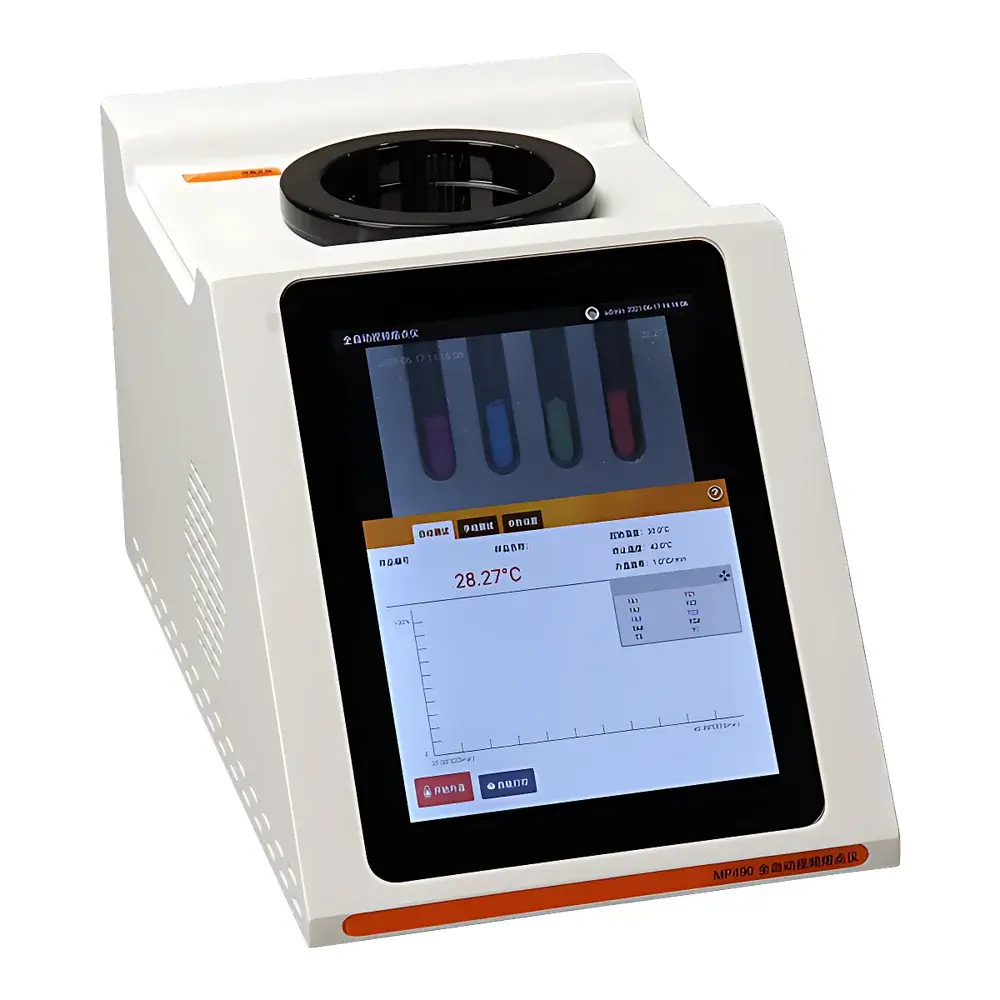
Hanon MP450 Fully Automated Video Melting Point Apparatus
| Brand | Hanon |
|---|---|
| Origin | Shandong, China |
| Model | MP450 |
| Temperature Range | Ambient to 350 °C |
| Heating Rate | 0.1–20 °C/min |
| Temperature Repeatability | ±0.2 °C (at 0.20 °C/min) |
| Temperature Accuracy | ±0.4 °C (<200 °C), ±0.7 °C (<300 °C) |
| Capillary Dimensions | Sealed-end, OD 1.3–1.4 mm, L 110 mm |
| Sample Capacity | 4 samples per run |
| Temperature Resolution | 0.1 °C |
| Data Storage | 128 GB internal (≥40,000 min video archive) |
| Compliance | FDA 21 CFR Part 11 (audit trail enabled), GLP/GMP-ready |
| Display | 8-inch capacitive TFT touchscreen (Android OS) |
| Camera | 720p HD, 8× optical zoom |
| Connectivity | USB ×3, RS-232, Wi-Fi, RJ45 Ethernet |
| Cooling | Ambient to 50 °C in ≤7 min |
Overview
The Hanon MP450 Fully Automated Video Melting Point Apparatus is an advanced thermal analysis instrument engineered for precise, reproducible, and visually verifiable determination of melting point, onset of decomposition, and polymorphic transition temperatures in crystalline organic solids. Unlike conventional capillary-based melting point systems relying solely on optical transmittance or manual observation, the MP450 integrates high-fidelity video imaging with real-time thermal profiling to deliver objective, traceable, and method-validated results. Its core measurement principle combines dynamic image analysis—using a calibrated 720p CCD camera with 8× optical magnification—to detect subtle changes in sample morphology, opacity, and color against a thermally stabilized background. Simultaneously, a high-stability Peltier-controlled heating block ensures accurate temperature ramping across the full 0–350 °C range, with resolution down to 0.1 °C and certified accuracy per ISO 8980-3 and USP <741>. The system is designed for regulatory-compliant laboratories requiring full data integrity, including time-stamped video overlays, immutable audit trails, and electronic signatures aligned with FDA 21 CFR Part 11 requirements.
Key Features
- Fully automated video-based detection: Eliminates subjective visual interpretation by applying pixel-intensity thresholding and edge-detection algorithms to identify initial collapse (onset) and complete liquefaction (clear point) with configurable transmission thresholds for each sample.
- Multi-point calibration support: Up to six independent temperature points can be validated using NIST-traceable reference standards (e.g., caffeine, acetanilide, indium), ensuring long-term metrological confidence across the operational range.
- Android-powered 8-inch capacitive touchscreen interface: Enables intuitive method setup, real-time video monitoring, and on-device data review—fully compliant with modern laboratory informatics workflows.
- Robust data governance architecture: Built-in audit trail logs all user actions—including method edits, calibration events, report exports, and login attempts—with tamper-proof timestamps and user attribution. Video files embed live temperature and elapsed time watermarks.
- Granular user access control: Four-tier permission model (Administrator, Supervisor, Operator, IT Support) with role-specific privilege assignment, password complexity enforcement, mandatory periodic password rotation, and session timeout lockout.
- High-throughput dual-mode operation: Simultaneously processes four standard capillaries (1.3–1.4 mm OD, 110 mm length) per run, with optional batch scheduling and auto-restart functionality for unattended overnight analysis.
Sample Compatibility & Compliance
The MP450 accommodates a broad spectrum of thermally sensitive organic compounds—including pharmaceutical actives (APIs), intermediates, excipients, dyes, fragrances, and agrochemicals—without requiring derivatization or dilution. Its video-centric detection mechanism overcomes inherent limitations of photometric systems when analyzing deeply colored, opaque, or highly scattering samples (e.g., metal complexes, carbon-black-loaded polymers). All hardware and firmware comply with IEC 61010-1 safety standards. The software platform supports 21 CFR Part 11 compliance through electronic signature validation, audit trail retention, and secure data export protocols (PDF/A-2, CSV, MP4). It meets GLP and GMP documentation requirements for QC release testing, stability studies, and regulatory submissions (ICH Q5, Q6A).
Software & Data Management
Embedded Android OS hosts a dedicated analytical suite supporting method creation, parameter optimization (heating rate, dwell time, detection sensitivity), and customizable report templates. Data—including raw video streams, thermal curves, metadata, and calibration records—is stored locally on 128 GB eMMC flash memory (expandable via USB 3.0), with automatic backup to external drives or network shares. Search functionality enables rapid retrieval by sample ID, date range, operator name, or melting point interval. Export formats include timestamped PDF reports with embedded video thumbnails, CSV datasets for statistical process control (SPC), and H.264-encoded MP4 files compatible with LIMS integration. Remote printing via Wi-Fi or Ethernet supports wireless laser printers and thermal label printers—ideal for paperless QC environments.
Applications
- Pharmaceutical quality control: Verification of identity and purity per USP <741>, EP 2.2.17, and JP 2.60; polymorph screening during solid-form selection.
- Chemical R&D: Reaction endpoint confirmation, purity assessment of synthetic intermediates, and thermal stability profiling of novel heterocycles.
- Academic research: Teaching labs benefit from real-time visualization of phase transitions; graduate studies leverage synchronized video-thermal datasets for kinetic modeling.
- Regulatory filing support: Generation of ALCOA+ (Attributable, Legible, Contemporaneous, Original, Accurate, Complete, Consistent, Enduring, Available) data packages for FDA, EMA, and PMDA submissions.
- Contract manufacturing organizations (CMOs): Scalable deployment across multiple instruments with centralized reporting and shared printer infrastructure.
FAQ
Does the MP450 support multi-point temperature calibration?
Yes—the instrument supports up to six independent calibration points using certified reference materials, enabling linearity verification across its full operating range.
Can video recordings be exported and archived externally?
Yes—videos are stored in H.264 MP4 format with embedded temperature/time watermarks and can be exported via USB, network share, or cloud-synced storage solutions.
Is the system compatible with LIMS or ELN platforms?
Yes—CSV and PDF exports follow standardized schemas; API-level integration is supported via TCP/IP socket communication for custom middleware deployment.
What capillary specifications are required for optimal performance?
Standard sealed-end capillaries with outer diameter 1.3–1.4 mm and length 110 mm are recommended. Non-standard dimensions may affect thermal equilibration and detection consistency.
How does the MP450 ensure data integrity under GLP/GMP conditions?
Through enforced audit trails, electronic signatures, password lifecycle management, immutable video watermarking, and 21 CFR Part 11–compliant user access controls—all validated during IQ/OQ/PQ protocols.



