
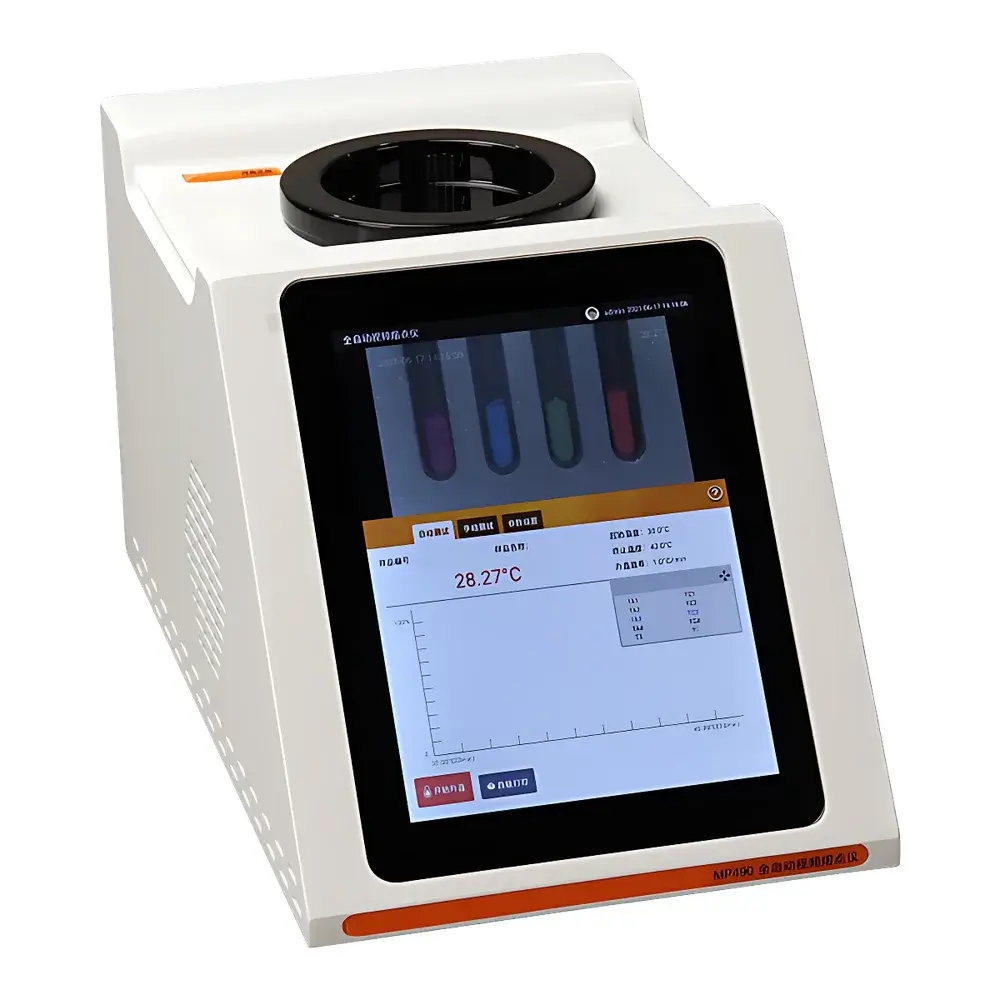
Hanon MP470 Fully Automated Video Melting Point Apparatus
| Brand | Hanon |
|---|---|
| Origin | Shandong, China |
| Model | MP470 |
| Temperature Range | Ambient to 400 °C |
| Heating Rate | 0.1–20 °C/min |
| Temperature Repeatability | ±0.2 °C (at 0.20 °C/min) |
| Temperature Accuracy | ±0.4 °C (<200 °C), ±0.7 °C (<300 °C) |
| Capillary Dimensions | Sealed-end, OD 1.3–1.4 mm, L 110 mm |
| Sample Capacity | 4 samples per run |
| Temperature Resolution | 0.1 °C |
| Display | 8-inch capacitive TFT touchscreen (Android OS) |
| Data Storage | Up to 128 GB (≥40,000 min video archive) |
| Connectivity | USB ×3, RS232, Wi-Fi, RJ45 |
| Video | 720p, 8× optical zoom, real-time watermarking (timestamp + temperature), synchronized thermal profile playback |
| Calibration | Up to 6-point certified reference material calibration |
| Compliance | FDA 21 CFR Part 11 audit trail, user role-based access control (Admin/Supervisor/Operator/IT), password aging & complexity policies, screen lock timeout |
Overview
The Hanon MP470 Fully Automated Video Melting Point Apparatus is an advanced thermal analysis instrument engineered for precise, reproducible, and auditable determination of melting point, onset of decomposition, and polymorphic transition temperatures in solid organic compounds. It employs high-resolution digital video imaging coupled with dynamic optical transmittance analysis—rather than traditional manual visual observation or single-point photodiode detection—to objectively identify phase transitions based on real-time changes in light transmission through the sample column within a standardized capillary tube. This video-based methodology eliminates subjective interpretation, enables retrospective verification, and supports detection of subtle events such as discoloration, sintering, or bubbling prior to full melting—critical for pharmaceutical development, quality control of active pharmaceutical ingredients (APIs), and regulatory submission packages.
Key Features
- Fully automated measurement workflow with pre-programmed methods, including customizable initial/final melt detection thresholds based on optical transmittance gradients.
- 8-inch Android-powered capacitive touchscreen interface with intuitive navigation, multi-language support, and embedded software extensibility for GLP/GMP-compliant workflows.
- 720p HD camera system with 8× optical zoom and low-noise CCD sensor, enabling clear visualization of particle morphology, crystal habit evolution, and color shifts during heating.
- Multi-layer thermal insulation architecture ensures exceptional temperature stability (±0.2 °C repeatability at 0.20 °C/min) while achieving rapid thermal ramping: ambient to 350 °C ≤5 minutes; 350 °C to 50 °C ≤7 minutes.
- Comprehensive data integrity framework compliant with FDA 21 CFR Part 11: immutable audit trail logging all user actions, parameter changes, and result modifications; time- and temperature-stamped watermarked video export; electronic signatures for report approval.
- Four-channel parallel testing capability with independent thermal profiling per sample position, supporting comparative studies and statistical validation per ICH Q5C and USP <741> guidelines.
- Robust data management: local storage up to 128 GB (supporting >40,000 minutes of compressed video), USB backup/restore, network file sharing via Wi-Fi or Ethernet, and direct wireless printing to laser or thermal printers.
Sample Compatibility & Compliance
The MP470 accommodates standard sealed-end capillaries (OD 1.3–1.4 mm, length 110 mm), compatible with widely accepted reference materials including USP Melting Point Reference Standards (e.g., acetanilide, indomethacin, caffeine). Its video-based detection mechanism provides reliable performance across diverse sample types—including highly colored, opaque, or thermally unstable compounds—that often challenge conventional photometric or manual methods. The system meets key international standards for thermal analysis instrumentation: ISO 11357-3 (DSC and melting point), ASTM E324 (standard test method for melting point), and pharmacopoeial requirements outlined in USP <741>, EP 2.2.17, and JP 2.60. Full traceability is ensured through NIST-traceable temperature calibration using certified reference substances at up to six points across the operational range (ambient to 400 °C).
Software & Data Management
Built on a secure Android platform, the MP470 firmware supports granular user permission levels—Administrator, Supervisor, Operator, and IT—with configurable access rights assigned at account creation. Password policies enforce complexity rules (minimum length, uppercase/lowercase/digit/symbol requirements) and automatic expiration (configurable interval), requiring renewal before re-authentication. An auto-lock screen activates after user-defined idle time, enforcing re-login. All measurement sessions generate timestamped, tamper-evident records containing raw video, thermal curve, metadata (operator ID, method name, calibration status), and watermarked playback synchronized with temperature progression. Data exports comply with ALCOA+ principles (Attributable, Legible, Contemporaneous, Original, Accurate) and are structured for seamless integration into LIMS or electronic lab notebook (ELN) systems via CSV, PDF, or encrypted video (.mp4) formats.
Applications
- Pharmaceutical R&D and QC: Polymorph screening, batch release testing of APIs and excipients, stability-indicating method development, and impurity profiling per ICH Q5A–Q5E.
- Chemical manufacturing: Purity assessment of fine chemicals, dyes, agrochemical intermediates, and specialty polymers.
- Academic research: Solid-state chemistry investigations, crystal engineering, hydrate/solvate characterization, and thermal degradation kinetics.
- Regulatory submissions: Generation of auditable, video-supported melting data for FDA, EMA, PMDA, and WHO prequalification dossiers.
- Contract laboratories: High-throughput screening with method validation documentation, instrument qualification (IQ/OQ/PQ), and 21 CFR Part 11–compliant reporting.
FAQ
Does the MP470 support calibration with multiple reference standards?
Yes—the instrument supports up to six-point calibration using certified melting point reference materials traceable to NIST or national metrology institutes.
Can video recordings be exported with embedded temperature and time stamps?
Yes—every exported video includes a real-time, non-removable watermark displaying current temperature and elapsed time, ensuring data integrity and chain-of-custody compliance.
Is remote monitoring or control possible?
While direct remote control is not supported, instruments connected via Wi-Fi or Ethernet can be accessed for file transfer, report generation, and status checking through secure network protocols.
What capillary specifications are required?
Standard one-end-sealed capillaries with outer diameter 1.3–1.4 mm and length 110 mm, consistent with USP <741> and EP 2.2.17 recommendations.
How does the MP470 handle dark or decomposing samples?
Unlike photodiode-based systems, its high-dynamic-range video analysis detects morphological changes—including charring, expansion, or gas evolution—enabling accurate endpoint identification even when optical transmission remains low.



