
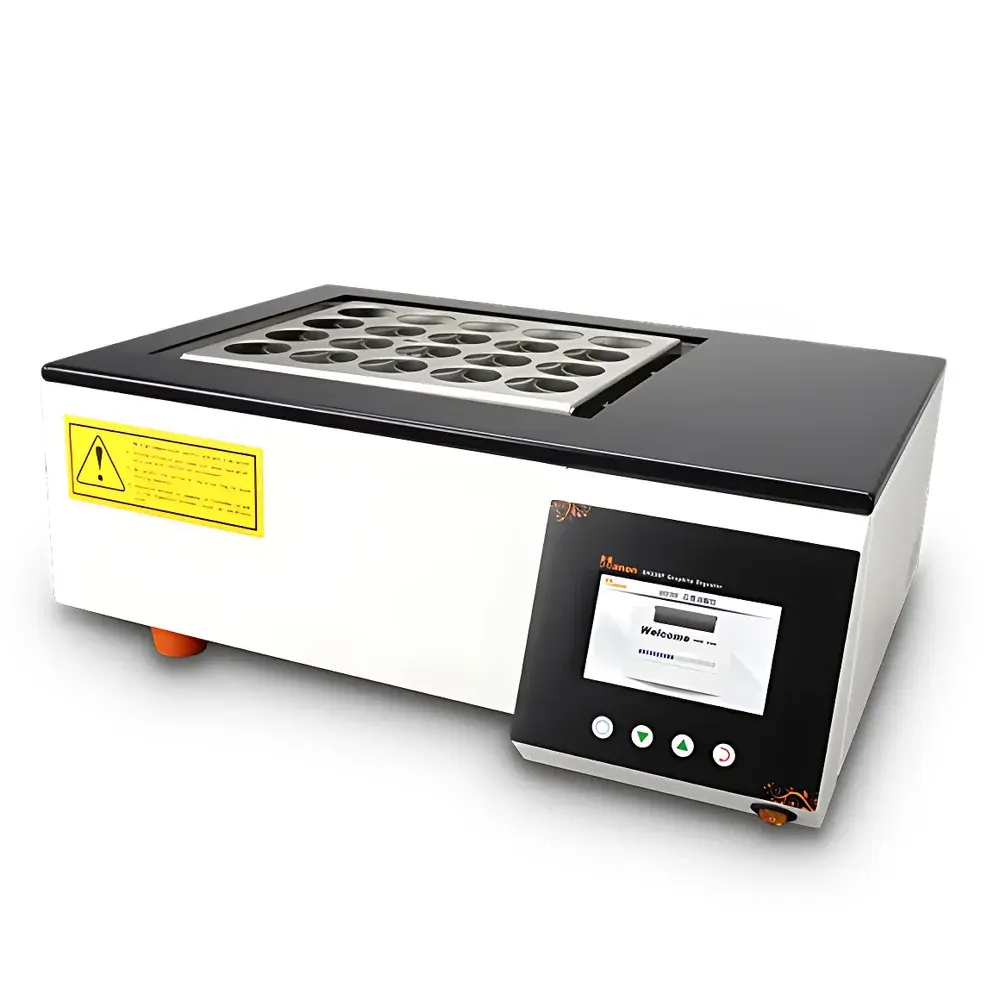
Hanon SH220F Graphite Block Digestion System
| Brand | Hanon |
|---|---|
| Origin | Shandong, China |
| Manufacturer Type | Authorized Distributor |
| Country of Origin | China |
| Model | SH220F |
| Instrument Type | Graphite Block Digestion System |
| Automation Level | Fully Automatic |
| Digestion Positions | 30 |
| Temperature Range | Ambient +5 °C to 450 °C |
| Temperature Control Accuracy | ±1 °C |
| Heating Principle | Infrared Radiation + High-Purity Graphite Thermal Conduction |
| Reagent Channel Capacity | Up to 20 Samples Simultaneously |
| Display | 4.3-inch Color TFT LCD |
| Programmable Methods | 10 Predefined Multi-Stage Programs (up to 5 Temp/Time Segments Each) |
| Power Supply | 220 VAC ±10%, 50 Hz |
| Rated Power | 3.6 kW |
| Dimensions (L×W×H) | 515 mm × 421 mm × 211 mm |
| Net Weight | 25 kg |
| Safety Protections | Over-Temperature, Over-Current, Over-Voltage, Real-Time Heating Element Diagnostics |
| Graphite Block Treatment | CVD-Coated Surface for Oxidation Resistance |
| Housing Finish | PTFE-Impregnated Stainless Steel with Ceramic Fiber + Optimized Air-Channel Insulation |
| Exhaust Integration | Compatible with WD03 Acid Fume Extraction Unit and S402 Triple-Stage Neutralization System (Water Wash + NaOH Neutralization + Activated Carbon Adsorption) |
| Digestion Vessel Compatibility | 300 mL Borosilicate or Quartz Tubes (H₂O @ 20 °C) |
Overview
The Hanon SH220F Graphite Block Digestion System is a fully automated, high-precision sample preparation instrument engineered for reproducible open-vessel acid digestion in regulated and research laboratory environments. It operates on the principle of uniform conductive heating via infrared-radiated, high-purity graphite blocks—eliminating hot spots and ensuring consistent thermal energy transfer across all 30 digestion positions. Unlike traditional ceramic or metal heating blocks, the SH220F’s graphite core is treated using chemical vapor deposition (CVD), conferring exceptional resistance to oxidation, flaking, or surface degradation at sustained temperatures up to 450 °C. This architecture supports rigorous method compliance in food safety (AOAC 999.10, ISO 11047), environmental analysis (EPA 3050B, 3051A), agricultural testing (ISO 11466), and pharmaceutical quality control (USP <231>, ICH Q5C). Its design prioritizes operator safety, analytical robustness, and long-term system stability—making it especially suited for laboratories performing routine Kjeldahl nitrogen analysis in tandem with Hanon KjelMaster series analyzers.
Key Features
- High-fidelity PID temperature control with ±1 °C accuracy across the full operating range (ambient +5 °C to 450 °C); achieves 400 °C in ≤25 minutes
- 30-position graphite block with CVD-coated surface—minimizes inter-hole thermal deviation (<2 °C at 400 °C) and extends service life under aggressive HNO₃/H₂SO₄/HF digestion protocols
- 4.3-inch color TFT LCD interface supporting dual heating profiles: linear ramp and programmable multi-segment curve (10 stored methods, each with up to 5 temperature/time steps)
- Real-time health monitoring of individual heating elements with automatic fault detection and audible/visual alerts
- Full enclosure with PTFE-impregnated stainless steel housing and concealed ceramic fiber insulation—surface temperature remains <50 °C during operation
- Integrated safety suite: over-temperature cutoff, current surge protection, voltage fluctuation compensation, and thermal runaway prevention
- Stereoscopic circumferential heating geometry ensures radial and axial thermal uniformity—critical for trace metal recovery consistency (e.g., Cd, Pb, As in soil per ISO 11466)
Sample Compatibility & Compliance
The SH220F accommodates standard 300 mL digestion tubes (borosilicate or quartz), enabling parallel processing of up to 20 samples per batch under identical thermal conditions. Its corrosion-resistant construction—including PFA-sealed lids (WD03 system), PTFE-lined exhaust pathways, and alkaline-neutralized gas scrubbing (S402)—ensures compatibility with concentrated nitric, sulfuric, hydrochloric, perchloric, and hydrofluoric acids. The system meets structural and operational requirements aligned with GLP documentation standards and supports audit-ready workflows when paired with Hanon’s optional data logging modules. While not certified to IEC 61000-4-x or UL 61010-1 as a standalone unit, its electrical architecture conforms to CE-compliant EMC and safety design principles applicable to Class II laboratory equipment.
Software & Data Management
The embedded firmware implements deterministic real-time temperature regulation without external PC dependency. All 10 user-defined digestion programs—including segment-specific dwell times, ramp rates, and hold temperatures—are retained in non-volatile memory. Optional RS-232 or USB-C connectivity enables integration with LIMS platforms or custom SCADA systems for time-stamped event logging (start/end timestamps, max temperature achieved, fault codes). Though native software does not provide FDA 21 CFR Part 11-compliant electronic signatures, the system generates ASCII-formatted log files suitable for manual import into validated data review workflows compliant with ISO/IEC 17025 clause 7.7.
Applications
The SH220F serves as a primary digestion platform for elemental analysis by ICP-OES, ICP-MS, AAS, and IC. Typical use cases include: total metal quantification in soils and sediments (EPA Method 3051A); nutrient and heavy metal profiling in feedstuffs and cereals (AOAC 999.10); residual catalyst detection in polymer matrices; and protein-bound nitrogen release in Kjeldahl workflows. Its thermal consistency directly impacts recovery rates—validated studies show ≥98.5% spike recovery for Cr, Ni, Cu, Zn, and Cd across heterogeneous biological matrices when operated within calibrated temperature gradients.
FAQ
What digestion vessel sizes are supported?
Standard 300 mL borosilicate or quartz tubes (filled to 20 °C water capacity); custom adapters available for 50–100 mL micro-vessels.
Is the system compatible with hydrofluoric acid (HF)?
Yes—when used with PFA-sealed digestion lids (WD03) and PTFE exhaust tubing; HF-compatible quartz vessels recommended.
Can digestion programs be exported or backed up?
Programs reside in onboard flash memory; export requires serial communication and third-party terminal software.
Does the SH220F meet ISO/IEC 17025 calibration traceability requirements?
Temperature sensors are factory-calibrated against NIST-traceable references; annual verification using accredited dry-block calibrators is advised.
What maintenance intervals are recommended for the graphite block?
No scheduled replacement; CVD coating extends functional life beyond 5,000 cycles at 400 °C—visual inspection for surface pitting every 500 runs is sufficient.



