
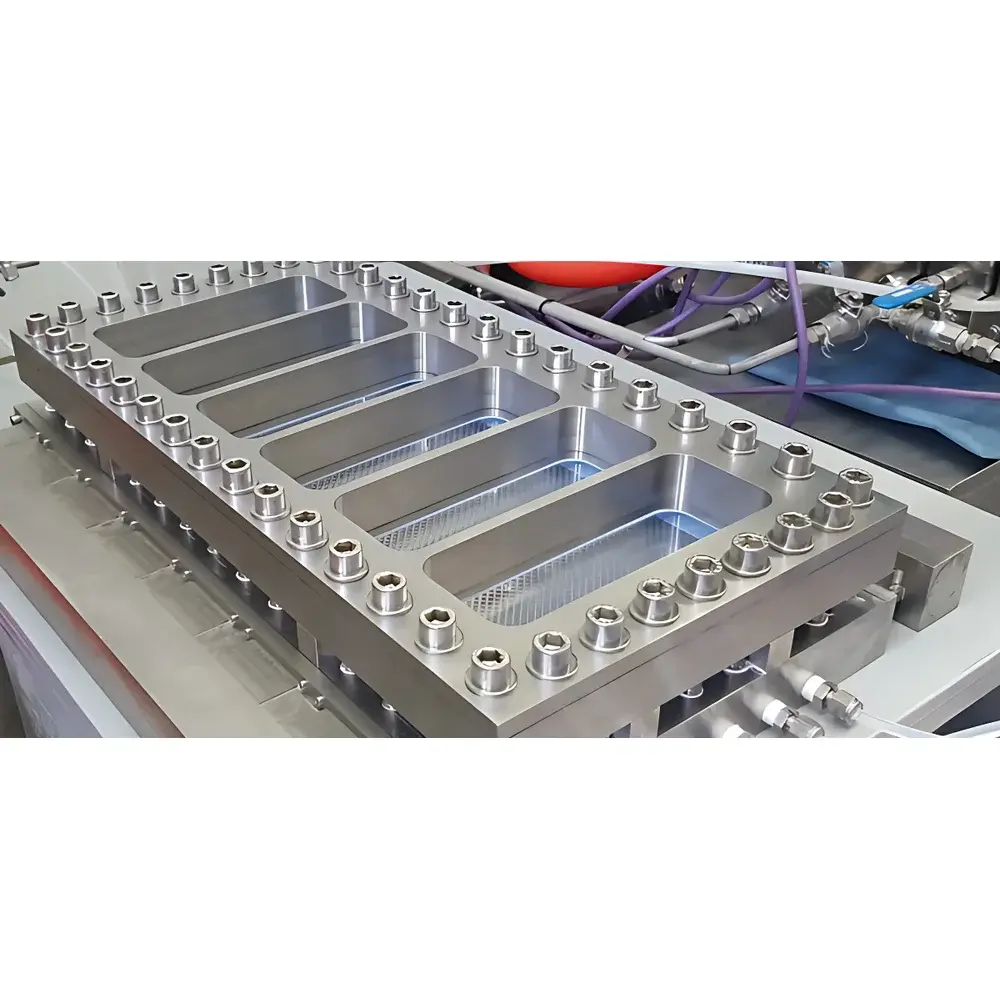
HANU HX-150 Continuous-Flow Photochemical Reactor
| Brand | CREAFLOW |
|---|---|
| Origin | Belgium |
| Model | HX-150 |
| Reactor Volume | 150 mL |
| Operating Pressure | 0–10 bar |
| Temperature Range | −20 to 80 °C |
| Window Material | Borosilicate glass (transmission >325 nm) / Quartz (transmission >200 nm) |
| Construction Materials | 316L stainless steel, Hastelloy C-276 (customizable) |
| Heat Exchange | External thermal fluid circuit |
| Flow Regime | Laminar-to-turbulent transition via static mixing and pulsed flow |
| Residence Time Distribution | Narrow (Péclet number >100) |
| Optical Path Geometry | Integrated transparent irradiation windows with uniform photon flux delivery |
Overview
The HANU HX-150 Continuous-Flow Photochemical Reactor is an engineered platform for scalable, reproducible photochemical synthesis under controlled irradiation, temperature, and residence time conditions. Designed using COSTA (Controlled Oscillatory Shear and Turbulent Advection) fluid dynamics principles, the reactor integrates static micromixing geometry with synchronized pulsatile flow actuation to achieve high interfacial renewal and uniform photon absorption across the reaction volume. Unlike batch photoreactors subject to photon gradient decay and thermal runaway, the HX-150 enables precise spatiotemporal control of light exposure through its optically transparent, chemically resistant windows and low-pressure-drop channel architecture. Its modular design supports seamless integration into automated synthesis workflows and aligns with modern process intensification strategies for pharmaceutical, agrochemical, and fine chemical development.
Key Features
- Optimized photonic efficiency via dual-window configuration: borosilicate (UV-A/visible) and optional fused quartz (deep UV down to 200 nm), enabling broad-spectrum photoactivation.
- Static mixing elements—2 mm × 2 mm serpentine channels with integrated baffles—induce controlled flow splitting and recombination, generating laminar-turbulent transition regimes without mechanical moving parts.
- Pulsed-flow modulation system delivers programmable pressure oscillations (0.1–5 Hz), enhancing radial mass transfer and minimizing axial dispersion (measured Péclet numbers >100).
- Modular, tool-free reactor core assembly allows rapid exchange of irradiation modules, material-contact components (e.g., 316L SS or Hastelloy C-276), and thermal management interfaces.
- Low-pressure-drop design (<2 bar at 50 mL/min aqueous flow) supports high-throughput operation while maintaining compatibility with standard HPLC and syringe pump infrastructure.
- Full traceability-ready architecture: all process parameters—including flow rate, temperature, pressure, pulse frequency, and irradiance—are logged via analog/digital I/O ports compliant with Modbus RTU and EtherCAT protocols.
Sample Compatibility & Compliance
The HX-150 accommodates homogeneous solutions, colloidal suspensions, gas–liquid slurries, and solid-catalyzed reactions—including heterogeneous photocatalysis with TiO₂, Ru(bpy)₃²⁺ immobilized resins, and semiconductor nanoparticles. All wetted surfaces meet ASTM A240 and ASTM B575 specifications for corrosion resistance. The reactor complies with PED 2014/68/EU for pressure equipment up to 10 bar and conforms to ISO 14644-1 Class 5 cleanroom-compatible assembly practices. Optional validation packages support IQ/OQ documentation per GMP Annex 15 and FDA 21 CFR Part 11 requirements for electronic records and signatures.
Software & Data Management
The reactor operates natively with CREAFLOW’s FlowSynth Control Suite v3.2—a deterministic real-time control application supporting PID-regulated temperature loops, closed-loop pulse synchronization, and dynamic residence time adjustment. Raw sensor data (±0.1 °C temperature accuracy, ±0.05 bar pressure resolution) are streamed to local SQLite databases or cloud-hosted time-series platforms (InfluxDB, TimescaleDB). Export formats include CSV, HDF5, and ASTM E2995-compliant .rxn files for kinetic modeling in MATLAB, Python (SciPy), or Aspen Custom Modeler. Audit trails record user actions, parameter changes, and calibration events with SHA-256 hashing for GLP/GMP audit readiness.
Applications
- Photocatalytic C–H functionalization and cross-coupling (e.g., aryl halide amination, decarboxylative alkylation) under visible-light irradiation.
- Continuous synthesis of photosensitive APIs—including retinoids, porphyrin derivatives, and azobenzene-based prodrugs—with strict control over quantum yield and byproduct formation.
- Scale-up studies from lab-scale (HX-15) to pilot production (HX-150), leveraging linear geometric similarity and identical dimensionless numbers (Re, Fr, Da, Φ).
- In-line PAT integration with UV-Vis spectrophotometers (200–800 nm), FTIR flow cells, and Raman probes for real-time reaction progress monitoring and endpoint determination.
- Multi-phase photo-oxidation processes involving O₂ sparging, slurry-phase photocatalysts, and biphasic solvent systems (e.g., water/ethyl acetate).
FAQ
What light sources are compatible with the HX-150?
The reactor accepts collimated LED arrays (365, 405, 450, and 525 nm), medium-pressure mercury lamps (with bandpass filtering), and fiber-coupled laser diodes (up to 5 W optical power). Irradiance is adjustable from 10 to 1200 mW/cm² at the window surface.
Can the HX-150 be operated under inert atmosphere?
Yes—integrated gas purging ports and VCR fittings enable continuous N₂ or Ar blanketing; optional pressure-tight feedthroughs support anhydrous, oxygen-free operation down to <1 ppm O₂.
Is reactor cleaning validated for multi-product use?
Standard cleaning protocols (NaOH/EtOH rinse, followed by HPLC-grade MeCN flush) demonstrate ≤10 ppm carryover for API intermediates; full CIP validation kits with conductivity and TOC monitoring are available upon request.
How is photon flux calibrated and maintained?
Each unit ships with NIST-traceable radiometric calibration certificates for both window materials; in situ irradiance mapping is performed using a calibrated photodiode array mounted on the optical rail.
Does the system support reaction calorimetry?
While not intrinsically calorimetric, the HX-150’s thermal fluid interface enables indirect heat flow estimation via ΔT measurement across the heat exchanger, with typical uncertainty <±5% when coupled with calibrated flow meters and thermistors.



