
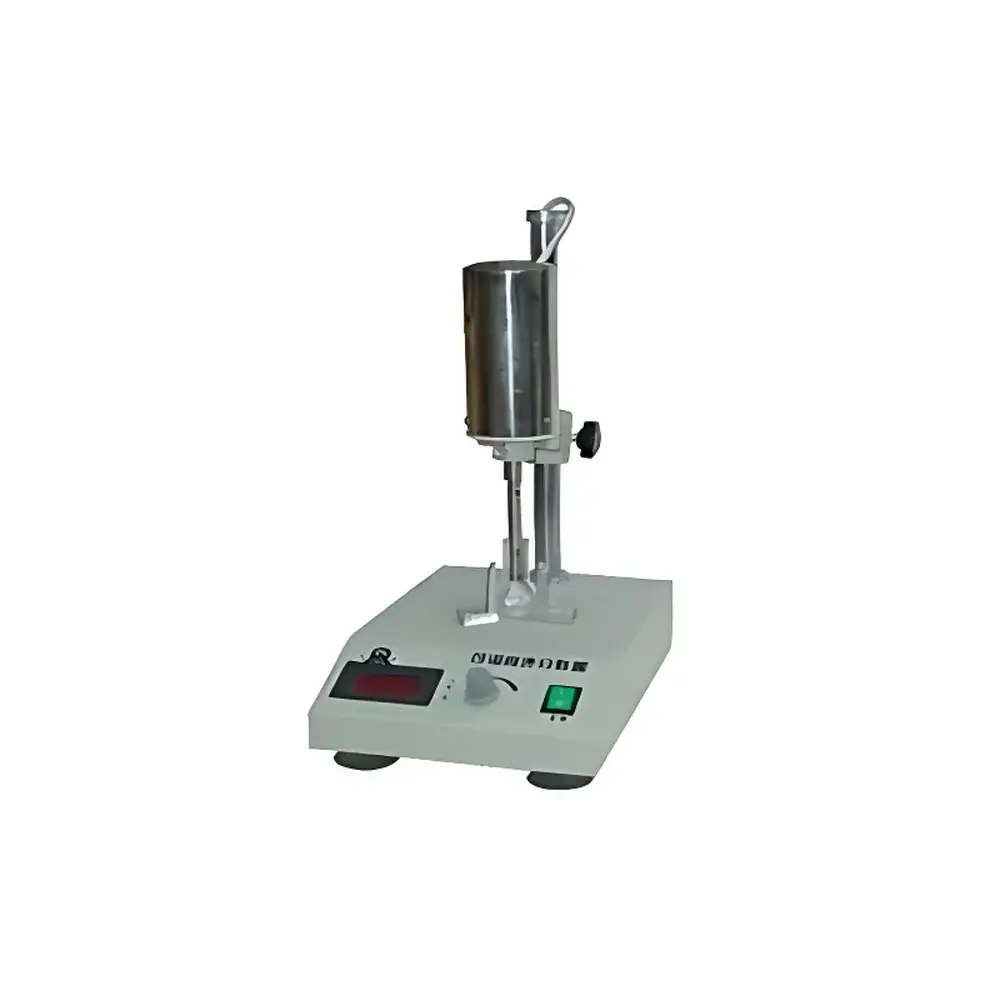
Hanuo FSH-2S Digital Display High-Speed Homogenizer
| Brand | Hanuo |
|---|---|
| Origin | Shanghai, China |
| Model | FSH-2S |
| Motor Speed | 22,000 rpm |
| Homogenizing Blade Speed Range | 8,000–20,000 rpm |
| Power | 185 W |
| Dimensions (W×D×H) | 300 × 250 × 400 mm |
| Weight | 10 kg |
| Voltage | 220 V ±10% |
| Operating Temperature | −10 to +45 °C |
| Continuous Operation Time | 5 min |
| Display | Digital LED RPM readout |
| Blade Type | Internal shear-type stainless steel probes (2 included) |
Overview
The Hanuo FSH-2S Digital Display High-Speed Homogenizer is an internally driven, high-shear laboratory homogenizer engineered for reproducible cell disruption, tissue homogenization, emulsification, and solvent extraction. It operates on the principle of rotor-stator mechanical shearing—where a rapidly rotating stainless-steel probe (rotor) generates intense hydrodynamic cavitation and turbulent flow within a stationary sample container, resulting in efficient particle size reduction and phase dispersion. Designed for routine use in molecular biology, pharmacology, food science, and environmental laboratories, the FSH-2S delivers precise speed control across a wide operational range, enabling users to tailor energy input to sample viscosity, thermal sensitivity, and target subcellular integrity (e.g., nuclear isolation vs. complete lysis). Its compact benchtop architecture integrates a brush-type series-wound motor with silicon-controlled rectifier (SCR) speed regulation and optical tachometric feedback—ensuring stable rotational output and real-time digital RPM verification.
Key Features
- Digitally calibrated LED display showing actual rotational speed (rpm) with ±50 rpm resolution—enabling traceable, repeatable parameter documentation.
- Dual interchangeable stainless-steel homogenizing probes: one optimized for viscous tissue slurries (8,000–18,000 rpm), another for low-viscosity emulsions or organic extractions (8,000–20,000 rpm).
- Internal shear geometry minimizes aerosol generation and cross-contamination risk compared to external rotor-stator systems; ideal for BSL-2-compatible workflows.
- Low-speed mode (≤3,000 rpm) functions as a magnetic-free mechanical stirrer for gentle suspension mixing—eliminating need for auxiliary equipment.
- Thermally protected motor with automatic thermal cutoff after 5 minutes of continuous operation, aligned with IEC 61000-3-2 harmonic emission standards for lab-grade electrical safety.
- Robust aluminum-alloy housing with non-slip rubber feet and integrated cable management; meets IP20 ingress protection for dry indoor laboratory environments.
Sample Compatibility & Compliance
The FSH-2S accommodates samples ranging from 0.5 mL to 250 mL in standard glass or polypropylene tubes, centrifuge bottles, or beakers. It supports aqueous, organic, and biphasic systems—including water-immiscible solvent extractions (e.g., chloroform/methanol for lipidomics), homogenization of fibrous plant tissues (e.g., leaf, root), soft animal organs (liver, spleen), and cultured cell pellets. While not certified for GMP manufacturing, its design facilitates GLP-aligned documentation: digital speed logging enables correlation with SOP-defined protocols (e.g., USP for emulsion droplet size consistency or ASTM D6978-05 for particulate dispersion validation). All wetted parts are 316L stainless steel—resistant to common solvents (acetone, ethanol, ethyl acetate) and compatible with alkaline cleaning agents.
Software & Data Management
The FSH-2S operates as a standalone instrument without proprietary software dependency. RPM values are displayed locally via a 4-digit LED panel; no data export or PC interface is provided. However, its analog speed control architecture allows integration into validated workflows where manual entry of setpoints into electronic lab notebooks (ELNs) satisfies 21 CFR Part 11 audit requirements—provided operators document timestamped speed settings, probe type, sample volume, and duration per run. For laboratories requiring automated traceability, third-party USB-based tachometer loggers (e.g., Extech 461830) may be deployed alongside the unit to record time-stamped speed profiles.
Applications
- Molecular biology: Nuclear isolation, mitochondrial enrichment, and controlled DNA shearing for library prep (e.g., ChIP-seq, ATAC-seq).
- Pharmaceutical R&D: Emulsion formulation development (oil-in-water, water-in-oil), active pharmaceutical ingredient (API) suspension homogenization, and excipient compatibility screening.
- Food & agriculture: Extraction of phytochemicals (polyphenols, carotenoids), homogenization of dairy matrices for fat globule analysis, and microbial cell lysis for enzyme recovery.
- Environmental testing: Soil slurry homogenization prior to heavy metal leaching assays (EPA Method 1311), and sediment-bound contaminant extraction.
- Quality control labs: Routine QC of raw material uniformity (e.g., herbal powder homogeneity per ISO 13320:2020 laser diffraction guidance).
FAQ
What is the maximum recommended sample volume for optimal homogenization efficiency?
For consistent shear distribution and minimal heat accumulation, the FSH-2S achieves best results with 10–100 mL in standard cylindrical vessels (diameter ≥30 mm); volumes below 5 mL require micro-probe adaptation (not included).
Can the FSH-2S be used for sterile applications?
Yes—probes and sample containers may be autoclaved (121 °C, 20 min, unwrapped); however, the main unit must remain outside sterilization chambers and be surface-decontaminated using 70% ethanol or hydrogen peroxide wipes.
Is speed calibration traceable to national standards?
The built-in optical tachometer is factory-calibrated against NIST-traceable reference instruments; recalibration services are available through Hanuo’s authorized service centers in Asia-Pacific regions.
Does the unit comply with electromagnetic compatibility (EMC) directives for EU laboratories?
It meets CE marking requirements under Directive 2014/30/EU (EMC Directive) and 2014/35/EU (LVD), verified via third-party testing at SGS Shanghai (Test Report No. GZ22-018456).
What maintenance intervals are recommended for sustained performance?
Inspect probe threads and shaft alignment every 200 operating hours; lubricate gear housing annually with ISO VG 68 synthetic oil; replace carbon brushes after 1,500 hours or if sparking occurs.



