
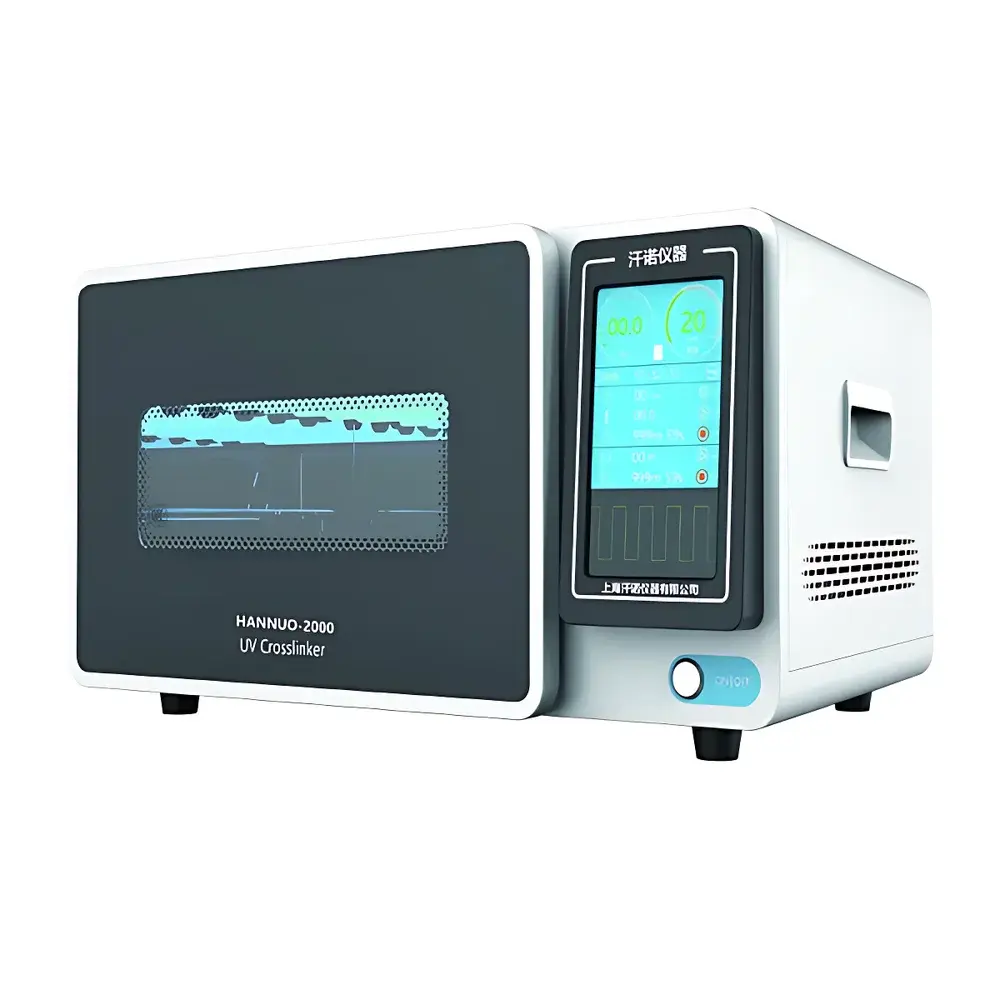
Hanuo HANNUO-2000 Intelligent UV Crosslinker
| Brand | Hanuo |
|---|---|
| Model | HANNUO-2000 |
| UV Wavelength | 254 nm (standard), optional 312 nm or 365 nm |
| Exposure Time Range | 0–999 min 59 s |
| Exposure Energy Range | 0–99.99 J |
| UV Irradiance | 5 mW/cm² |
| Chamber Dimensions | 340 mm × 260 mm × 150 mm |
| Power Supply | 220 V / 50 Hz / 100 W |
| Weight | 13 kg |
| Data Storage Capacity | 50 protocols |
| Display | 7-inch TFT touch screen |
| Safety Features | Interlocked safety door, UV-blocking viewing window, automatic shutdown upon door opening |
| Calibration & Diagnostics | Built-in calibration function, power-fail data retention, real-time energy integration (J/cm² mode) |
Overview
The Hanuo HANNUO-2000 Intelligent UV Crosslinker is a precision-engineered ultraviolet irradiation system designed for reproducible nucleic acid immobilization and UV-mediated molecular biology applications. It operates on the principle of controlled UV-C (254 nm) photon absorption by nucleic acids—inducing covalent crosslinks between pyrimidine bases and solid supports such as nylon or nitrocellulose membranes. Unlike time-based exposure methods, the HANNUO-2000 integrates real-time UV irradiance monitoring via a calibrated photodiode sensor, enabling dose-controlled exposure in joules per square centimeter (J/cm²). This energy-integrated control eliminates variability caused by lamp aging, ambient temperature fluctuations, or voltage drift—ensuring consistent crosslinking efficiency across instruments and over time. The system supports three discrete UV bands (254 nm, 312 nm, and 365 nm), allowing users to select optimal wavelengths for distinct applications: 254 nm for maximal DNA-RNA membrane binding; 312 nm for UV-induced mutagenesis or RecA-mediated recombination assays; and 365 nm for photochemical polymer modification or low-damage surface decontamination.
Key Features
- Microprocessor-controlled UV dosimetry with real-time energy integration (J/cm² mode), delivering high inter-run reproducibility independent of lamp intensity decay.
- 7-inch capacitive TFT touchscreen interface supporting bilingual (English/Chinese) operation, intuitive protocol navigation, and on-device parameter editing.
- Triple-wavelength capability (254/312/365 nm) with hardware-switched lamp arrays—no manual filter changes required.
- Stainless-steel exposure chamber (340 × 260 × 150 mm) featuring drawer-style access, UV-blocking transparent viewport, and electromagnetic door interlock that halts irradiation within <100 ms of door actuation.
- Automatic power-fail recovery: up to 50 user-defined protocols—including exposure time, target energy, wavelength selection, and dwell settings—are retained in non-volatile memory.
- Built-in self-calibration routine compliant with internal traceability requirements; supports periodic verification without external instrumentation.
- Dual operating modes: time-based (0–999 min 59 s) and energy-based (0–99.99 J, referenced to 1 cm² active area), both logged with timestamp and operator ID fields.
Sample Compatibility & Compliance
The HANNUO-2000 accommodates standard Western/Northern/Southern blotting membranes (up to 20 × 20 cm), mini-gels (e.g., 10 × 10 cm agarose or acrylamide), microtiter plates (96-well format), and custom substrates including glass slides and polymer films. Its UV output profile conforms to IEC 62471:2006 (Photobiological Safety of Lamps) for Risk Group 3 (moderate hazard) classification, requiring operator adherence to ANSI Z136.1 safety standards. While not certified for GLP/GMP environments out-of-the-box, the instrument’s audit-ready features—including tamper-resistant protocol logs, electronic signature support (via optional RS232/USB export), and 21 CFR Part 11–compatible data export—enable integration into regulated QC workflows when deployed with validated SOPs.
Software & Data Management
All operational parameters and exposure records are stored locally in an encrypted SQLite database. Each session entry includes date/time stamp, selected wavelength, measured irradiance (mW/cm²), cumulative energy (J/cm²), exposure duration, and user-assigned protocol ID. Data can be exported in CSV format via USB flash drive for traceability, trend analysis, or inclusion in laboratory information management systems (LIMS). The firmware supports firmware-over-the-air (FOTA) updates through secure HTTPS endpoints—maintaining alignment with evolving ISO/IEC 17025 documentation requirements. No cloud connectivity or remote telemetry is enabled by default, preserving data sovereignty.
Applications
- Nucleic acid immobilization on positively charged nylon or nitrocellulose membranes for hybridization-based detection (e.g., DIG-labeled probes, radioactive labeling).
- UV-mediated cleavage of DNA in agarose gels prior to Southern transfer.
- Induction of thymine dimers for restriction enzyme inhibition studies or UV-mutagenesis screening (e.g., recA-dependent recombination assays).
- PCR carryover contamination prevention via targeted UV irradiation of pipette tips, tubes, and work surfaces.
- Surface functionalization of polystyrene or PDMS substrates in microfluidics development.
- Validation of UV sterilization efficacy on non-porous labware under defined radiant exposure conditions (ASTM E2197-22).
FAQ
What is the difference between time-based and energy-based exposure modes?
Time-based mode applies fixed-duration irradiation regardless of lamp output degradation; energy-based mode dynamically adjusts exposure duration to deliver a precise radiant dose (J/cm²), compensating for lamp aging and voltage variance.
Can the HANNUO-2000 be used for RNA crosslinking?
Yes—254 nm irradiation efficiently crosslinks both DNA and RNA to positively charged membranes, though RNA may require marginally higher doses due to secondary structure shielding.
Is calibration traceable to NIST or other national standards?
The built-in photodiode is factory-calibrated against a NIST-traceable reference radiometer (model LI-1800, LICOR Biosciences); full calibration certificates are available upon request with purchase.
Does the instrument meet FDA 21 CFR Part 11 requirements?
It provides foundational elements—electronic audit trails, user authentication hooks, and exportable raw data—but requires site-specific validation and procedural controls to achieve full Part 11 compliance.
How often should the UV lamps be replaced?
Lamp lifetime is rated at ≥1,000 hours at nominal output; performance drift beyond ±10% of initial irradiance (measured at 254 nm) indicates replacement is warranted.
Related Products




