
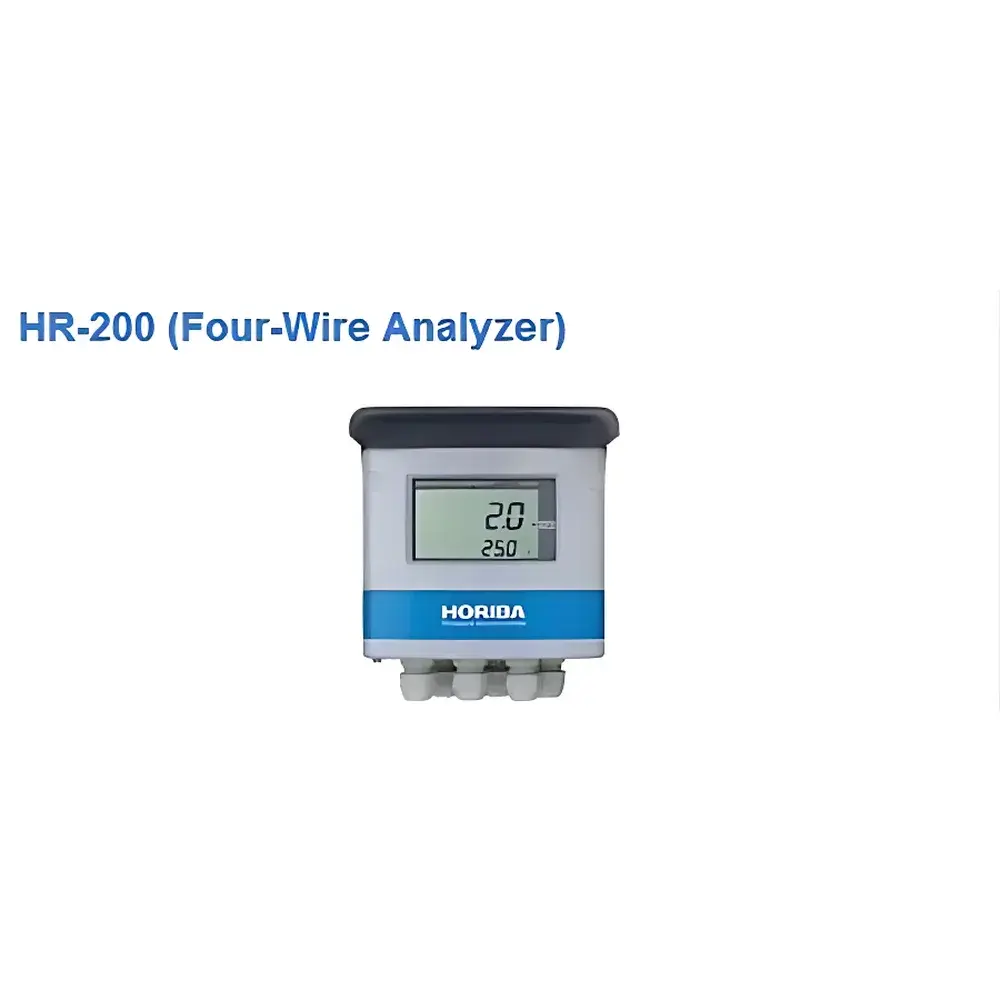
HORIBA HR-200 Industrial Online Free Chlorine Analyzer
| Brand | HORIBA |
|---|---|
| Origin | Japan |
| Model | HR-200 |
| Measurement Principle | Amperometric (Polarographic) |
| Range | 0–3 mg/L Cl₂ |
| Resolution | 0.01 mg/L |
| Repeatability | ±0.05 mg/L (max) |
| Linearity | ±0.05 mg/L (max) |
| Temperature Range | 0–50 °C |
| Temp. Resolution | 0.1 °C |
| Temp. Accuracy | ±0.5 °C |
| Output | Two isolated 4–20 mA DC (max load 900 Ω) |
| Relay Outputs | 3 SPDT (1c), configurable for alarm/control/clean activation |
| Digital Interface | RS-485 (2-wire, input/output isolated) |
| Enclosure Rating | IP65 |
| Power Supply | 90–264 V AC, 50/60 Hz, ≤35 VA |
| Operating Ambient | 0–55 °C |
| Weight | ~4.5 kg |
| Compliance | CE, FCC, RoHS, WEEE |
Overview
The HORIBA HR-200 is an industrial-grade, outdoor-rated online free chlorine analyzer engineered for continuous, real-time monitoring of residual chlorine in potable water distribution systems, wastewater effluent streams, cooling tower circuits, and process water loops. It employs a robust amperometric (polarographic) detection principle—utilizing a three-electrode sensor system with a gold working electrode, silver/silver chloride reference electrode, and platinum counter electrode—to deliver stable, interference-resistant measurements of free chlorine (Cl₂) in aqueous solution. Unlike colorimetric DPD-based analyzers, the HR-200 provides direct electrochemical quantification without reagent consumption, eliminating drift associated with photometric pathlength variation or reagent degradation. Its measurement range spans 0–3 mg/L with 0.01 mg/L resolution, calibrated against traceable DPD-standardized reference values per ISO 7393-2 and ASTM D1253. Designed for unattended operation in demanding environments, the HR-200 integrates temperature compensation (0–50 °C) and automatic electrode conditioning to maintain long-term baseline stability.
Key Features
- IP65-rated aluminum enclosure for outdoor deployment—resistant to dust ingress, rain, and corrosion in industrial perimeters.
- Integrated electrochemical cleaning function: periodic polarization cycles between cathodic and anodic potentials restore sensor surface activity, extending maintenance intervals beyond 6 months under typical municipal water conditions.
- Large backlit LCD display with simultaneous real-time readouts of free chlorine concentration and temperature—enabling immediate field verification without external instrumentation.
- Dual isolated 4–20 mA analog outputs with configurable scaling, supporting integration into PLCs, SCADA systems, or DCS platforms compliant with IEC 61131-3 and Modbus RTU over RS-485.
- Three programmable SPDT relay outputs: assignable to high/low alarms, automatic cleaner actuation (triggered on alarm or timed interval), or fault status indication (e.g., sensor failure, power loss, calibration timeout).
- Comprehensive self-diagnostic suite: monitors reference electrode potential drift, zero-point deviation, temperature sensor integrity, and internal circuit health—logging events with timestamps for GLP-compliant audit trails.
Sample Compatibility & Compliance
The HR-200 is validated for use in low-turbidity (50 µS/cm. It meets ISO 9001-certified manufacturing standards and carries CE marking per EMC Directive 2014/30/EU and Low Voltage Directive 2014/35/EU. FCC Part 15 Class A certification ensures electromagnetic compatibility in factory-floor environments. RoHS 2011/65/EU and WEEE 2012/19/EU compliance confirms restricted substance management and end-of-life responsibility. While not intrinsically safe, its design aligns with EN 61000-6-2 (immunity) and EN 61000-6-4 (emissions) for industrial installations. No USP , EPA Method 334.0, or ISO 10523 validation data are provided; users requiring regulatory method traceability must perform site-specific correlation studies against certified laboratory DPD titration.
Software & Data Management
The HR-200 operates autonomously without embedded firmware updates or cloud connectivity. All configuration—including relay logic, mA output scaling, alarm hysteresis, and auto-clean cycle frequency—is performed locally via front-panel navigation or RS-485 using HORIBA’s proprietary ASCII command protocol (documented in Instruction Manual IM-HR200-E). Calibration history (date, operator ID, zero/span values, DPD comparison results) is stored in non-volatile memory for ≥1,000 entries. Data export requires manual retrieval via serial terminal; no native CSV export, time-series logging, or FDA 21 CFR Part 11-compliant electronic signature capability is implemented. For GMP-regulated utilities, third-party SCADA historians (e.g., Ignition, Siemens Desigo CC) must handle audit trail generation, user access control, and electronic record retention.
Applications
- Municipal drinking water disinfection control at clearwell outlets and booster station injection points.
- Wastewater tertiary treatment effluent monitoring prior to environmental discharge per local NPDES permit limits.
- Cooling water system chlorination management to prevent biofilm formation while minimizing corrosion risk.
- Pharmaceutical facility purified water (PW) loop surveillance where low-level residual chlorine indicates upstream system breach.
- Food & beverage process rinse water verification to ensure microbial kill efficacy without exceeding organoleptic thresholds.
FAQ
Does the HR-200 require daily reagent addition or consumable cartridges?
No. As an amperometric analyzer, it operates without DPD reagents, buffer solutions, or optical filters—reducing operational cost and waste generation.
Can the sensor be immersed directly in open-channel flow?
Yes, when mounted with the optional flow-through cell (HR-FCC-200) or wall-mounted bypass assembly; direct submersion without flow conditioning is not recommended due to potential air entrapment and laminar boundary layer effects.
Is temperature compensation automatic and adjustable?
Yes. The integrated Pt1000 RTD performs real-time compensation across 0–50 °C; the compensation algorithm follows the standard chlorine solubility curve per ISO 7393-2 Annex B and cannot be user-modified.
What is the expected service life of the polarographic sensor under continuous operation?
Typical electrode lifespan exceeds 18 months in clean, low-fouling applications; replacement intervals decrease in high-sulfide or high-organic-load environments—sensor diagnostics will flag declining signal-to-noise ratio before functional failure.
Does HORIBA provide NIST-traceable calibration certificates with shipment?
No. Factory calibration uses internally validated DPD reference standards; users must perform initial field calibration against certified reference materials per their site’s QA/QC protocol.
Related Products







