
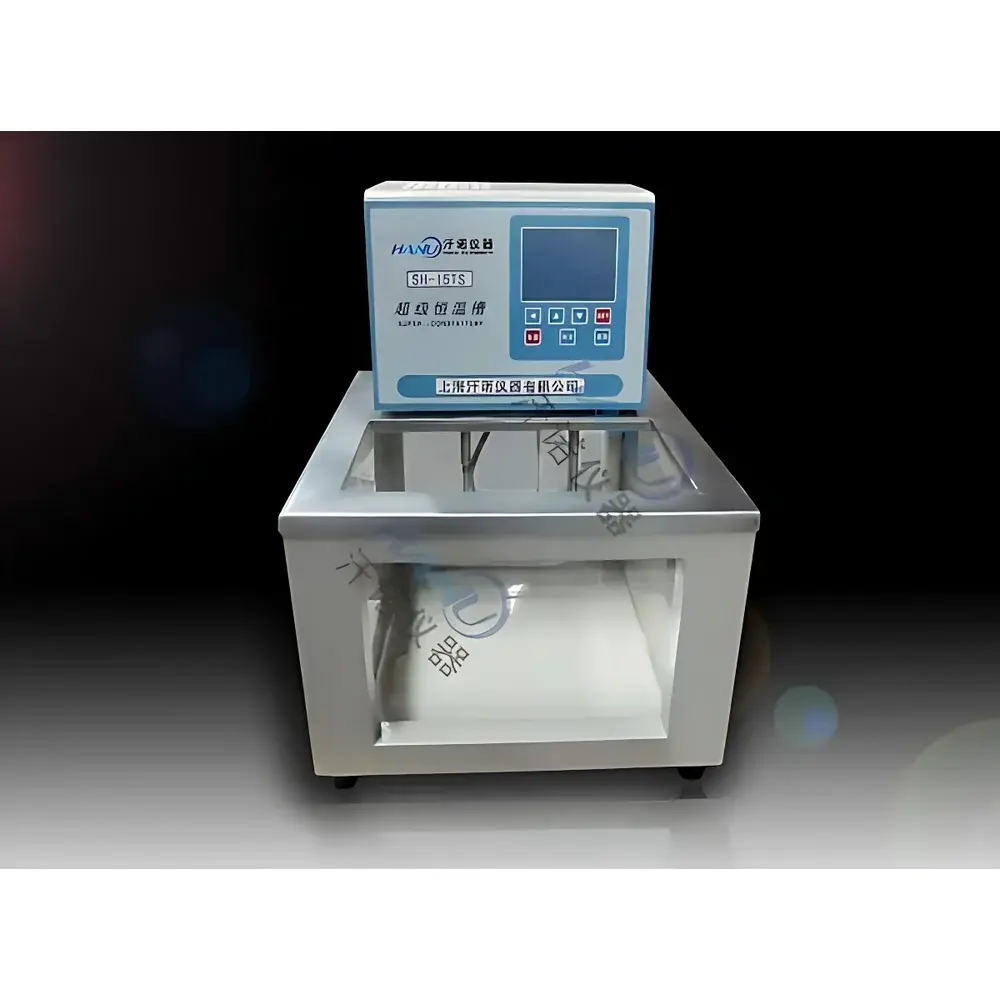
Hanuo HN-15T-II Precision Glass Thermostatic Water Bath
| Brand | Hanuo |
|---|---|
| Origin | Shanghai, China |
| Model | HN-15T-II |
| Type | Circulating Thermostatic Bath |
| Circulation | Internal Only |
| Temperature Control | Heating & Cooling |
| Bath Volume | 15 L |
| Temperature Range | 0–100 °C |
| Temperature Stability | ±0.05 °C |
| Display Resolution | 0.01 °C |
| Tank Dimensions (W×D×H) | 300×250×200 mm |
| Opening Size | 248×160 mm² |
| Construction | Triple-Transparent Borosilicate Glass Tank |
| Control System | PID Digital Controller |
| Optional Features | RS232/RS485 Interface, Multi-Stage Programmable Ramp/Soak Profiles (1–30 segments), External Probe Input for Dual-Zone Monitoring |
Overview
The Hanuo HN-15T-II Precision Glass Thermostatic Water Bath is an engineered laboratory temperature control system designed for applications demanding high thermal stability, visual process monitoring, and reproducible thermal environments. Utilizing a triple-sided transparent borosilicate glass tank, the unit enables real-time optical observation of sample behavior—including color transitions, phase separation, convection patterns, and reaction kinetics—without compromising thermal integrity. Its dual-mode (heating and cooling) thermoregulation architecture operates across a continuous range of 0 to 100 °C, making it suitable for both low-temperature enzymatic assays and high-temperature calibration or distillation support. The bath employs a closed-loop PID digital controller with adaptive tuning to maintain temperature stability within ±0.05 °C under steady-state conditions—a specification aligned with ISO/IEC 17025-compliant calibration workflows and ASTM E1137/E1142 reference temperature applications. Unlike conventional metal-walled baths, its all-glass construction eliminates metallic ion leaching, ensuring compatibility with sensitive biological, pharmaceutical, and analytical chemistry protocols.
Key Features
- Triple-transparent borosilicate glass tank for unobstructed 270° visual access to bath interior and immersed samples
- PID-controlled heating/cooling system with auto-tuning capability ensures rapid thermal equilibration and minimal overshoot
- Internal recirculation pump maintains uniform temperature distribution (<0.05 °C spatial deviation across full 15 L volume)
- High-resolution digital display showing both setpoint and actual bath temperature with 0.01 °C resolution
- Compact desktop footprint (300×250×200 mm) optimized for space-constrained laboratories and fume hood integration
- Multi-function programmability: optional 1–30 segment ramp/soak profiles with real-time progress indication
- Expandable interface support: RS232 or RS485 port for remote parameter setting, data logging, and synchronization with LIMS or SCADA systems
- Dual-sensor capability: internal bath sensor plus optional external probe input for closed-loop control of auxiliary equipment (e.g., jacketed reactors or flow cells)
- Material compatibility: chemically inert glass chamber rated for aqueous and low-viscosity oil media up to 100 °C
Sample Compatibility & Compliance
The HN-15T-II accommodates standard laboratory vessels—including volumetric flasks, reaction tubes, cuvettes, and immersion probes—within its 248×160 mm open-top aperture. Its non-metallic wetted path prevents catalytic interference in redox-sensitive reactions and eliminates contamination risk in USP compounding or ISO 13485 medical device testing environments. The unit complies with IEC 61010-1 safety standards for laboratory electrical equipment and meets electromagnetic compatibility requirements per EN 61326-1. When configured with audit-trail-enabled software (via optional communication module), it supports GLP/GMP documentation needs including user authentication, parameter change logging, and timestamped temperature history export—facilitating FDA 21 CFR Part 11 readiness where validated electronic records are required.
Software & Data Management
While the base unit operates via front-panel controls, the optional serial interface enables integration with third-party data acquisition platforms (e.g., LabVIEW, MATLAB, or custom Python scripts). Firmware supports ASCII-based command protocols for remote initiation of temperature ramps, hold durations, and status queries. Logged temperature data can be exported as CSV files with millisecond timestamps for post-hoc statistical analysis (e.g., Cpk calculation per ISO 22514-2). For regulated environments, the programmable version includes configurable event triggers—such as deviation alarms (>±0.1 °C from setpoint), power-failure recovery modes, and automatic shutdown upon timeout—to reinforce procedural consistency during unattended operation.
Applications
- Calibration of liquid-in-glass thermometers, RTDs, and thermistors against NIST-traceable references
- Temperature-dependent kinetic studies in enzymology, polymerization, and photochemical reaction monitoring
- Stability testing of biologics and small-molecule APIs per ICH Q5C guidelines
- Thermal conditioning of viscometers, densitometers, and refractometers prior to measurement
- Controlled solubility and crystallization experiments requiring precise thermal gradients
- Support for electrophoresis apparatus, spectrophotometer cuvette thermostats, and microplate readers
- Process validation of sterilization cycles and depyrogenation ovens using calibrated thermal mapping probes
FAQ
What is the maximum operating temperature when using silicone oil instead of water?
The HN-15T-II is rated for 0–100 °C with water; when filled with certified silicone oil (e.g., Dow Corning 200 Fluid), the upper limit remains 100 °C due to thermal management constraints of the integrated cooling coil.
Does the unit include over-temperature protection?
Yes—a redundant mechanical thermostat cuts power if the digital controller fails, limiting maximum temperature to 110 °C.
Can the bath be used for external circulation applications?
No; the HN-15T-II features internal recirculation only. For external loop configurations, consider the HN-15T-II-C variant with dual inlet/outlet ports.
Is the glass tank resistant to thermal shock?
The borosilicate glass conforms to DIN ISO 3585 specifications and withstands rapid temperature changes up to 50 K without fracture, provided thermal gradients remain uniform across the surface.
How often does the system require recalibration?
Annual verification against a certified reference thermometer is recommended per ISO/IEC 17025 Clause 6.5.2; factory calibration certificate includes as-found/as-left data at three points (25 °C, 50 °C, 75 °C).
Related Products



