
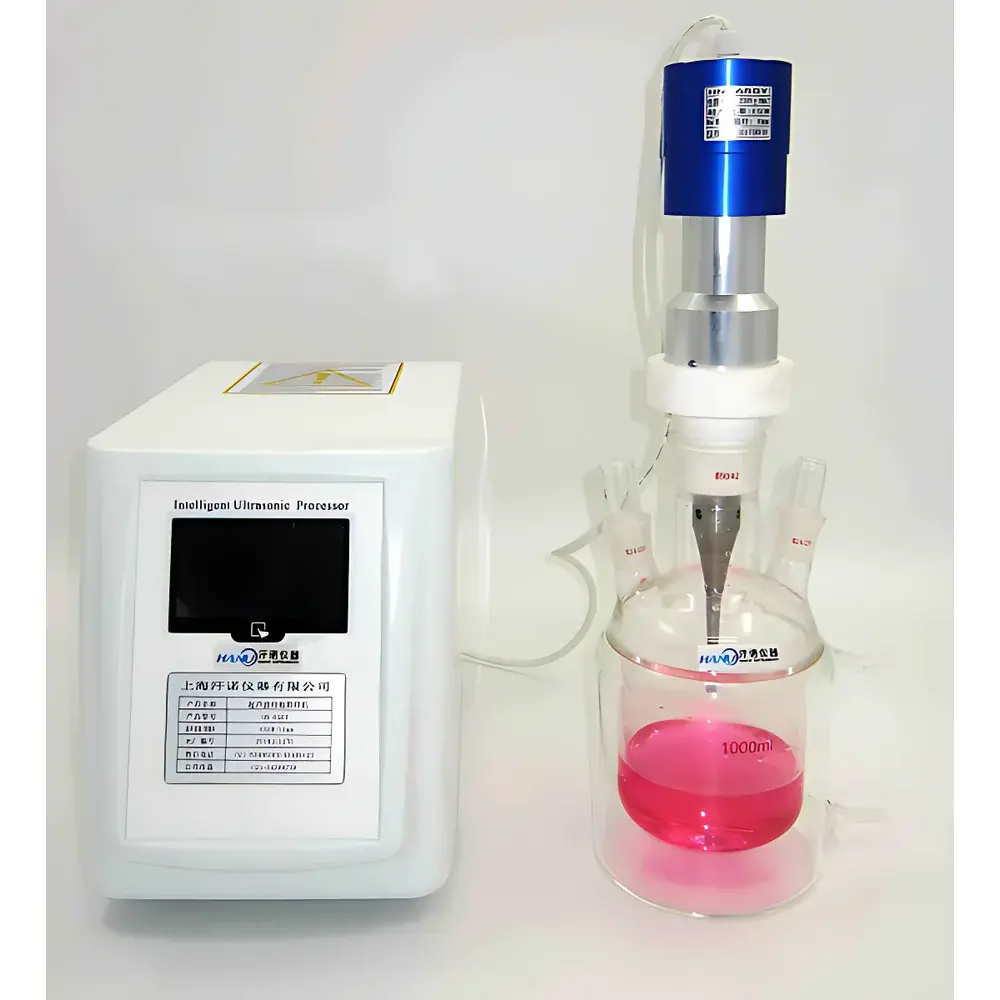
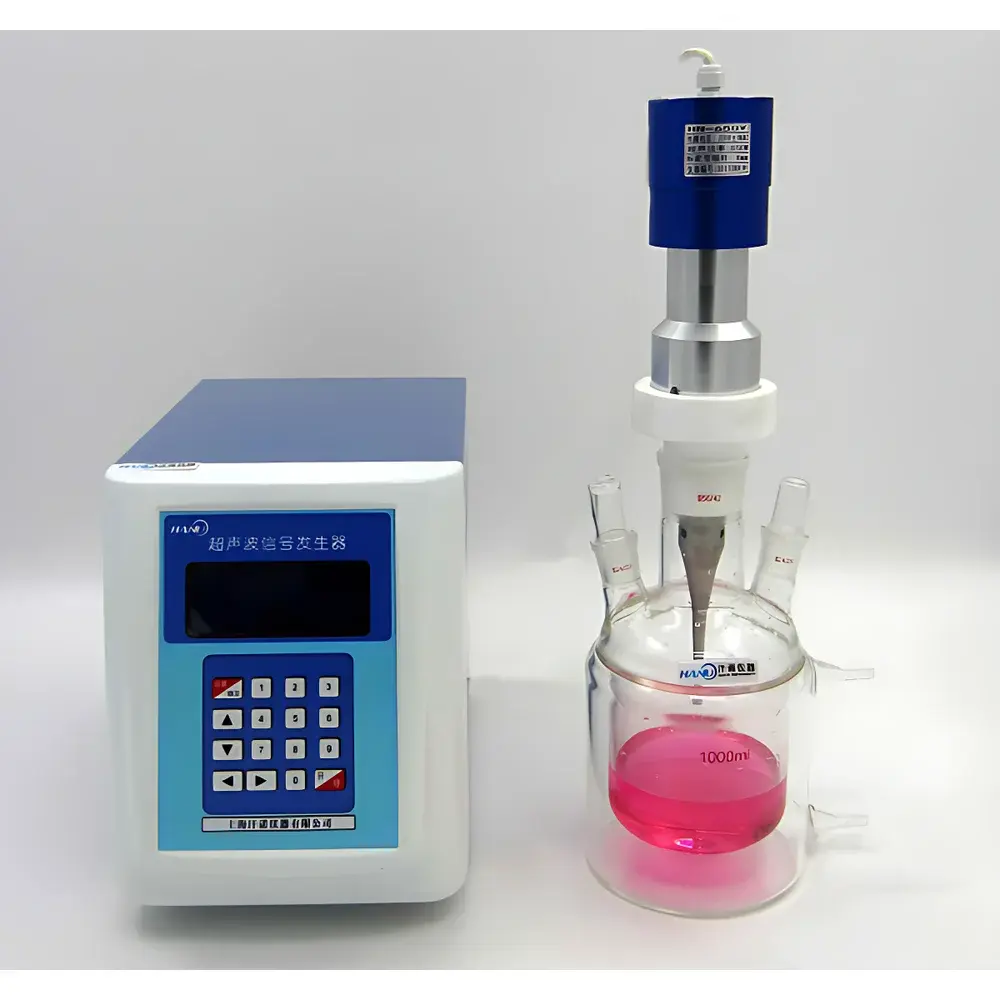
Hanuo HN-2008 Low-Temperature Ultrasonic Extractor
| Brand | Hanuo |
|---|---|
| Model | HN-2008 |
| Origin | Shanghai, China |
| Ultrasonic Power | 100–1500 W (continuously adjustable) |
| Frequency | 20–25 kHz |
| Temperature Range | −20 to 100 °C |
| Temperature Control Accuracy | ±0.05 °C |
| Reaction Vessel Capacity | 10–500 mL |
| Probe Diameter Options | 6, 10, 15, 20, 25 mm |
| Magnetic Stirring Speed | 0–1200 rpm |
| Refrigeration System | Integrated compressor (650 W), 6 L cold bath capacity |
Overview
The Hanuo HN-2008 Low-Temperature Ultrasonic Extractor is an integrated laboratory system engineered for controlled, reproducible ultrasonic-assisted extraction and sonochemical synthesis under precisely regulated thermal conditions. It operates on the principle of high-intensity ultrasound-induced acoustic cavitation—generating transient microbubbles in liquid media that collapse violently, producing localized hotspots (>5000 K), high shear forces, and radical species essential for cell disruption, solvent penetration, and bond cleavage. Unlike ambient-temperature ultrasonic baths or probe systems, the HN-2008 integrates active refrigeration (−20 °C minimum) with precision Peltier or compressor-based temperature control, enabling thermally sensitive extractions—such as labile phytochemical isolation, enzymatic reaction modulation, or cold-stage polymer degradation studies—without thermal denaturation or volatile loss. Its fully sealed, multi-port reaction vessel supports inert-atmosphere processing, gas sparging, reflux condensation, and continuous reagent addition, making it suitable for both analytical-scale sample preparation and exploratory synthetic methodology development.
Key Features
- Microprocessor-controlled LCD interface with real-time display of temperature, power output, sonication duration, and duty cycle.
- Continuously adjustable ultrasonic power (100–1500 W) with automatic amplitude compensation—maintains consistent cavitation intensity across variable sample viscosities and volumes.
- Integrated dual-mode thermal management: high-capacity refrigeration (−20 °C min, 6 L cold bath) and precise resistive heating (up to 100 °C), both governed by PID algorithms with ±0.05 °C stability.
- Submersible titanium alloy ultrasonic probe (standard Ø20 mm; optional diameters: 6, 10, 15, 25 mm) optimized for energy transfer efficiency and corrosion resistance in organic/aqueous solvents.
- Internal magnetic stirring (0–1200 rpm) ensures homogeneous temperature distribution and mass transfer during prolonged sonication—critical for quantitative recovery in solid–liquid extractions.
- Modular, chemically resistant reaction chamber with standardized ground-glass joints (e.g., 24/40, 19/22) compatible with condensers, dropping funnels, gas inlets, vacuum adapters, and Schlenk-line accessories.
- Intermittent sonication mode (programmable on/off intervals) minimizes cumulative thermal load and prevents probe erosion or sample overheating during extended protocols.
Sample Compatibility & Compliance
The HN-2008 accommodates diverse sample matrices—including plant tissues, microbial biomass, soil extracts, polymer composites, and pharmaceutical intermediates—within its 10–500 mL operational volume range. Its sealed architecture meets basic containment requirements for low-hazard organic solvents (e.g., ethanol, ethyl acetate, hexane) and aqueous buffers. While not certified for Class I/II biosafety or explosion-proof operation, the system adheres to general electrical safety standards (IEC 61010-1) and incorporates over-temperature, over-current, and dry-run protection circuits. For GLP-compliant workflows, timestamped parameter logging (via optional RS232/USB export) supports audit-ready documentation aligned with ISO/IEC 17025 traceability expectations.
Software & Data Management
The embedded controller stores up to 20 user-defined protocols with full parameter recall (power, temperature setpoint, stir speed, sonication timing). Data export via USB flash drive enables post-acquisition analysis in third-party platforms (e.g., Excel, MATLAB, Python Pandas). Though no proprietary software suite is bundled, the device supports ASCII-formatted CSV logs containing time-stamped temperature, power, and status flags—facilitating integration into LIMS environments or automated QA/QC reporting pipelines compliant with FDA 21 CFR Part 11 when paired with validated electronic signature tools.
Applications
- Accelerated extraction of thermolabile natural products (e.g., flavonoids, terpenes, alkaloids) from botanicals at sub-zero temperatures to suppress enzymatic oxidation.
- Sonochemical synthesis of nanomaterials (e.g., metal oxides, MOFs) under cryogenic conditions to control nucleation kinetics and particle size distribution.
- Cell lysis and protein solubilization for proteomics workflows requiring minimal thermal stress and high reproducibility between replicates.
- Green chemistry applications: ultrasound-enhanced transesterification or ester hydrolysis using low-boiling solvents cooled below their ambient boiling points.
- Method development for pharmacopeial assays (e.g., USP <724> on transdermal delivery systems) where controlled cavitation energy input must be decoupled from thermal drift.
FAQ
What is the minimum operating temperature, and how is sub-zero stability achieved?
The system achieves −20 °C using a dedicated hermetic compressor (650 W) coupled with a 6 L recirculating cold bath—enabling stable low-temperature sonication without external chillers.
Can the HN-2008 be used for nitrogen-purged reactions?
Yes—the multi-port reaction vessel includes dedicated gas inlet/outlet ports and vacuum-compatible seals, supporting inert atmosphere operations with standard Schlenk-line hardware.
Is probe erosion monitored or compensated during long-duration runs?
Amplitude is dynamically adjusted in real time to maintain constant cavitation energy output despite progressive tip wear or changing acoustic impedance.
Does the system comply with FDA 21 CFR Part 11 for electronic records?
The base unit provides timestamped parameter logs; full Part 11 compliance requires integration with validated third-party audit-trail software and electronic signature infrastructure.
What maintenance is required for the refrigeration module?
The sealed compressor system is maintenance-free under normal operation; periodic inspection of coolant levels and condenser coil cleanliness is recommended per manufacturer guidelines.



