
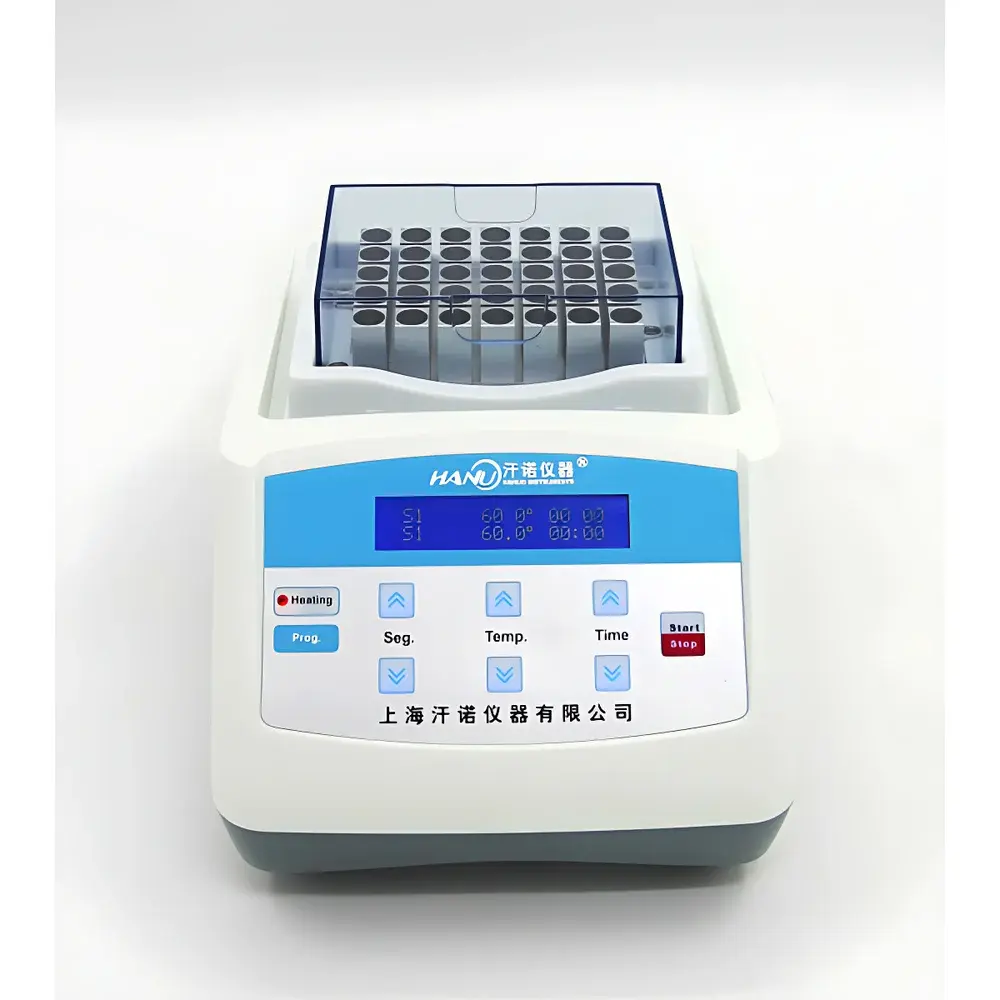
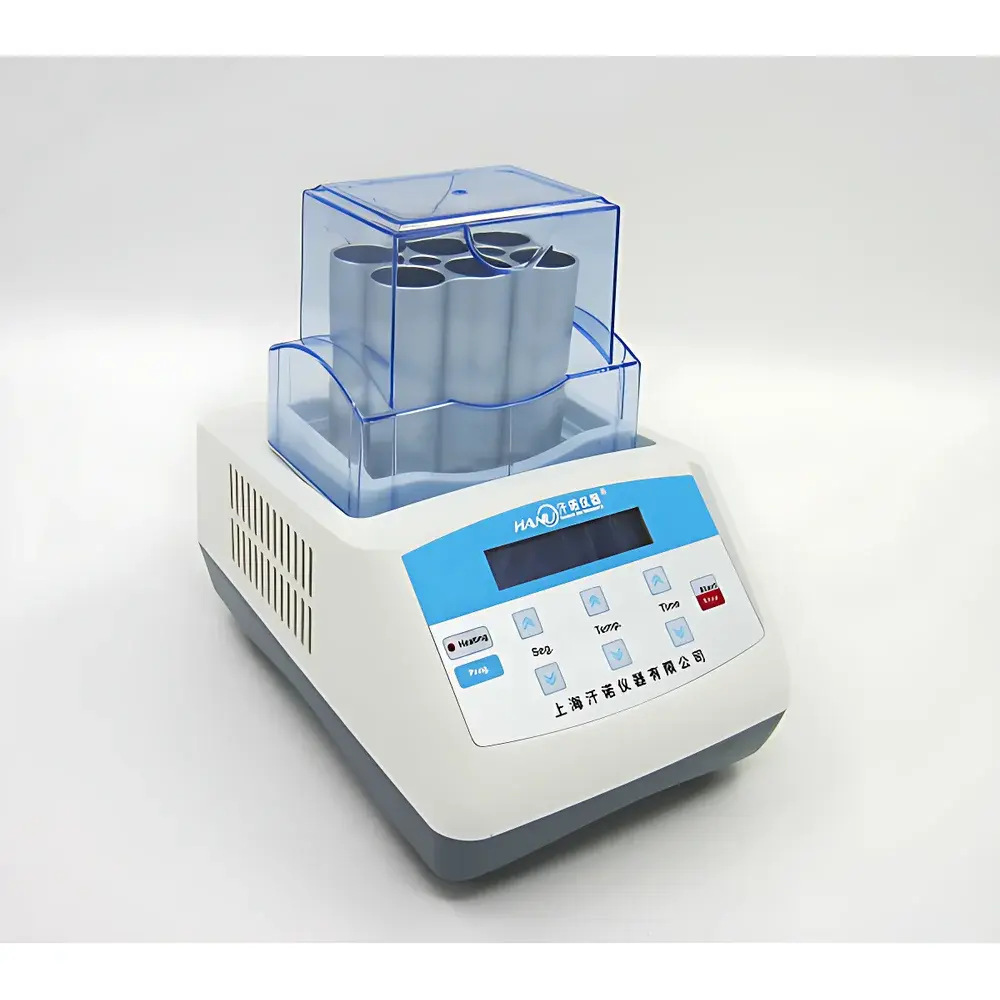
Hanuo HNDTC-100 Refrigerated Dry Block Thermostat
| Brand | Hanuo |
|---|---|
| Origin | Shanghai, China |
| Model | HNDTC-100 |
| Temperature Range | -10 °C to 100 °C |
| Temperature Accuracy | ±0.5 °C @ 100 °C |
| Temperature Uniformity | ≤±0.3 °C @ 40 °C |
| Module Temperature Gradient | 0.3 °C @ 40 °C |
| Display Resolution | 0.1 °C |
| Heating Time | ≤15 min (20 °C → 100 °C) |
| Cooling Time | ≤20 min (RT → −25 °C, ambient 30 °C) / ≤30 min (RT → −30 °C, ambient 25 °C) |
| Power Consumption | 150 W |
| Dimensions (W×D×H) | 270 × 190 × 170 mm |
| Net Weight | 2.2 kg |
| Timer Range | 1 sec – 99 h 59 min |
| Programmable Steps | Up to 5 temperature/time segments |
| Safety Features | Over-temperature protection, self-diagnostic error detection with audible alarm, temperature offset calibration |
Overview
The Hanuo HNDTC-100 Refrigerated Dry Block Thermostat is a precision-engineered thermal management system designed for laboratories requiring stable, programmable, and bidirectional temperature control—from sub-ambient cooling to high-temperature incubation—without the use of liquid media. Unlike traditional water baths, this device employs solid-state Peltier thermoelectric modules for both heating and active cooling, eliminating risks associated with condensation, evaporation, contamination, or bath fluid degradation. Its microprocessor-based control architecture ensures rapid thermal response, high reproducibility across repeated cycles, and robust long-term stability—critical for sensitive biochemical workflows including enzyme kinetics, nucleic acid denaturation/annealing, PCR setup, serum coagulation assays, and pre-electrophoresis sample conditioning. The instrument’s compact footprint and modular design support seamless integration into benchtop workflows under ISO 15195-accredited clinical labs, GLP-compliant research environments, and GMP-aligned QC laboratories.
Key Features
- Intuitive capacitive-touch interface with real-time temperature and countdown timer display—no mechanical buttons required;
- Multi-step programmable protocol capability: up to five independent temperature setpoints with corresponding dwell times, enabling complex thermal ramping sequences (e.g., denaturation–annealing–extension profiles);
- Integrated self-diagnostics with audible alarm and on-screen error code reporting for immediate fault identification (e.g., sensor failure, thermal overload, module disconnect);
- User-accessible temperature offset calibration function to maintain traceable accuracy against NIST-traceable reference standards;
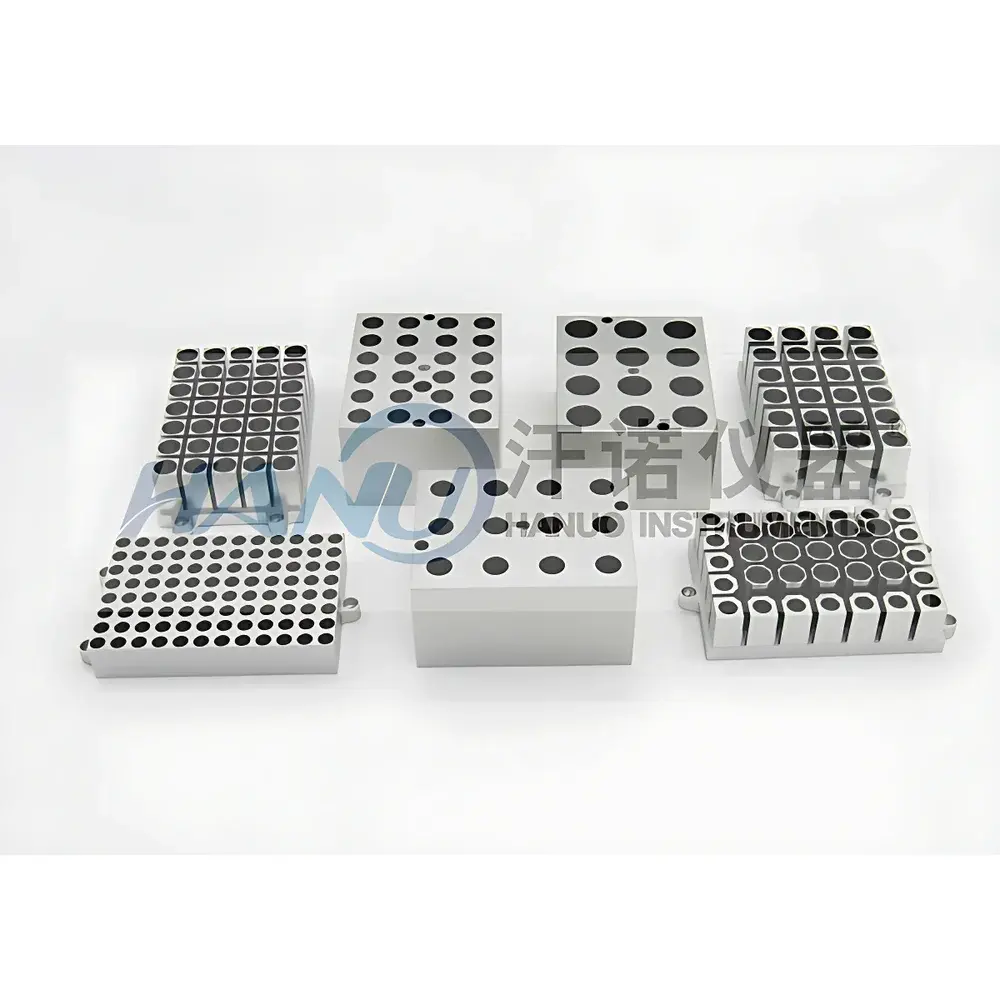
- Quick-release, tool-free module interchange system—facilitating rapid decontamination between runs and minimizing cross-contamination risk in multi-user settings;
- Dual safety architecture: hardware-based over-temperature cutoff (independent of software control) plus software-enforced thermal limits;
- High-resolution 0.1 °C LCD display with backlight for low-light lab conditions and ergonomic viewing angles.
Sample Compatibility & Compliance
The HNDTC-100 supports interchangeable aluminum heating/cooling blocks optimized for common laboratory consumables. Standard configurations include 96-well PCR plates (flat-bottom), 0.2 mL, 0.5 mL, 1.5 mL, and 2.0 mL microcentrifuge tubes, as well as specialized formats such as 5 mL, 15 mL, and 50 mL conical tubes (optional high-capacity modules). All modules are CNC-machined for precise thermal coupling and uniform heat transfer. The system complies with IEC 61010-1:2010 for electrical safety in laboratory equipment and meets electromagnetic compatibility requirements per EN 61326-1:2013. While not FDA-cleared as a medical device, its operational parameters align with ASTM E2885-22 (Standard Guide for Thermal Stability Testing of Biological Samples) and support documentation practices consistent with 21 CFR Part 11 for electronic records and signatures when used with validated data capture workflows.
Software & Data Management
The HNDTC-100 operates as a standalone instrument with no proprietary software dependency; all configuration and monitoring occur via the front-panel interface. However, it supports optional RS-232 or USB-to-serial connectivity (via external adapter) for integration into centralized lab information management systems (LIMS) or custom Python/Matlab-based logging scripts. Timestamped temperature logs—including setpoint, actual block temperature, elapsed time, and error events—can be exported for audit trails. When deployed in regulated environments, users may implement procedural controls (e.g., daily verification using calibrated thermistors, periodic calibration per ISO/IEC 17025:2017 Clause 6.5) to ensure ongoing metrological integrity. Audit-ready operation is further supported by configurable password protection for parameter modification and tamper-evident event logging.
Applications
- Thermal pretreatment of serum samples prior to coagulation time assays (e.g., PT, aPTT);
- Controlled denaturation and renaturation of recombinant proteins during purification optimization;
- Pre-incubation of restriction enzyme digests at precise sub-37 °C temperatures to minimize star activity;
- Rapid equilibration of qPCR master mixes before plate loading to reduce pipetting-induced thermal drift;
- Stabilization of thermolabile enzymes (e.g., Taq polymerase, reverse transcriptase) during reaction assembly;
- Parallel processing of multiple sample types—such as blood, plasma, tissue lysates, and bacterial cultures—across identical thermal profiles for inter-assay comparability;
- Validation studies supporting temperature mapping per USP Annex for sterile compounding environments.
FAQ
What is the minimum achievable temperature and under what ambient conditions?
The HNDTC-100 achieves −30 °C when operated in an ambient environment of 25 °C, verified per manufacturer test protocol. Performance degrades linearly above 30 °C ambient; maximum cooling capacity is −25 °C at 30 °C ambient.
Can the unit maintain temperature stability during prolonged incubations at 4 °C?
Yes—the system maintains ≤±0.3 °C uniformity across the block surface at 4 °C for durations exceeding 24 hours, provided ventilation grilles remain unobstructed and ambient airflow meets minimum clearance requirements (≥10 cm on all sides).
Are third-party modules compatible with the HNDTC-100?
Only Hanuo-certified modules are guaranteed for thermal performance, mechanical fit, and safety compliance. Non-OEM blocks may compromise temperature uniformity, trigger false alarms, or void the warranty.
Does the instrument support GLP-compliant calibration documentation?
The device includes built-in offset calibration functionality and supports external verification using Class A platinum resistance thermometers (PRTs). Users must generate and retain calibration certificates per their internal SOPs; no factory-issued calibration certificate is included by default.
How frequently should preventive maintenance be performed?
Annual inspection of Peltier module thermal interface paste, fan operation, and housing ventilation integrity is recommended. No scheduled lubrication or consumable replacement is required within the first 5 years of normal use.



