
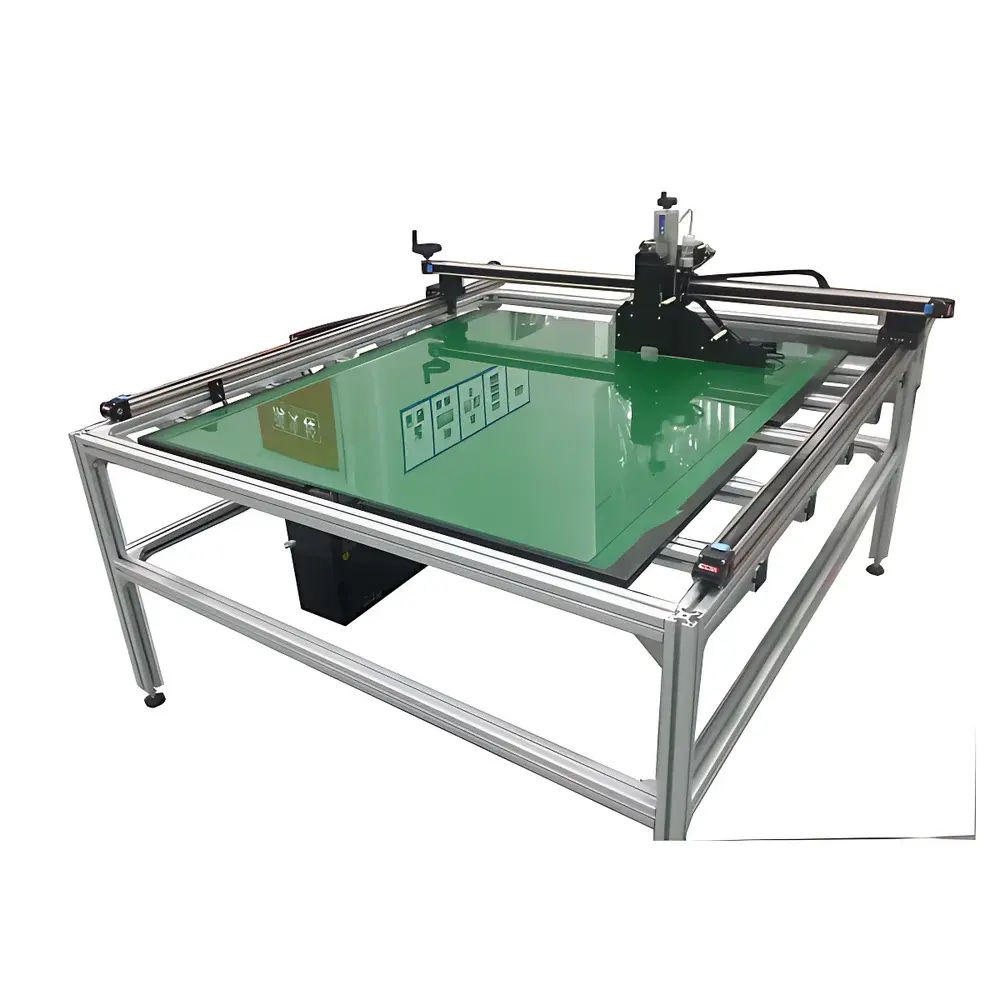
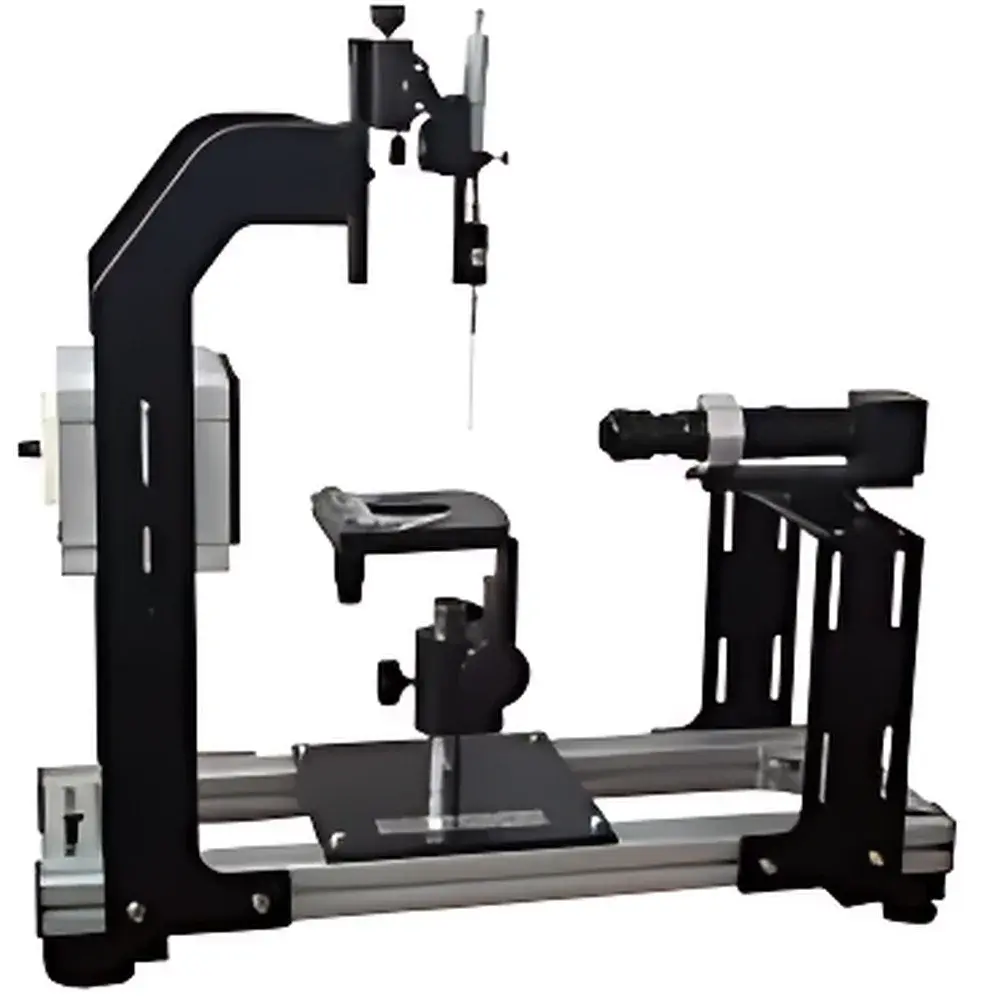
HARKE DPT Large-Platform Contact Angle Goniometer
| Brand | HARKE |
|---|---|
| Origin | Beijing, China |
| Manufacturer Type | Direct Manufacturer |
| Instrument Category | Domestic |
| Model | HARKE-DPT |
| Instrument Class | Dynamic Contact Angle Meter |
| Instrument Form Factor | Benchtop Laboratory System |
| Contact Angle Measurement Range | 0–180° |
| Contact Angle Measurement Accuracy | ±0.1° |
| Fixed Sample Stage Dimensions | 120 × 120 mm |
| Optical Magnification | 0.75×–4.5× Continuous Zoom |
| Surface/Interfacial Tension Measurement Range | 0.01–1000 mN/m |
| Surface/Interfacial Tension Measurement Accuracy | ±0.01 mN/m |
| Stage Travel (X-axis) | 0–800 mm |
| Measurement Head Vertical Travel (Z-axis) | 0–100 mm |
| Working Distance (Objective) | >90 mm |
| Syringe Volume | 100 µL |
| Automated Dispenser Travel Range | 0–50 mm |
| Illumination | Adjustable LED Backlight |
| Image Sensor | High-Resolution CMOS Camera |
| Analysis Modes | Automatic Baseline Circle Fitting, Manual Baseline Circle Fitting, Sessile Drop, Tilting Plate (Dynamic CA), and Captive Bubble |
| Software Capabilities | Real-time Image Capture at Configurable Intervals, Video Recording & Playback, Frame-by-Frame Measurement Extraction, On-Image Data Annotation, Exportable CSV/Excel Reports, Audit-Trail-Enabled Session Logging |
Overview
The HARKE DPT Large-Platform Contact Angle Goniometer is an engineered benchtop instrument designed for high-precision, repeatable quantification of solid–liquid interfacial behavior under controlled laboratory conditions. It operates on the sessile drop method—where a precisely dispensed liquid droplet rests on a solid substrate—and employs optical goniometry to determine the contact angle θ at the three-phase boundary (solid–liquid–vapor). The system integrates a motorized large-stage architecture with extended X- and Z-axis travel (up to 800 mm horizontal and 100 mm vertical), enabling stable positioning and measurement across oversized or irregularly shaped substrates—such as coated metal panels, composite laminates, or functionalized glass sheets—without compromising optical alignment or measurement fidelity. Its core optical path features a continuously variable zoom lens (0.75×–4.5×) with >90 mm working distance, ensuring minimal disturbance to delicate or volatile samples during imaging. The device supports dynamic contact angle analysis via tilting plate and captive bubble configurations, facilitating hysteresis evaluation (advancing/receding angles), surface energy component calculation (Owens–Wendt, Wu, van Oss–Chaudhury–Good models), and interfacial tension derivation from pendant/sessile drop profiles.
Key Features
- Large-format mechanical platform (120 × 120 mm fixed stage + 800 mm motorized X-travel) optimized for macro-scale and heterogeneous samples
- High-stability measurement head with dual-axis motorized translation (X and Z), enabling reproducible positioning without manual re-alignment
- Adjustable LED backlight illumination with continuous intensity control, minimizing thermal drift and glare-induced edge detection errors
- High-resolution CMOS camera synchronized with real-time image acquisition software for frame-accurate temporal analysis
- Automated 100 µL microdispenser with 50 mm linear travel range, supporting consistent droplet volume delivery and sequential multi-point testing
- Dual-mode analysis engine: automatic baseline circle fitting (ISO 19403-2 compliant edge detection) and manual interactive refinement for complex or low-contrast interfaces
- Robust aluminum alloy frame with vibration-damped base, suitable for long-duration measurements in shared lab environments
Sample Compatibility & Compliance
The HARKE DPT accommodates rigid and semi-rigid planar substrates up to 1600 mm wide (with optional extension rails), including metallic foils, polymer films, ceramic tiles, printed circuit boards, and biomedical membranes. Its extended working distance (>90 mm) permits integration with environmental chambers (humidity/temperature-controlled) and electrochemical cells. The instrument meets fundamental requirements for GLP-compliant surface characterization workflows: all measurement sessions are timestamped, user-logged, and exportable with embedded metadata (camera settings, magnification, droplet volume, ambient temperature/humidity if interfaced). Software supports configurable audit trails and report templates aligned with ISO 19403 (Plastics — Determination of contact angle), ASTM D7334 (Standard Practice for Surface Wettability of Coatings), and USP (Performance Assessment of Pharmaceutical Packaging Materials).
Software & Data Management
The proprietary HARKE CA Suite provides a modular interface for acquisition, analysis, and reporting. Users configure automated time-lapse capture (e.g., 1 frame/sec over 300 sec for evaporation kinetics), trigger-based recording (on contact angle deviation >0.5°), or manual snapshot sequences. Each image retains embedded calibration parameters and analytical flags. Measured values—including static/dynamic contact angles, surface tension, and derived surface energy components—are stored in structured CSV files with column headers traceable to ISO/IEC 17025 data integrity guidelines. Batch processing enables statistical summarization (mean, SD, CV%) across multiple samples or conditions. Export options include annotated PNG overlays, PDF reports with embedded graphs, and Excel-compatible datasets compatible with LIMS integration.
Applications
This goniometer serves critical quality control and R&D functions across regulated and industrial sectors. In coatings development, it validates hydrophobicity of anti-fouling marine paints or oleophobicity of display cover glasses. In pharmaceutical manufacturing, it assesses tablet film-coating uniformity and excipient wettability during dissolution modeling. In microelectronics, it characterizes solder mask adhesion and underfill flow behavior. Academic users apply it to study plasma-treated polymer aging, nanocomposite wettability transitions, or bio-inspired superhydrophobic surfaces. Its large platform and dynamic capabilities also support tribological studies (contact angle evolution under shear), inkjet printhead substrate screening, and filtration membrane performance benchmarking.
FAQ
What sample dimensions can the HARKE DPT accommodate?
The standard fixed stage measures 120 × 120 mm, but the motorized X-axis allows positioning of substrates up to 1600 mm wide when using extended rail kits.
Does the system comply with FDA 21 CFR Part 11 requirements?
While the base software does not include electronic signature modules, it supports full audit-trail logging, user access controls, and immutable session records—enabling validation per Part 11 when deployed within a qualified IT infrastructure.
Can interfacial tension be measured for liquid–liquid systems?
Yes—the system supports pendant drop analysis for immiscible liquid pairs (e.g., oil–water), with surface/interfacial tension calculated via Young–Laplace curve fitting.
Is calibration traceable to national standards?
Geometric calibration uses NIST-traceable stage micrometers; contact angle verification employs certified reference slides (e.g., AccuAngle™ 30°/60°/90° standards) per ISO 19403-4.
What maintenance is required for long-term accuracy?
Annual verification of optical alignment, dispenser volumetric accuracy (via gravimetric check), and stage encoder linearity is recommended; no routine optical recalibration is needed under stable environmental conditions.



