
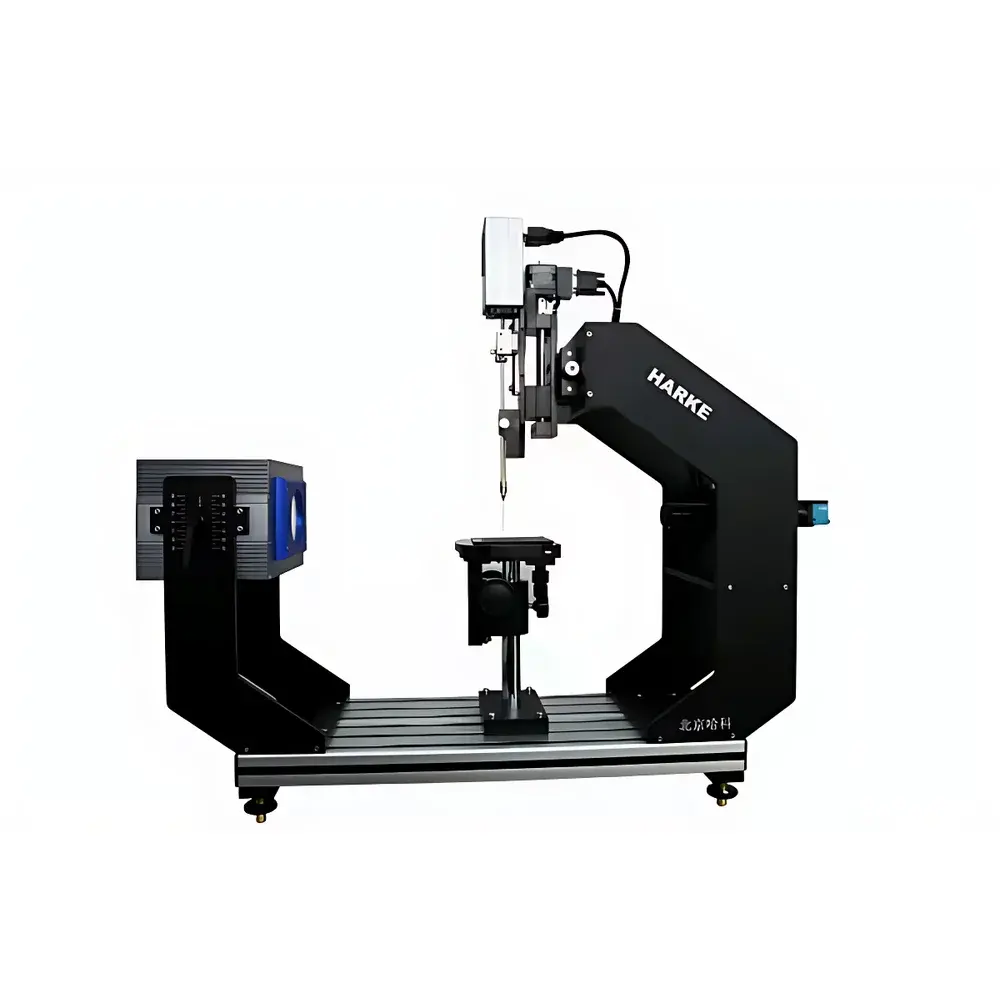
HARKE HARKE-SPCA-P Video-Based Optical Contact Angle Analyzer
| Brand | HARKE |
|---|---|
| Model | HARKE-SPCA-P |
| Type | Benchtop Video Optical Contact Angle Analyzer |
| Contact Angle Measurement Range | 0–180° |
| Contact Angle Accuracy | ±0.1° |
| Stage Dimensions | 100 mm × 120 mm |
| Optical Zoom | 0.7×–4.5× |
| Surface/Interfacial Tension Range | 0–1000 mN/m |
| Surface/Interfacial Tension Resolution | 0.01 mN/m |
| Imaging Frame Rate | Up to 1000 fps (optional) |
| Software | SPCA 1.0 |
| Power Supply | 220 V, 3 A, 50 Hz |
| Weight | 30 kg |
| Operating Temperature | Ambient |
Overview
The HARKE HARKE-SPCA-P is a benchtop video-based optical contact angle analyzer engineered for precision characterization of solid–liquid interfacial phenomena. It operates on the principle of sessile drop analysis using high-resolution digital imaging and advanced edge-detection algorithms to quantify the contact angle—the angle formed at the three-phase boundary where a liquid droplet meets a solid surface and surrounding vapor or immiscible liquid phase. This measurement serves as a direct indicator of surface wettability and enables quantitative inference of solid surface energy, liquid surface tension, and interfacial tension via established thermodynamic models (e.g., Owens–Wendt, Wu, van Oss–Chaudhury–Good). The instrument supports both static and dynamic contact angle measurements—including advancing, receding, and roll-off angles—and accommodates heterogeneous, anisotropic, and topographically complex surfaces through multi-method fitting (circle, ellipse, tangent, Young–Laplace, height-width, and polynomial-based contour fitting). Its modular optical architecture and calibrated syringe dosing system ensure reproducible droplet deposition with sub-microliter volume control—critical for GLP-compliant surface energy mapping and process validation in regulated environments.
Key Features
- Benchtop design with rigid aluminum alloy frame and vibration-damped optical baseplate for stable imaging under ambient lab conditions
- Motorized high-precision XYZ translation stage (±0.1 mm positioning accuracy) with programmable sample alignment and multi-point auto-scan capability
- Variable-magnification telecentric lens system (0.7×–4.5×), enabling pixel-level resolution across wide field-of-view (up to 12 mm × 9 mm) and high-magnification micro-region analysis
- USB 3.0 monochrome CMOS camera (1920 × 1200 px) with adjustable exposure, gain, and real-time frame rates up to 1000 fps for dynamic wetting kinetics (spreading, absorption, evaporation)
- Integrated motorized syringe pump with PTFE-coated stainless-steel needle, offering programmable dispensing volumes from 0.1 µL to 100 µL with stepless flow control
- Eight built-in contact angle calculation algorithms—including axisymmetric drop shape analysis (ADSA), Young–Laplace curve fitting, and baseline-free tangential methods—to accommodate non-ideal droplets on rough or chemically heterogeneous surfaces
- Real-time coordinate overlay, reference line anchoring, and automatic baseline detection to minimize operator-dependent bias in manual analysis workflows
Sample Compatibility & Compliance
The HARKE-SPCA-P accommodates flat, curved, fibrous, porous, and powdered samples (after cold-pressing into pellets). Standard stage dimensions (100 mm × 120 mm) support substrates up to 100 mm in diameter or length; optional extended stages and custom holders are available for films, fibers, textiles, and micro-patterned wafers. All measurement protocols align with ASTM D7334 (Standard Practice for Surface Wettability of Coatings by Contact Angle Measurement), ISO 19403-2 (Paints and varnishes—Determination of contact angle), and ISO 1420 (Rubber—Determination of surface wettability). Data acquisition and processing comply with ALCOA+ principles (Attributable, Legible, Contemporaneous, Original, Accurate, Complete, Consistent, Enduring, Available); audit trails, electronic signatures, and user-access controls in SPCA 1.0 software support FDA 21 CFR Part 11 readiness when deployed in GMP/QbD environments.
Software & Data Management
SPCA 1.0 is a Windows-native application designed for scientific traceability and workflow automation. It provides synchronized hardware control (stage, camera, dispenser), real-time droplet tracking, batch-mode analysis of up to 999 images per session, and export of raw pixel coordinates, fitted parameters, and time-series plots in CSV, PNG, and PDF formats. Built-in modules calculate surface free energy components (dispersive, polar, acidic–basic), critical micelle concentration (CMC) from pendant drop series, and contact angle hysteresis profiles. All data files embed metadata (timestamp, operator ID, instrument serial number, calibration status), and the software maintains immutable audit logs of parameter changes, analysis edits, and report generation events—ensuring full compliance with ISO/IEC 17025 documentation requirements.
Applications
This system is routinely deployed in R&D and QC laboratories across industries requiring surface functionality assessment: hydrophobic coating development for medical devices (ISO 10993-5 cytocompatibility screening), inkjet print head nozzle wettability validation, pharmaceutical tablet film-coating uniformity testing (USP ), polymer blend compatibility evaluation, mineral flotation reagent optimization, and semiconductor wafer cleaning efficacy verification. It also supports fundamental research in colloidal science, biomaterial adhesion mechanics, and stimuli-responsive surface design—where quantifying dynamic interfacial response to temperature, humidity, or electric fields is essential.
FAQ
What contact angle methods does the SPCA 1.0 software support?
Circle, ellipse, tangent, height-width, Young–Laplace, polynomial, baseline-free, and automated dynamic profile fitting.
Can the system measure contact angles on curved or irregular surfaces?
Yes—via motorized tilt-stage integration (optional) and curvature-compensated image projection algorithms in SPCA 1.0.
Is interfacial tension between two immiscible liquids measurable?
Yes—using pendant drop, sessile drop, or du Noüy ring methods with appropriate accessories and calibration standards.
Does the instrument meet regulatory requirements for pharmaceutical QA?
With validated SPCA 1.0 configuration and documented IQ/OQ/PQ protocols, it supports 21 CFR Part 11 and EU Annex 11 compliance.
What is the minimum resolvable droplet volume?
0.1 µL using the standard 0.5 mm inner-diameter PTFE needle and calibrated micro-syringe drive.



