
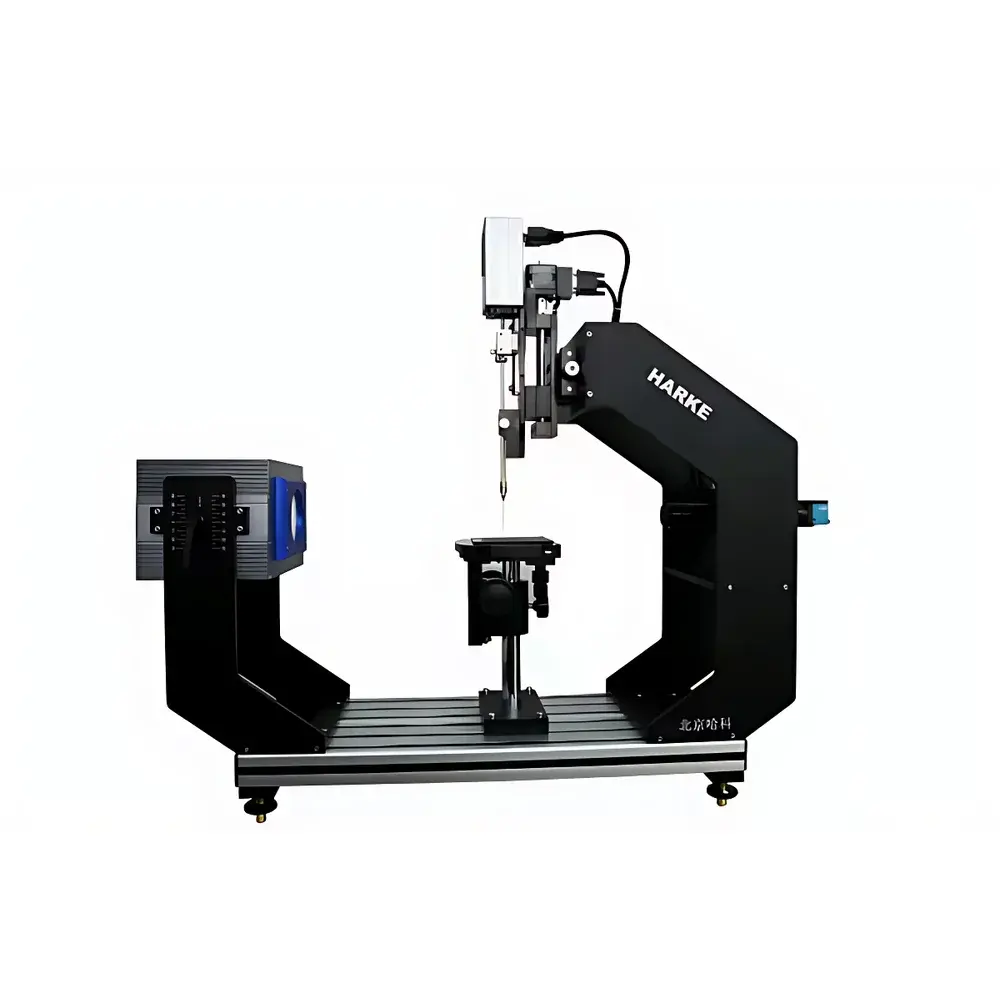
HARKE HARKE-SPCAk Dynamic Powder Contact Angle Analyzer
| Brand | HARKE |
|---|---|
| Model | HARKE-SPCAk |
| Type | Video-Based Optical Contact Angle Analyzer |
| Form Factor | Benchtop Laboratory Instrument |
| Contact Angle Range | 0–180° |
| Contact Angle Accuracy | ±0.1° |
| Contact Angle Resolution | ±0.01° |
| Sample Stage Dimensions | 100 mm × 120 mm |
| Optical Zoom Magnification | 0.7×–4.5× |
| Surface/Interfacial Tension Range | 0–1000 mN/m |
| Surface/Interfacial Tension Resolution | 0.01 mN/m |
| Imaging System | USB 3.0 High-Speed Camera (30 fps standard |
| Software | SPCA1.0 |
| Power Supply | 220 V, 3 A, 50 Hz |
| Weight | 30 kg |
| Footprint | 300 mm × 760 mm |
| Lens Vertical Travel | 30 mm |
| Syringe Dispenser Vertical Travel | 30 mm |
| Positioning Accuracy (X/Y/Z) | ±0.1 mm |
| Measurement Methods | Circle Fitting, Ellipse Fitting, Height-Width Method, and 5 additional algorithmic approaches |
| Temperature Condition | Ambient |
Overview
The HARKE HARKE-SPCAk Dynamic Powder Contact Angle Analyzer is a benchtop video-optical instrument engineered for quantitative, time-resolved analysis of liquid penetration into porous and granular solid systems. Unlike conventional static contact angle measurement devices—designed primarily for smooth, non-porous substrates—the HARKE-SPCAk integrates high-speed imaging, precision motorized stage control, and advanced software algorithms to capture the evolution of wetting behavior in real time. It operates on the fundamental principle of optical silhouette analysis: a high-resolution camera records the advancing meniscus as liquid is dispensed onto or absorbed by powder beds or sintered pellets, while dedicated image processing extracts dynamic contact angle (advancing, receding, and equilibrium) and capillary rise kinetics. This capability makes it indispensable for characterizing wettability heterogeneity, pore network accessibility, and imbibition dynamics—critical parameters in pharmaceutical tablet formulation, battery electrode slurry design, catalyst support evaluation, and soil science research.
Key Features
- High-speed optical acquisition system with USB 3.0 interface supporting frame rates from 30 fps (standard) up to 1000 fps (optional), enabling millisecond-scale resolution of liquid front propagation in powders.
- Motorized XYZ sample and syringe positioning stages with ±0.1 mm repeatability, ensuring precise spatial registration between droplet deposition and absorption zone.
- Variable magnification optical path (0.7×–4.5×) with fixed-focus lens turret, optimized for both macro-scale bed visualization and micro-scale particle-level meniscus tracking.
- Multi-algorithm contact angle computation engine (8 methods including circle, ellipse, height-width, and tangent-based fitting), each validated against NIST-traceable reference surfaces for inter-method comparability.
- Built-in surface and interfacial tension calculation module compliant with the pendant drop and sessile drop methods per ASTM D7490 and ISO 19403-2.
- Integrated environmental enclosure option (not included standard) for controlled humidity/temperature operation during long-duration imbibition studies.
Sample Compatibility & Compliance
The HARKE-SPCAk accommodates diverse particulate and porous samples—including free-flowing powders, compressed tablets, ceramic filters, fibrous mats, and geological core fragments—within its 100 mm × 120 mm stage area. Sample height tolerance is extended via 30 mm vertical travel of both lens and syringe units. All measurements adhere to internationally recognized standards: contact angle data reporting follows ISO 19403-1 (surface free energy determination) and ASTM D7334 (surface wettability of solid substrates), while software audit trails and user access controls support GLP-compliant workflows. The SPCA1.0 software includes electronic signature capability and configurable data retention policies aligned with FDA 21 CFR Part 11 requirements for regulated environments.
Software & Data Management
SPCA1.0 is a Windows-based application developed specifically for dynamic contact angle quantification. It provides synchronized video playback with overlaid contact angle vs. time curves, automatic baseline correction for substrate tilt, and batch processing for multi-sample comparative analysis. Raw image sequences are saved in lossless TIFF format; processed results export to CSV, Excel, and PDF with embedded metadata (timestamp, operator ID, calibration status). The software maintains full audit history—including parameter changes, manual corrections, and version-controlled algorithm updates—to satisfy traceability requirements in QA/QC and R&D documentation systems.
Applications
- Pharmaceutical development: Quantifying excipient wettability and disintegration kinetics in direct compression formulations.
- Energy materials: Assessing electrolyte infiltration into Li-ion battery cathode/anode coatings and separator membranes.
- Agrochemicals: Evaluating surfactant-enhanced wetting of hydrophobic active ingredients on leaf surfaces or soil particles.
- Materials science: Characterizing surface energy anisotropy in 3D-printed porous scaffolds and metal-organic frameworks (MOFs).
- Geotechnical engineering: Measuring capillary suction pressure and saturation rate in unsaturated soils under controlled boundary conditions.
FAQ
What distinguishes dynamic powder contact angle measurement from static sessile drop analysis?
Static methods assume thermodynamic equilibrium on idealized flat surfaces; dynamic powder analysis captures transient capillary-driven flow through heterogeneous pore networks—requiring temporal resolution, volumetric dispensing control, and edge-detection robustness not present in basic optical goniometers.
Can the HARKE-SPCAk measure contact angles on irregularly shaped particles or agglomerates?
Yes—its high-magnification optics and multi-method fitting algorithms accommodate non-uniform silhouettes; however, reproducibility requires consistent sample packing density and bed leveling prior to testing.
Is surface free energy calculation supported for porous substrates?
The SPCA1.0 software implements Owens-Wendt, Wu, and van Oss-Chaudhury-Good models using dynamic contact angle inputs, though interpretation assumes effective homogeneous surface chemistry at the macroscopic scale.
Does the system comply with regulatory data integrity requirements?
When configured with user authentication, audit trail logging, and electronic signatures enabled, the SPCA1.0 platform meets core technical controls outlined in FDA 21 CFR Part 11 and EU Annex 11 for computerized systems in GxP environments.
Related Products



