
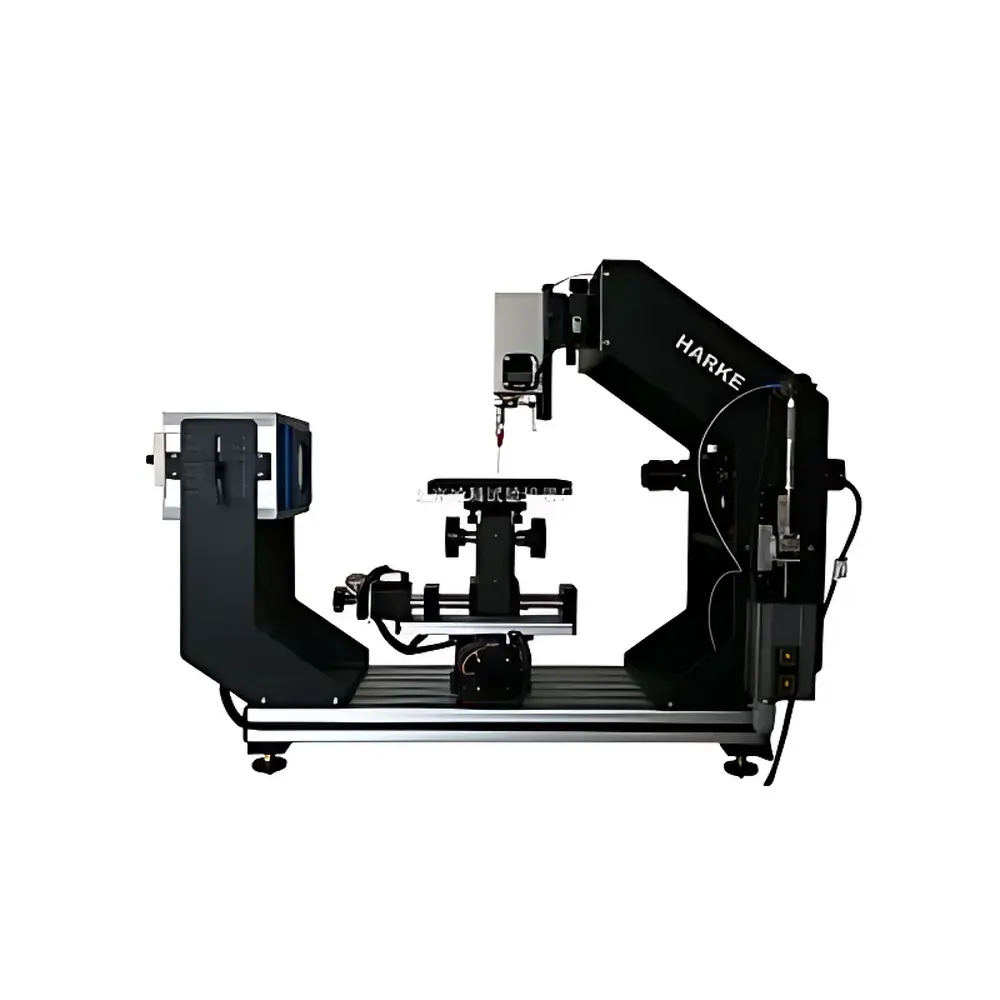
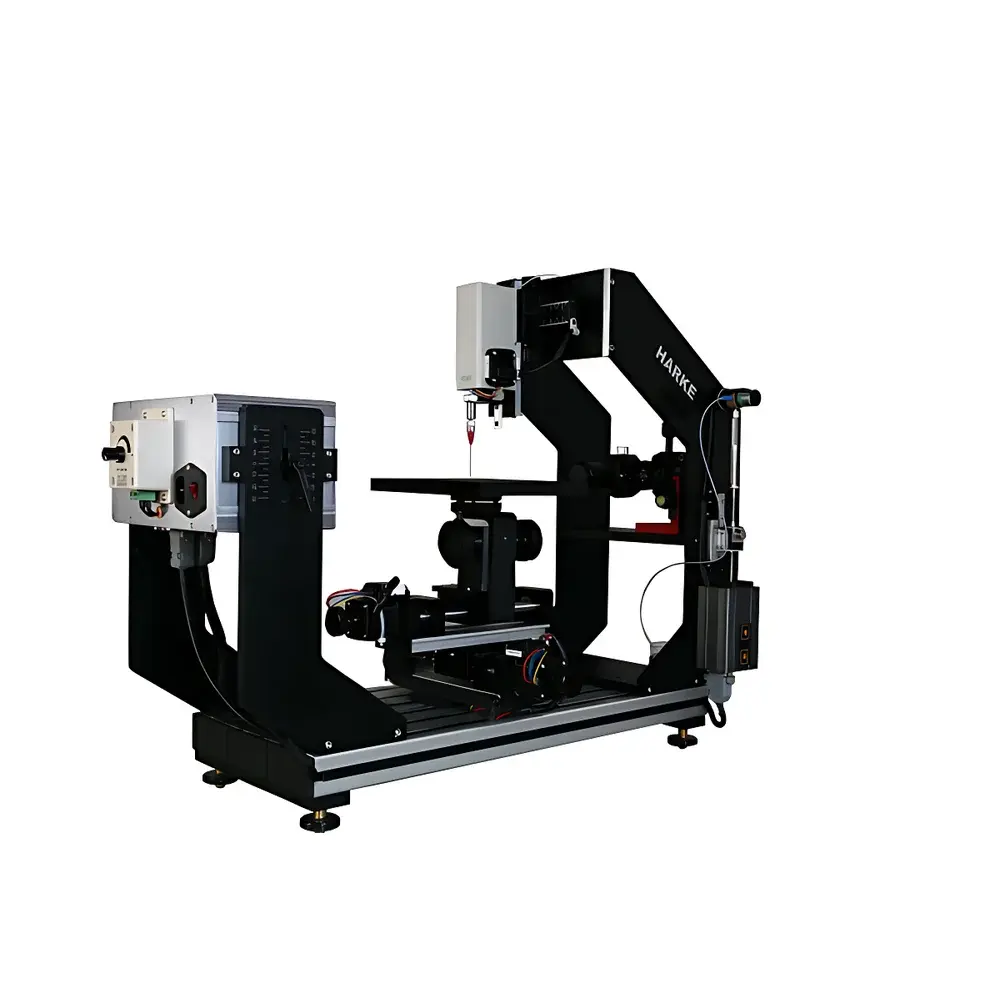
HARKE HARKE-SPCAX2 Video-Based Optical Contact Angle Analyzer
| Brand | HARKE |
|---|---|
| Origin | Beijing, China |
| Manufacturer Type | Direct Manufacturer |
| Instrument Type | Benchtop Video Optical Contact Angle Analyzer |
| Contact Angle Measurement Range | 0–180° |
| Contact Angle Accuracy | ±0.1° |
| Sample Stage Dimensions | 120 mm × 120 mm |
| Optical Magnification | 0.7×–4.7× (parfocal zoom) |
| Surface/Interfacial Tension Range | 0–1000 mN/m |
| Surface/Interfacial Tension Accuracy | ±0.01 mN/m |
| Measurement Methods | Sessile Drop, Tilting Plate (Roll-off), Captive Bubble |
| Analysis Algorithms | Tangent, Circle Fit, Ellipse Fit, Local Profile Fitting, Full Profile Fitting, Young–Laplace Fitting, Dynamic Tracking, Goniometric Ruler |
| Image Processing | Dual-mode (manual + auto-edge detection) |
| Surface Energy Calculation Models | Zisman, Fowkes, Owens–Wendt, Wu, van Oss–Chaudhury–Good |
| Motorized XYZ Stage (Stage Travel | X±50 mm, Y±30 mm, Z±50 mm |
| Fixed Plate Translation | ±150 mm Y-axis) |
| Precision Syringe Pump (Auto Dispensing | 250 µL range, ±0.1 µL accuracy |
| Manual Mode | 2 mL range, ±0.1 µL accuracy) |
| Overall Dimensions | 230 mm (W) × 640 mm (D) × 750 mm (H) |
| Weight | 38 kg |
Overview
The HARKE HARKE-SPCAX2 is a benchtop video-based optical contact angle analyzer engineered for high-precision quantification of solid–liquid interfacial phenomena. It operates on the principle of digital image capture and geometric contour analysis of sessile or captive droplets under controlled environmental conditions. By combining parfocal continuous zoom optics (0.7×–4.7×), a high-resolution CMOS imaging system, and motorized multi-axis sample positioning, the instrument delivers reproducible contact angle measurements across the full 0–180° range—critical for characterizing hydrophobicity, oleophobicity, wettability hysteresis, and dynamic wetting behavior. Designed in accordance with ISO 19403-2 (Contact angle measurement — Part 2: Static contact angle), ASTM D7334 (Standard Practice for Surface Wettability of Coatings by Contact Angle Measurement), and GB/T 24368–2009 (Glass surface hydrophobic contaminant detection via contact angle method), the HARKE-SPCAX2 supports both routine QC testing and advanced academic research in materials science, coatings development, biomedical device evaluation, and microfluidics.
Key Features
- Parfocal zoom optical system with calibrated magnification (0.7×–4.7×), eliminating refocusing during magnification changes and ensuring consistent pixel-to-length calibration across all imaging modes.
- Motorized XYZ translation stage with programmable travel limits: ±50 mm (X), ±30 mm (Y), ±50 mm (Z); plus independent ±150 mm Y-axis translation of the fixed mounting plate for large or irregular samples.
- Dual-mode dispensing system: precision syringe pump (250 µL capacity, ±0.1 µL resolution) for automated sequential dosing; manual syringe module (2 mL capacity, ±0.1 µL resolution) for rapid prototyping or viscous fluid handling.
- Integrated heated stage option (ambient to 120°C, ±0.5°C thermal stability) enabling temperature-dependent contact angle and surface energy mapping per ISO 19403-4.
- Real-time image acquisition at up to 60 fps (720p), with synchronized timestamped video recording, frame-by-frame playback, and configurable interval snapshot capture (e.g., 100 ms–10 s intervals).
- Multi-algorithm contact angle computation engine supporting tangent, circle/ellipse fitting, local/full profile fitting, Young–Laplace numerical solution, and dynamic tracking for advancing/receding angle determination.
Sample Compatibility & Compliance
The HARKE-SPCAX2 accommodates flat, curved, or textured substrates up to 100 mm (W) × 80 mm (T) × any practical length, mounted on a 120 mm × 120 mm rigid aluminum stage. Its modular design permits integration with environmental chambers (humidity control, inert gas purge) and optional accessories such as tilting stages (for roll-off angle and sliding angle assessment) and captive bubble modules (for hydrophilic surface characterization). All measurement protocols comply with GLP-aligned data integrity requirements: audit-trail-enabled software logs operator ID, timestamp, parameter settings, raw images, and analysis history. The system supports FDA 21 CFR Part 11–compliant electronic signatures when deployed with validated software configurations.
Software & Data Management
HARKE’s proprietary SPCAX Software v4.2 provides a deterministic, scriptable interface for experiment setup, real-time visualization, batch processing, and traceable reporting. Raw images are stored in lossless TIFF format with embedded EXIF metadata (exposure time, lens magnification, stage coordinates). Surface energy calculations implement Zisman, Fowkes, Owens–Wendt, Wu, and van Oss–Chaudhury–Good models with user-defined liquid probe sets (e.g., water, diiodomethane, ethylene glycol). Export options include CSV (numerical results), PDF (formatted reports with annotated images), and XML (for LIMS integration). Data files are structured for long-term archival and reanalysis without dependency on proprietary runtime environments.
Applications
- Quality control of anti-fouling coatings, plasma-treated polymers, and self-cleaning surfaces in automotive and architectural glass manufacturing.
- Surface energy mapping of printed electronics substrates to optimize ink adhesion and film uniformity.
- Dynamic contact angle profiling of pharmaceutical tablet films during dissolution testing (per USP ).
- Wettability hysteresis analysis of filtration membranes and battery separator materials.
- Interfacial tension quantification of surfactant solutions, microemulsions, and biofluids using pendant drop or rotating drop methods (with optional add-ons).
- Academic research in colloid and interface science, including Cassie–Baxter/Wenzel state transition studies and nanomaterial functionalization validation.
FAQ
What contact angle analysis methods does the HARKE-SPCAX2 support?
The system implements eight distinct algorithms: tangent, circle fit, ellipse fit, local profile fitting, full profile fitting, Young–Laplace numerical solution, dynamic tracking, and goniometric ruler—each selectable per image or applied in batch mode.
Can the instrument measure surface energy of heterogeneous or rough surfaces?
Yes. The software supports multi-liquid surface energy models (Owens–Wendt, Wu, van Oss) and includes correction tools for roughness-induced contact angle deviation based on Wenzel and Cassie–Baxter frameworks.
Is the software compliant with regulatory data integrity standards?
When configured with audit trail, electronic signature, and role-based access controls, the system meets ALCOA+ principles and supports 21 CFR Part 11 compliance for regulated laboratories.
Does the system support captive bubble measurements?
Captive bubble functionality is available as an optional hardware module, enabling contact angle measurement on highly hydrophilic or transparent substrates.
What is the minimum droplet volume resolvable for accurate contact angle calculation?
With optimal lighting and contrast, the system reliably analyzes droplets as small as 0.5 µL (≈1.2 mm diameter) using full-profile fitting; sub-microliter analysis requires optional high-magnification lens upgrade.



