
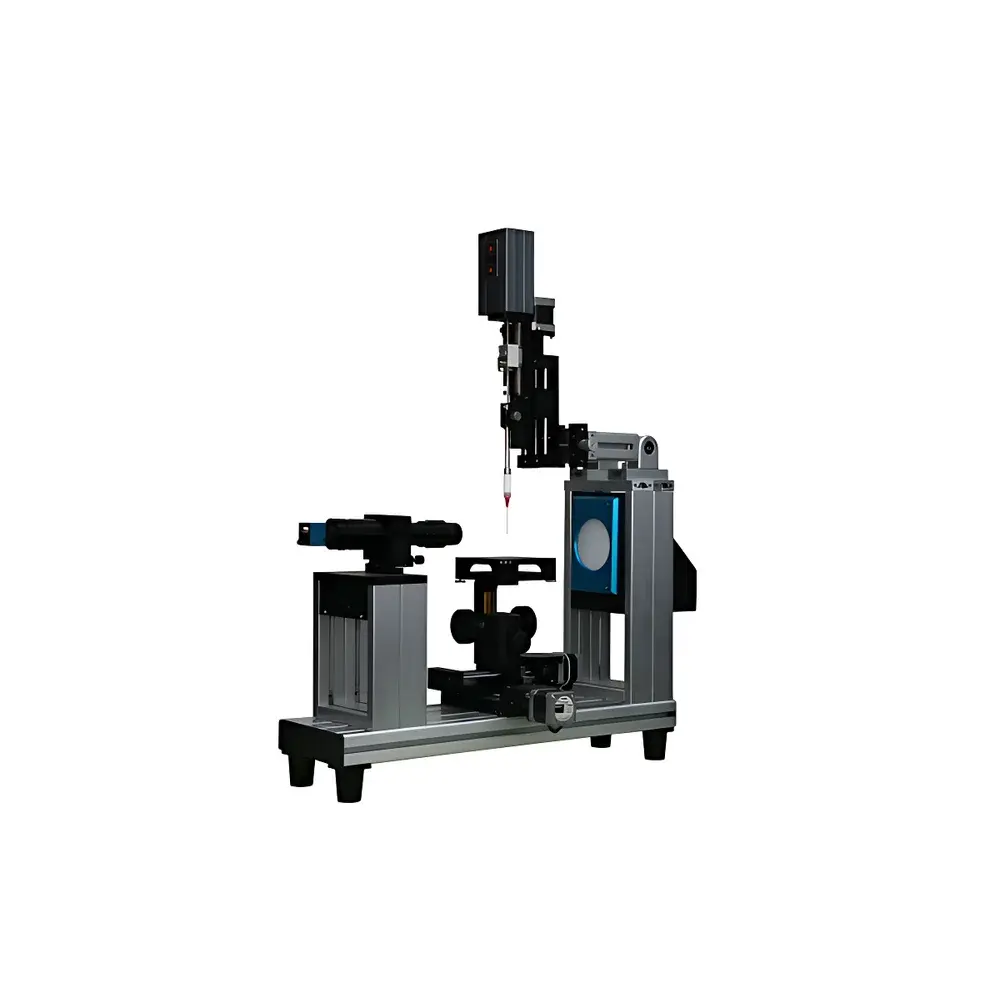
HARKE HK-10 Video-Based Optical Contact Angle Analyzer
| Brand | HARKE |
|---|---|
| Origin | Beijing, China |
| Manufacturer Type | Direct Manufacturer |
| Instrument Category | Domestic |
| Model | HK-10 |
| Instrument Class | Video Optical Contact Angle Meter |
| Form Factor | Benchtop Laboratory System |
| Contact Angle Measurement Range | 0–180° |
| Contact Angle Accuracy | ±0.1° |
| Sample Stage Dimensions | 100 × 100 mm |
| Optical Magnification | 0.5×–0.7× (Stepped Zoom Lens) |
| Surface/Interfacial Tension Range | 0–1000 mN/m |
| Surface/Interfacial Tension Accuracy | ±0.01 mN/m |
| Measurement Methods | Sessile Drop, Captive Bubble, Immersion, Tilting Plate (Sliding Angle), Expansion/Contraction, Rolling-off |
| Surface Tension Methods | Pendant Drop, Ring (Du Noüy), Wilhelmy Plate, Maximum Bubble Pressure, Drop Volume |
| Software | HKCA10 v3.x |
| Camera Interface | USB 3.0 |
| Frame Rate | Up to 1000 fps (Optional High-Speed Modules) |
| Power Supply | 220 V / 3 A / 50 Hz |
| Operating Temperature | Ambient (Optional Thermostatic or Heated Stage) |
Overview
The HARKE HK-10 is a precision-engineered video-based optical contact angle analyzer designed for rigorous surface and interfacial property characterization in academic research laboratories, quality control environments, and industrial R&D settings. It operates on the principle of sessile drop analysis—capturing high-resolution images of liquid droplets dispensed onto solid substrates—and applying advanced edge-detection algorithms to determine contact angle values via geometric fitting (circle, ellipse, or Young–Laplace contour models). Complementing static measurements, the system supports dynamic contact angle acquisition through automated expansion/contraction cycles and tilting-stage protocols to quantify advancing, receding, and sliding angles. Its pendant drop module enables accurate determination of surface and interfacial tension (SFT/IFT) across a broad range (0–1000 mN/m), leveraging axisymmetric drop shape analysis (ADSA) based on the Young–Laplace equation. The instrument is engineered for reproducibility, long-term stability, and compliance with methodological standards referenced in ASTM D7490, ISO 19403-2, and GB/T 24368–2009—the Chinese national standard for hydrophobic contaminant detection on glass surfaces.
Key Features
- Benchtop modular architecture with rigid aluminum frame and vibration-damped optical baseplate for measurement stability
- Stepped zoom optical system (0.5×–0.7×) featuring fixed-magnification telecentric lens for minimal distortion and pixel-level spatial calibration
- USB 3.0 high-speed camera capable of real-time capture at up to 1000 frames per second (configurable), enabling precise temporal resolution for dynamic wetting kinetics
- Motorized XYZ sample stage with manual X-axis fine adjustment; 100 × 100 mm flat-stage platform accommodating standard petri dishes, wafers, films, fibers, and irregular solids
- Automated syringe pump with 60 mm vertical travel and programmable dispensing volume (nL–µL resolution), supporting repeatable drop formation and sequential multi-drop assays
- HKCA10 software suite with dual-mode analysis: real-time live fitting (circle/ellipse/Y-L) and post-acquisition ADSA refinement; includes auto-zero time detection, batch processing, and statistical reporting
- Comprehensive method library: sessile drop, captive bubble, immersion, tilting plate, expansion/contraction, and rolling-off protocols—all accessible via intuitive GUI workflow templates
Sample Compatibility & Compliance
The HK-10 accommodates diverse material geometries without requiring specialized fixtures: planar substrates (glass slides, silicon wafers, polymer films), porous media (paper, filter membranes, nonwovens), fibrous assemblies (single fibers, yarns, textiles), particulate layers (powders, granules, catalyst beds), and macroscopic 3D objects (coated tools, biomedical implants, packaging laminates). Surface energy calculation modules implement Owens–Wendt–Rabel–Kaelble (OWRK), Wu harmonic mean, and van Oss–Chaudhury–Good (vOCG) models using user-defined probe liquids. All measurement workflows support audit-trail logging and export of raw image sequences, metadata, and numerical results in CSV/PNG/TIF formats—fully traceable for GLP/GMP-aligned documentation. While not pre-certified for FDA 21 CFR Part 11, the software architecture permits integration with validated electronic lab notebook (ELN) systems and supports timestamped operator authentication.
Software & Data Management
HKCA10 v3.x is a Windows-native application built on a deterministic real-time imaging engine. It provides synchronized hardware control (camera exposure, pump actuation, stage movement), live curve plotting (θ vs. t), and dynamic parameter overlays (base diameter, height, volume). Each session generates a structured project file (.hkproj) containing embedded TIFF stacks, calibration profiles, and analysis parameters—ensuring full experimental reproducibility. Batch analysis mode processes hundreds of images using identical fitting constraints, while ROI masking allows selective evaluation of heterogeneous surfaces. Export options include ANSI-compliant CSV tables (with uncertainty propagation), publication-ready vector graphics (SVG/EPS), and annotated AVI/MKV video exports. Optional API access enables custom scripting (Python/C#) for integration into automated test sequences or LIMS environments.
Applications
- Surface functionalization validation of plasma-treated polymers, silanized glass, or ALD-coated semiconductors
- Hydrophobicity/hydrophilicity mapping of filtration membranes, medical device coatings, and anti-fouling marine paints
- Dynamic wettability assessment of inkjet-printed electronics, battery electrode slurries, and pharmaceutical tablet films
- Interfacial tension profiling of surfactant formulations, microemulsions, and crude oil–brine systems
- Adhesion prediction via surface energy component analysis for adhesive bonding, composite layup, and paint adhesion testing
- Quality assurance of paper absorbency, textile moisture management, and food packaging barrier performance
FAQ
What measurement methods does the HK-10 support for contact angle determination?
Sessile drop, captive bubble, immersion, tilting plate (sliding angle), expansion/contraction cycling, and rolling-off—each configurable with adjustable ramp rates, dwell times, and threshold criteria.
Can the HK-10 measure surface energy of solid materials?
Yes—using two or more probe liquids with known polar/dispersive components, the software calculates total surface energy and its Lifshitz–van der Waals and acid–base contributions via OWRK, Wu, or vOCG models.
Is high-speed imaging integrated as standard or optional?
Standard configuration includes USB 3.0 camera at 40 fps; higher frame rates (100/300/1000 fps) are available as factory-installed options with corresponding memory buffering upgrades.
Does the system comply with international testing standards?
The methodology aligns with ASTM D7490 (contact angle), ISO 19403-2 (optical methods), and GB/T 24368–2009; full compliance documentation requires site-specific IQ/OQ validation per user SOPs.
What temperature control options are available?
Ambient operation is standard; Peltier-heated stages (–10°C to +80°C), environmental chambers (–20°C to +150°C), and vacuum-compatible variants are offered as configurable accessories.
Related Products



