
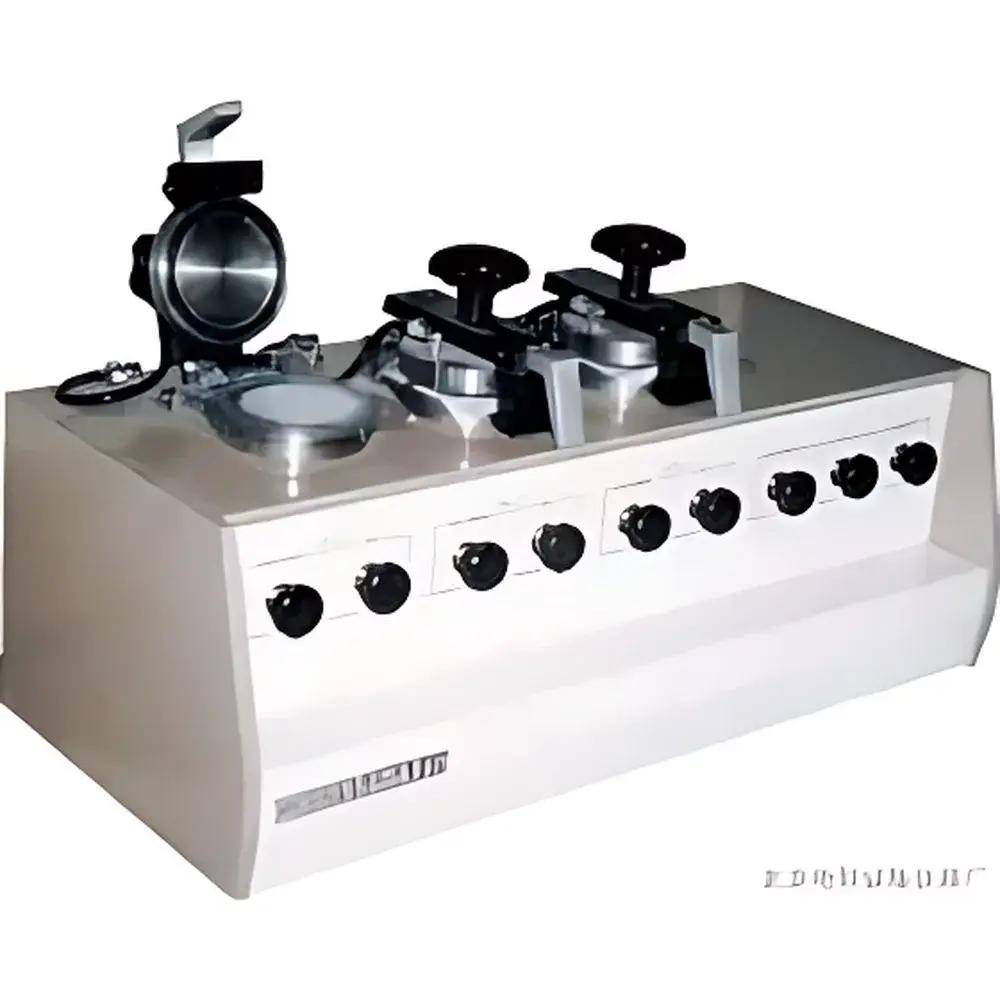
HARKE HK-CV3 Gas Permeability Tester for Thin Films
| Brand | HARKE |
|---|---|
| Origin | Beijing, China |
| Manufacturer Type | Direct Manufacturer |
| Country of Origin | China |
| Model | HK-CV3 |
| Pricing | Available Upon Request |
Overview
The HARKE HK-CV3 Gas Permeability Tester is a precision-engineered instrument designed for the quantitative determination of gas transmission rates through thin-film and sheet materials using the differential pressure (manometric) method. It operates on the fundamental principle of Fick’s law of diffusion and Henry’s law of solubility, enabling simultaneous calculation of oxygen transmission rate (OTR), carbon dioxide transmission rate (CO2TR), nitrogen transmission rate (NTR), as well as derived material parameters—including permeability coefficient (P), diffusion coefficient (D), and solubility coefficient (S)—under controlled temperature and pressure conditions. The system features dual-chamber architecture: a high-pressure test chamber (upper cavity) and a low-pressure measurement chamber (lower cavity), isolated by a standardized sample clamp. After vacuum conditioning of the lower chamber and system evacuation, a regulated test gas (e.g., O2, CO2, N2, He, or air) is introduced into the upper chamber to establish a stable, adjustable transmembrane pressure gradient (typically 0.1–0.3 MPa). Real-time monitoring of pressure rise in the evacuated lower chamber—via high-stability piezoresistive transducers—enables accurate, traceable quantification of gas permeation kinetics over time.
Key Features
- Differential pressure method compliant with ISO 15105-1, ISO 2556, ASTM D1434, JIS K7126-1, GB/T 1038–2000, and YBB 00082003 (Chinese pharmaceutical packaging standards)
- Integrated temperature-controlled test chamber with ±0.1 °C stability across 15–35 °C operating range, supporting thermally dependent permeability studies
- Automated vacuum sequence with dual-stage pumping and real-time vacuum integrity verification prior to test initiation
- Modular gas handling system compatible with multiple standard gases (O2, CO2, N2, He, synthetic air) without hardware modification
- High-resolution pressure sensing (≤0.1 Pa resolution) and drift-compensated data acquisition at 1 Hz sampling rate
- Robust stainless-steel test cavity construction with PTFE-sealed clamping mechanism ensuring leak-tight sample mounting (test area: 50 cm² standard)
Sample Compatibility & Compliance
The HK-CV3 accommodates rigid and flexible planar specimens up to 3 mm thickness and 100 mm diameter. It is validated for use with polymeric films (e.g., PET, PE, PP, PA, EVOH), metallized substrates (Al-coated PET, Al foil laminates), coextruded structures, paper-plastic composites, rubber sheets, and engineering thermoplastics (e.g., PVC, PVDC, PC). All test procedures adhere to Good Laboratory Practice (GLP) requirements, with full audit trail capability for calibration events, operator logins, method parameters, and raw pressure-time datasets. Instrument qualification documentation supports IQ/OQ protocols per ISO/IEC 17025 and FDA 21 CFR Part 11-compliant electronic record retention when paired with HARKE’s optional secure software package.
Software & Data Management
The HK-CV3 is operated via HARKE PermeaSoft™ v3.2—a Windows-based application delivering ISO-standardized calculation engines, automated parameter derivation (P, D, S), and customizable reporting templates. Software functions include multi-curve overlay, statistical batch analysis (n ≥ 3 replicates), uncertainty propagation per GUM (Guide to the Expression of Uncertainty in Measurement), and export to CSV, PDF, or XML formats. All user actions—including method edits, result approvals, and calibration interventions—are timestamped and digitally signed. Optional 21 CFR Part 11 module provides role-based access control, electronic signatures, and immutable audit logs required for regulated pharmaceutical and medical device packaging validation.
Applications
- Development and QC of high-barrier food packaging films requiring shelf-life modeling under modified atmosphere (MAP)
- Validation of sterile barrier systems per ISO 11607 for medical device pouches and trays
- Comparative assessment of coating efficacy (e.g., SiOx, AlOx) on flexible substrates
- Regulatory submission support for YBB-certified pharmaceutical blister foils and cold-forming aluminum sheets
- Accelerated aging studies correlating permeability shifts with thermal/humidity stress exposure
- Material selection support for battery separator films where O2/H2O ingress impacts electrochemical stability
FAQ
What gases can be tested with the HK-CV3?
Oxygen, carbon dioxide, nitrogen, helium, and dry air are fully supported; custom gas calibrations are available upon request.
Is temperature control mandatory during testing?
Yes—permeability is intrinsically temperature-dependent; the integrated Peltier-controlled chamber ensures reproducible thermal conditions per ISO 15105-1 Annex A.
Does the instrument meet FDA requirements for pharmaceutical packaging validation?
When configured with 21 CFR Part 11 software options and operated under documented SOPs, it fulfills data integrity and traceability requirements for YBB and USP submissions.
Can the HK-CV3 test non-planar or porous samples?
No—it is strictly designed for flat, non-porous, gas-tight specimens; foam, mesh, or fibrous materials require alternative methods such as coulometric or infrared detection systems.
What is the minimum detectable OTR value?
Detection limit is 0.05 cm³/m²·day·0.1 MPa for O2 at 23 °C, verified via certified reference films traceable to NIST SRM 1477.




