
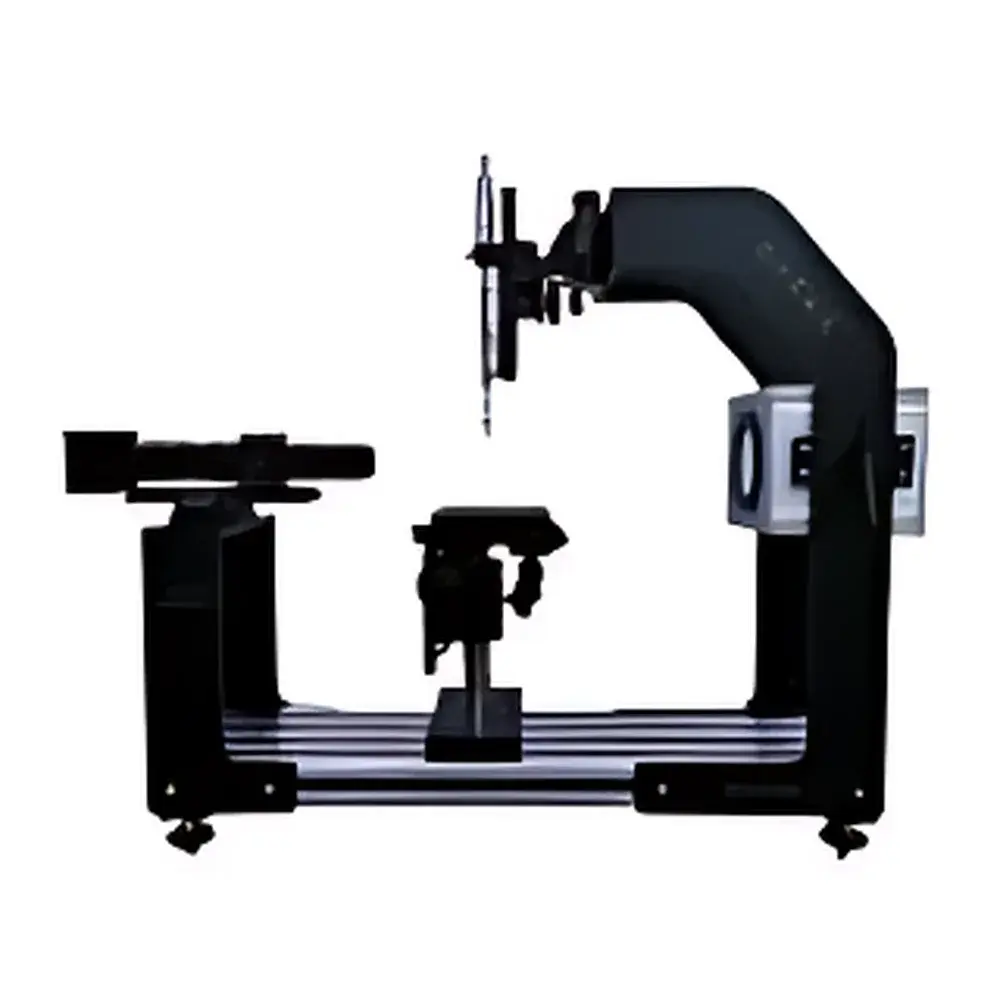
HARKE HK-SPCAZ Video-Based Optical Contact Angle Analyzer
| Brand | HARKE |
|---|---|
| Model | HK-SPCAZ |
| Type | Benchtop Video Optical Contact Angle Analyzer |
| Contact Angle Range | 0–180° |
| Contact Angle Accuracy | ±0.1° |
| Contact Angle Display Resolution | ±0.01° |
| Surface/Interfacial Tension Range | 0–1000 mN/m |
| Surface/Interfacial Tension Accuracy | ±0.01 mN/m |
| Sample Stage Dimensions | 100 mm × 120 mm |
| Lens Magnification | 0.7×–5× (ZF-180 Precision Stepping Zoom Lens) |
| Imaging Speed | Up to 1000 fps (USB 2.0 camera, configurable: 30/100/300/1000 fps) |
| Lens Vertical Travel | 120 mm |
| Instrument Dimensions | 260 mm × 700 mm × (height not specified) |
| Weight | ~30 kg |
| Power Supply | 220 V / 3 A / 50 Hz |
| Temperature Control | Integrated Electric Heating Stage |
| Surface Energy Calculation Method | Equation of State (EOS) |
| Interfacial Tension Method | Pendant Drop |
| Contact Angle Fitting Algorithms | Circle Fit, Ellipse Fit, Young–Laplace Fitting (Sessile Drop), Captive Bubble |
| Optional Accessories | Manual or Motorized Tilting Stage |
Overview
The HARKE HK-SPCAZ is a benchtop video-based optical contact angle analyzer engineered for high-precision quantification of solid–liquid and liquid–liquid interfacial behavior. It operates on the principle of digital image capture and geometric contour analysis of sessile drops, captive bubbles, and pendant drops—enabling direct measurement of contact angle, surface tension, interfacial tension, and derived thermodynamic parameters such as solid surface free energy via the Equation of State (EOS) method. Designed for routine quality control, R&D laboratories, and academic surface science research, the instrument delivers traceable, reproducible results under controlled thermal conditions. Its modular architecture supports both static and dynamic contact angle analysis—including advancing/receding angle acquisition with optional tilting stages—and conforms to widely referenced ASTM D7334 (Standard Practice for Surface Wettability of Coated Surfaces by Contact Angle Measurement) and ISO 19403 series (Paints and Varnishes – Determination of Contact Angle).
Key Features
- High-resolution optical imaging system featuring a ZF-180 stepping zoom lens (0.7×–5× magnification) with motorized focus and precise vertical travel (120 mm), enabling optimal drop morphology resolution across diverse sample topographies.
- USB 2.0 high-speed camera platform supporting frame rates from 30 fps (standard) up to 1000 fps (optional), facilitating dynamic wetting studies including drop deposition, spreading kinetics, and evaporation-driven contact line migration.
- Electrically heated sample stage with closed-loop temperature regulation, allowing systematic investigation of temperature-dependent wettability and interfacial phenomena in compliance with GLP-relevant thermal stability protocols.
- Integrated HARKE-SPCA1.0 software suite with multi-algorithm fitting engines: circle fit (for near-spherical drops), ellipse fit (for moderate asymmetry), and Young–Laplace numerical fitting (for high-accuracy, non-ideal droplet contours).
- Benchtop mechanical design (260 mm × 700 mm footprint, ~30 kg) optimized for space-constrained laboratory environments while maintaining structural rigidity to minimize vibration-induced measurement drift.
- Comprehensive interfacial property quantification: contact angle (0–180°, ±0.1° accuracy, ±0.01° display resolution), surface/interfacial tension (0–1000 mN/m, ±0.01 mN/m accuracy) via pendant drop analysis, and EOS-based surface energy decomposition (Lifshitz–van der Waals, acid–base components).
Sample Compatibility & Compliance
The HK-SPCAZ accommodates flat, rigid, or moderately curved substrates up to 100 mm × 120 mm on its precision-machined stage. Samples include polymers, metals, ceramics, thin films, coatings, textiles, and biological membranes. The system supports both ambient and elevated temperature operation (via integrated heating), making it suitable for studies aligned with ISO 27448 (photocatalytic activity), ASTM D5946 (corona treatment verification), and USP <1058> (analytical instrument qualification). All measurement data—including raw images, fitted contours, metadata (timestamp, temperature, operator ID), and calculation logs—are stored in structured, audit-ready formats compatible with 21 CFR Part 11-compliant electronic record systems when deployed with validated software configurations.
Software & Data Management
HARKE-SPCA1.0 is a Windows-native application providing real-time video acquisition, automated droplet detection, batch processing, and export of calibrated numerical datasets (CSV, XLSX) and annotated images (TIFF, PNG). The software implements full audit trail functionality—recording user actions, parameter changes, and calibration events—with timestamped, non-erasable logs. Raw image sequences are preserved losslessly for retrospective reanalysis. Exported data integrates seamlessly with LIMS platforms and statistical process control (SPC) tools. Optional IQ/OQ documentation packages support GMP-regulated environments requiring formal instrument qualification per ASTM E2500 and ICH Q9 guidelines.
Applications
- Characterization of hydrophobic/hydrophilic coatings (e.g., anti-fog, self-cleaning, anti-icing surfaces)
- Quality assurance of printed electronics substrates and inkjet-printed functional layers
- Surface energy mapping for adhesive bonding optimization and failure root-cause analysis
- Stability assessment of emulsions and foams via interfacial tension kinetics
- Corrosion inhibitor efficacy evaluation through wetting angle shifts on metal substrates
- Biomedical material screening (e.g., cell adhesion substrates, drug delivery carriers)
- Plasma, corona, and flame treatment validation in packaging and automotive component manufacturing
FAQ
What contact angle fitting methods does the HK-SPCAZ support?
Circle fit, ellipse fit, and Young–Laplace numerical fitting for sessile drops; pendant drop analysis for surface/interfacial tension; captive bubble mode for hydrophobic surface characterization.
Is temperature control integrated into the base configuration?
Yes—the standard configuration includes an electrically heated sample stage with adjustable setpoint and real-time monitoring.
Can the system comply with FDA 21 CFR Part 11 requirements?
When deployed with validated HARKE-SPCA1.0 software configurations, electronic signatures, audit trails, and secure user access controls meet core Part 11 expectations for electronic records and signatures.
What is the maximum frame rate supported without hardware upgrade?
The base USB 2.0 camera operates at 30 fps; higher speeds (100/300/1000 fps) require optional high-speed camera modules and compatible frame grabbers.
Does the instrument support dynamic contact angle measurement?
Yes—advancing and receding contact angles can be measured using either manual or motorized tilting stages (optional accessories), enabling hysteresis analysis per ASTM D7490.



