
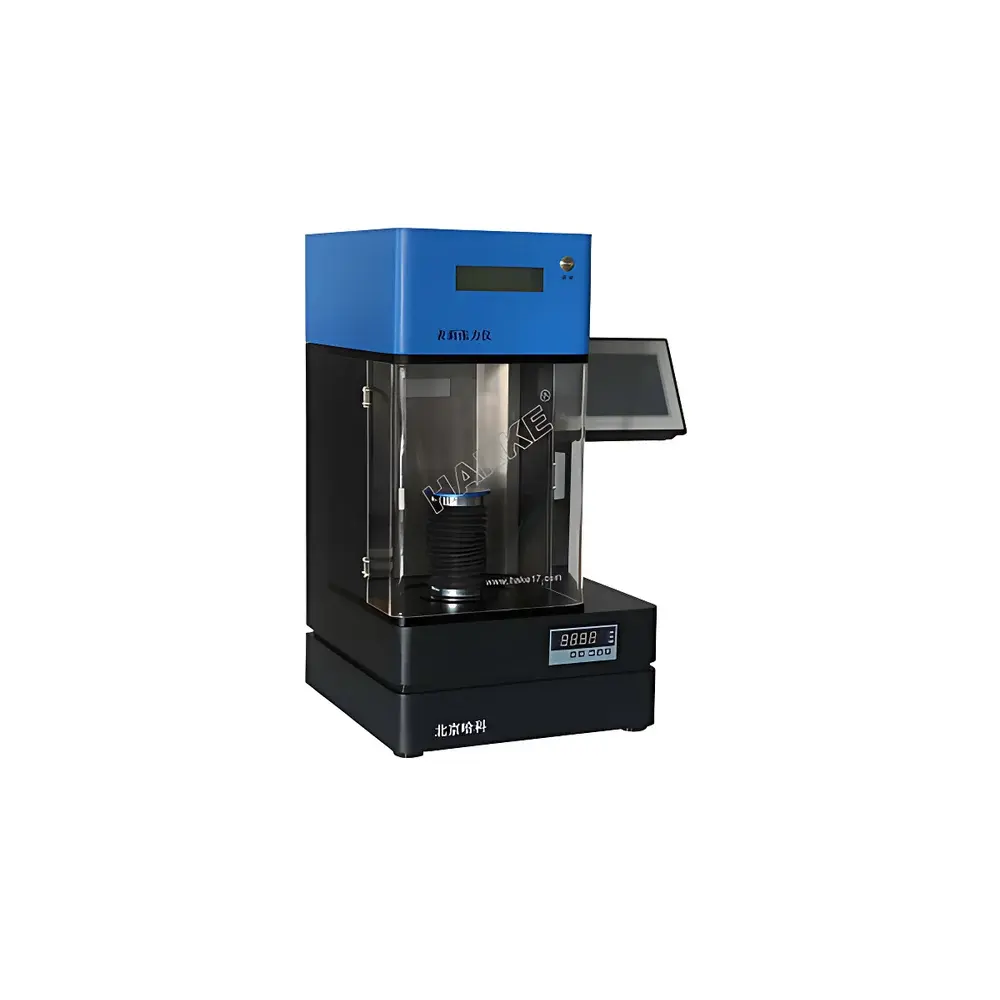
HARKE SFT-1 Advanced Surface Tensiometer
| Brand | HARKE |
|---|---|
| Model | SFT-1 |
| Measurement Principle | Wilhelmy Plate Method (Dynamical & Static) |
| Measurement Range | 0–400 mN/m |
| Resolution | 0.01 mN/m |
| Accuracy | ±0.1 mN/m |
| Temperature Display Range | 0–95 °C |
| Temperature Display Accuracy | ±0.1 °C |
| Sensor Capacity | 0–120 g |
| Sample Stage Vertical Speed | 0–10 mm/s |
| Sample Stage Travel Distance | 0–80 mm |
| Stage Positioning Accuracy | ±0.1 mm |
| Sample Vessel Diameter | Φ50 mm |
| Software | SFT-Al v3.2 |
| Dimensions (W×D×H) | 360 × 360 × 620 mm |
| Net Weight | 20 kg |
Overview
The HARKE SFT-1 Advanced Surface Tensiometer is a benchtop instrument engineered for high-reproducibility static and dynamic surface and interfacial tension measurements using the Wilhelmy plate method. Based on classical force-balance principles, it quantifies the vertical force exerted on a precisely calibrated platinum or glass plate as it contacts or withdraws from a liquid–air or liquid–liquid interface. This method conforms to ISO 1409, ASTM D971, and DIN 53914 standards, ensuring traceable, metrologically sound results across R&D, quality control, and regulatory environments. The instrument integrates a high-stability electromagnetic force transducer with sub-micron stage positioning and real-time thermal monitoring, enabling consistent measurements under controlled temperature conditions up to 95 °C—critical for studying temperature-dependent surfactant behavior, polymer solutions, and emulsion stability.
Key Features
- High-resolution Wilhelmy plate sensor with 0.01 mN/m display resolution and ±0.1 mN/m measurement accuracy, validated against NIST-traceable reference liquids (e.g., ultra-pure water, diiodomethane)
- Motorized vertical sample stage with programmable speed (0–10 mm/s) and 80 mm travel range, supporting both immersion and withdrawal cycles for dynamic surface tension profiling
- Integrated digital temperature sensor with ±0.1 °C accuracy and real-time feedback loop—enabling isothermal experiments and Arrhenius-based activation energy analysis
- Rigid aluminum alloy frame and vibration-damped optical baseplate to minimize environmental interference during low-force measurements
- Modular design accommodating optional accessories: Peltier-controlled temperature chamber, magnetic stirrer integration, and interchangeable plate geometries (platinum, filter paper, or Teflon-coated plates)
Sample Compatibility & Compliance
The SFT-1 supports aqueous and non-aqueous systems—including surfactant solutions, crude oils, pharmaceutical formulations, ink dispersions, and biological fluids—within standard sample vessel dimensions (Φ50 mm). Its Wilhelmy plate geometry ensures compatibility with Newtonian and weakly viscoelastic fluids; for highly structured or particulate-laden samples, optional cleaning protocols and plate calibration routines are embedded in SFT-Al software. Regulatory compliance includes full audit trail support (user login, parameter changes, raw data timestamps), electronic signature readiness per FDA 21 CFR Part 11, and alignment with GLP/GMP documentation workflows. All measurement procedures adhere to ISO/IEC 17025–compliant uncertainty budgets when operated within specified environmental conditions (23 ±2 °C, <60% RH).
Software & Data Management
SFT-Al v3.2 is a Windows-based application providing automated measurement sequencing, real-time curve visualization (force vs. time/position), and multi-parameter export (CSV, Excel, PDF). It enables batch processing of up to 99 samples with customizable pass/fail criteria based on user-defined tolerance bands. Raw sensor output is stored with metadata (operator ID, ambient temperature, calibration date, plate serial number), and all modifications are logged in an immutable audit trail. Data integrity is reinforced via local encrypted database storage and optional network backup to enterprise NAS or LIMS platforms. Software validation documentation (IQ/OQ/PQ templates) is available upon request for regulated laboratories.
Applications
- Surfactant critical micelle concentration (CMC) determination through surface tension isotherms
- Emulsion and foam stability assessment via interfacial tension kinetics at oil–water interfaces
- Quality assurance of coating formulations, agrochemical adjuvants, and detergent concentrates
- Surface activity screening of biopharmaceutical excipients (e.g., polysorbates, phospholipids)
- Interfacial rheology pre-screening prior to oscillatory interfacial shear experiments
- Evaluation of wettability modifiers in enhanced oil recovery (EOR) research
FAQ
What measurement principle does the SFT-1 employ?
It uses the Wilhelmy plate method, measuring the force exerted on a vertically immersed plate at equilibrium or during controlled motion.
Can the instrument measure interfacial tension between two immiscible liquids?
Yes—by replacing the air phase with a second liquid (e.g., oil), provided density contrast and interfacial stability allow stable plate immersion.
Is temperature control built-in or external?
The SFT-1 includes an integrated digital temperature sensor and display; precise thermostatic control requires optional Peltier or water-jacketed sample holders.
How often must the Wilhelmy plate be recalibrated?
Initial calibration is performed at factory; users should verify plate wetting perimeter annually or after mechanical impact, using certified reference liquids.
Does SFT-Al software support automated CMC calculation?
Yes—the software applies first-derivative analysis to surface tension vs. log[concentration] plots and reports CMC with confidence intervals based on user-defined smoothing parameters.
Related Products



