
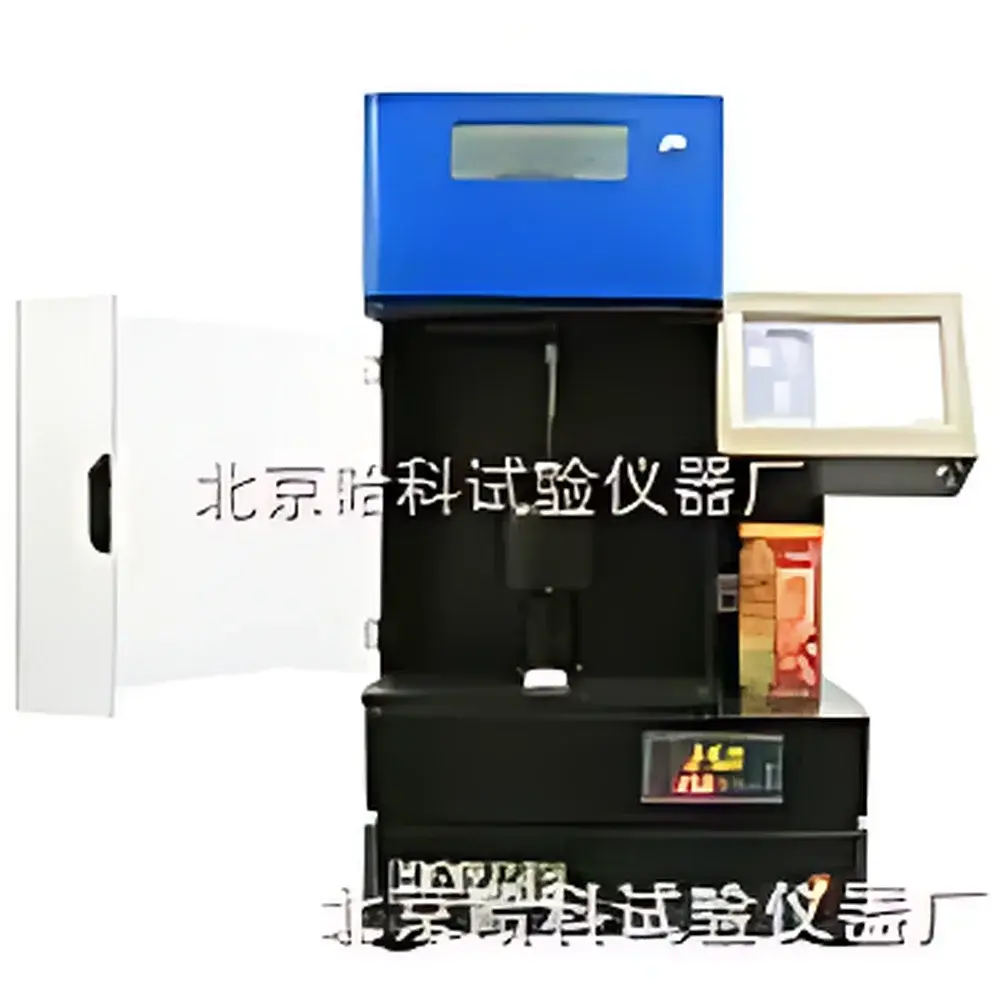
HARKE SFT-A4 Advanced Wilhelmy Plate Surface Tensiometer
| Brand | HARKE |
|---|---|
| Model | SFT-A4 |
| Measurement Range | 0–1000 mN/m |
| Resolution | 0.01 mN/m |
| Accuracy | ±0.01 mN/m |
| Temperature Readout Range | 0–95 °C |
| Temperature Resolution | 0.01 °C |
| Primary Method | Wilhelmy Plate (Platinum Plate) |
| Data Acquisition Rate | Up to 23 Hz |
| Vertical Stage Travel | 0–50 mm |
| Stage Repeatability | ±0.5 µm |
| Display | 7-inch color Wince-based touchscreen interface |
| Connectivity | USB 2.0 for data export and PC control |
| Power Supply | 220 V AC, 3 A |
| Dimensions (L×W×H) | 330 × 350 × 580 mm |
| Weight | 20 kg |
Overview
The HARKE SFT-A4 is a benchtop surface tensiometer engineered for high-precision interfacial property characterization in research laboratories, quality control environments, and industrial R&D settings. It operates on the fundamental principle of the Wilhelmy plate method—a gravimetric technique in which the vertical force exerted on a vertically immersed platinum plate is measured as it contacts or withdraws from a liquid surface. This force, directly proportional to the surface tension (γ), is captured via a high-resolution microbalance system with real-time compensation for buoyancy, meniscus weight, and plate geometry. The instrument also supports the du Noüy ring method and wetting perimeter analysis, enabling dual-mode validation and cross-method correlation per ISO 1409 and ASTM D971 standards. Designed for reproducibility under variable thermal conditions, the SFT-A4 integrates a calibrated Pt100 temperature sensor with software-synchronized readout—ensuring thermodynamic consistency across measurements.
Key Features
- High-stability platinum plate sensor with certified dimensional tolerances and surface roughness < 0.05 µm for consistent wetting behavior
- Dual-mode measurement capability: Wilhelmy plate (primary) and du Noüy ring (secondary), both compliant with ISO 6295 and DIN 53914
- Motorized Z-axis stage with precision lead screw drive, offering 0–50 mm travel, ±0.5 µm repeatability, and programmable velocity profiles for controlled immersion/emersion cycles
- Integrated 7-inch capacitive touchscreen running a deterministic WinCE-based OS—enabling standalone operation without external PC dependency
- Real-time data acquisition at up to 23 readings per second, with automatic zeroing, dynamic baseline correction, and adaptive noise filtering
- USB 2.0 interface for direct data export to USB storage devices; optional Ethernet or RS-232 modules available for networked lab integration
- Thermal monitoring subsystem with Pt100 probe, 0.01 °C resolution, and independent digital display synchronized with measurement timestamps
Sample Compatibility & Compliance
The SFT-A4 accommodates aqueous solutions, organic solvents, polymer melts, surfactant formulations, emulsions, and low-viscosity oils. Its open-sample chamber design permits easy insertion of custom sample holders, temperature-controlled Peltier cells (optional), or environmental enclosures for humidity control. All measurement protocols adhere to internationally recognized metrological frameworks: surface tension values are traceable to NIST-certified reference liquids (e.g., water at 20 °C = 72.75 mN/m), and calibration routines follow GLP-compliant documentation templates. The system supports audit-ready data integrity through timestamped metadata logging—including operator ID, ambient temperature/humidity, calibration history, and method parameters—aligning with FDA 21 CFR Part 11 requirements when used with validated software configurations.
Software & Data Management
The proprietary HARKE Tensiometry Suite (v4.x) provides full control over experimental workflows. It implements three standardized test methods: (1) dynamic Wilhelmy plate analysis with automatic meniscus detection via electronic edge-sensing algorithms; (2) static ring detachment with peak-force identification and correction for inner/outer ring circumference; and (3) contact angle-independent wetting perimeter quantification for heterogeneous surfaces. All acquired data are displayed in real time as force vs. position curves, with overlayable derivative plots (dF/dz) for critical point identification. Results are stored in an embedded SQL database with searchable metadata fields. Export formats include CSV, TXT, and Origin-compatible OPJ files. Optional software modules enable statistical process control (SPC) charting, trend analysis across batches, and automated report generation compliant with ISO/IEC 17025 laboratory accreditation criteria.
Applications
This tensiometer serves diverse application domains requiring quantitative interfacial characterization: formulation development of detergents, agrochemical adjuvants, and pharmaceutical emulsions; evaluation of coating wettability and substrate compatibility in printed electronics; monitoring of surfactant depletion kinetics in enhanced oil recovery studies; quality assurance of silicone fluids and fluorosurfactants; and fundamental research into Langmuir monolayers and nanoparticle-laden interfaces. Its robust mechanical architecture and thermal stability make it suitable for long-duration equilibrium measurements (e.g., adsorption isotherms) as well as rapid dynamic assessments (e.g., surfactant diffusion kinetics).
FAQ
What standards does the SFT-A4 comply with for surface tension measurement?
It conforms to ISO 1409, ASTM D971, ISO 6295, and DIN 53914 for Wilhelmy plate and du Noüy ring methodologies.
Can the instrument perform temperature-controlled experiments?
Yes—the built-in Pt100 sensor enables real-time thermal monitoring; for active temperature regulation, external Peltier stages or water-jacketed sample holders can be integrated via third-party controllers.
Is method validation supported out-of-the-box?
The system includes preloaded reference calibrations using standard liquids (water, ethanol, diiodomethane) and supports user-defined validation protocols with pass/fail thresholds and deviation reporting.
How is data integrity ensured during regulatory audits?
All measurements embed immutable metadata (time, operator, method, calibration ID); optional software licensing enables electronic signatures, audit trails, and 21 CFR Part 11-compliant user access controls.
What maintenance is required for the platinum plate sensor?
Routine cleaning with piranha solution or hot chromic acid is recommended after testing aggressive surfactants; HARKE supplies certified cleaning kits and dimensional verification templates to maintain metrological validity.



