
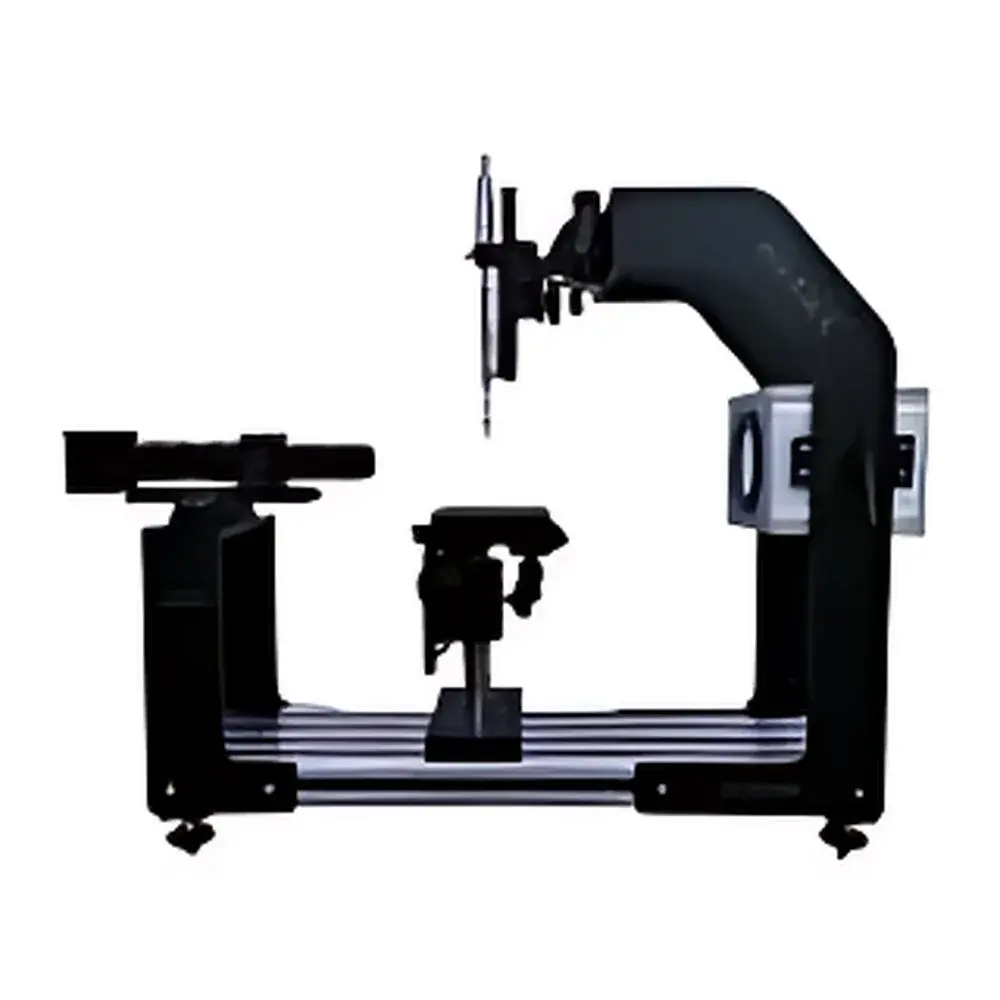
HARKE SPCA-1 Advanced Contact Angle Goniometer
| Brand | HARKE |
|---|---|
| Origin | Beijing, China |
| Manufacturer Type | Direct Manufacturer |
| Instrument Category | Domestic |
| Model | HARKE-SPCA-1 |
| Instrument Type | Benchtop Laboratory System |
| Contact Angle Measurement Range | 0–180° |
| Contact Angle Measurement Accuracy | ±0.1° |
| Contact Angle Display Resolution | 0.01° |
| Sample Stage Dimensions | 400 mm × 400 mm |
| Optical Magnification | 0.7×–4.5× |
| Surface/Interfacial Tension Measurement Range | 0–1000 mN/m |
| Surface/Interfacial Tension Measurement Accuracy | ±0.01 mN/m |
| Imaging System | USB 2.0 High-Speed Camera (30 fps standard |
| Lens | ZF-180 Precision Stepping Zoom Lens with 120 mm Vertical Travel |
| Software | HARKE-SPCA v1.0 |
| Surface Energy Analysis Method | Equation of State (EOS), Circle, Ellipse, and Small-Drop Fitting Algorithms |
| Power Supply | 220 V / 3 A / 50 Hz |
| Operating Temperature | Ambient |
| Weight | ~30 kg |
| Dimensions (W × D × H) | 260 mm × 700 mm × — mm (height not specified) |
Overview
The HARKE SPCA-1 Advanced Contact Angle Goniometer is a precision benchtop instrument engineered for quantitative analysis of solid–liquid–gas interfacial phenomena using sessile drop, pendant drop, and tilting plate methodologies. It operates on the principle of high-resolution shape image analysis—capturing and algorithmically fitting the contour of liquid droplets or hanging menisci against calibrated optical geometry—to determine contact angle, surface free energy, interfacial tension, and dynamic wetting behavior. Designed for rigorous laboratory environments, the system delivers traceable, reproducible measurements compliant with ASTM D7334 (Standard Practice for Surface Wettability of Polymer Coatings), ISO 19403 (Contact Angle Measurement by Optical Methods), and relevant sections of USP (Analytical Instrument Qualification). Its modular architecture supports both static and time-resolved characterization, enabling researchers to quantify wettability evolution during absorption, evaporation, or chemical modification processes.
Key Features
- Benchtop-integrated optical platform with ZF-180 stepping zoom lens (0.7×–4.5× magnification) and 120 mm vertical focus travel for precise focal plane alignment across diverse sample topographies.
- High-fidelity imaging subsystem: USB 2.0 camera operating at 30 fps (standard), with optional upgrade paths to 100, 300, or 1000 fps for transient droplet dynamics and rapid spreading kinetics.
- Large-format motorized sample stage (400 mm × 400 mm) accommodating oversized substrates, flexible films, or multi-position arrays—compatible with optional electric tilt stage (±90°) and Peltier-based heating module (up to 120°C).
- HARKE-SPCA v1.0 software suite featuring automated baseline detection, multi-algorithm droplet contour fitting (circle, ellipse, Young–Laplace, and polynomial), real-time contact angle vs. time plotting, and statistical reporting per ISO/IEC 17025 requirements.
- Comprehensive surface energy quantification via the Equation of State (EOS) method, supported by polar/dispersive component decomposition using Owens–Wendt, Wu, or van Oss–Chaudhury–Good models.
- Integrated pendant drop analysis for interfacial tension determination (0–1000 mN/m) with sub-mN/m resolution, applicable to surfactant solutions, polymer melts, and biofluids.
Sample Compatibility & Compliance
The SPCA-1 accommodates flat, curved, porous, fibrous, powdered, and ultra-hydrophobic/hydrophilic surfaces—including functionalized silicon wafers, coated glass, electrospun membranes, and medical-grade polymers. Sample mounting is tool-free and adjustable via three-point leveling. All measurement protocols align with GLP/GMP documentation standards: software enforces user authentication, audit trails, electronic signatures, and data integrity controls in accordance with FDA 21 CFR Part 11 when configured with validated software modules. Calibration verification is performed using certified reference goniometer slides (e.g., NIST-traceable 30°, 60°, 90°, and 120° standards) and standardized surfactant solutions (e.g., SDS, Triton X-100).
Software & Data Management
HARKE-SPCA v1.0 provides a deterministic, scriptable interface for repeatable experimental workflows. Raw image sequences, fitted contours, numerical outputs (θ_adv, θ_rec, Δθ, γ_sv, γ_lv, W_adh), and metadata are stored in structured HDF5 files with embedded timestamps, operator IDs, and instrument configuration logs. Batch processing enables parallel analysis of multi-sample datasets. Export options include CSV, PDF reports (with customizable templates), and direct integration into LIMS or ELN systems via RESTful API. Version-controlled software updates maintain backward compatibility and support periodic requalification per ISO/IEC 17025 Clause 5.9.
Applications
- Quality control of plasma-treated or corona-modified polymer films in flexible electronics manufacturing.
- Characterization of anti-fouling coatings on biomedical devices using advancing/receding contact angle hysteresis and surface energy mapping.
- Optimization of inkjet printhead nozzle wetting behavior via dynamic contact angle analysis under controlled humidity.
- Quantitative assessment of cleaning efficacy on semiconductor wafers through adhesion work (W_adh) and surface heterogeneity indices.
- Time-resolved study of water absorption in hydrogels and cellulose-based packaging materials.
- Determination of interfacial tension gradients in microemulsion formulation development for pharmaceutical delivery systems.
FAQ
What calibration standards are recommended for routine verification?
NIST-traceable goniometer calibration slides (30°, 60°, 90°, 120°) and certified surfactant reference solutions (e.g., 0.1 mM SDS in deionized water, γ = 72.0 ± 0.2 mN/m at 23°C) are advised for daily performance checks.
Is the software compliant with FDA 21 CFR Part 11 for regulated environments?
Yes—when deployed with validated installation qualification (IQ), operational qualification (OQ), and electronic signature modules, HARKE-SPCA v1.0 supports full Part 11 compliance including audit trail generation, role-based access control, and data immutability.
Can the system measure contact angles on rough or textured surfaces?
Yes—using advanced edge-detection algorithms and local baseline correction, the software accommodates topographical variations up to ±50 µm RMS roughness without requiring mechanical leveling.
What is the minimum detectable contact angle resolution?
The system displays contact angles to 0.01°, with measurement uncertainty of ±0.1° under ISO 19403-2 conditions (ambient temperature stability ±0.5°C, vibration isolation, and proper lighting uniformity).
Are third-party surface energy models supported?
The software natively implements EOS, Owens–Wendt, Wu, and van Oss–Chaudhury–Good models; custom model integration is available via Python API extension upon request.



