
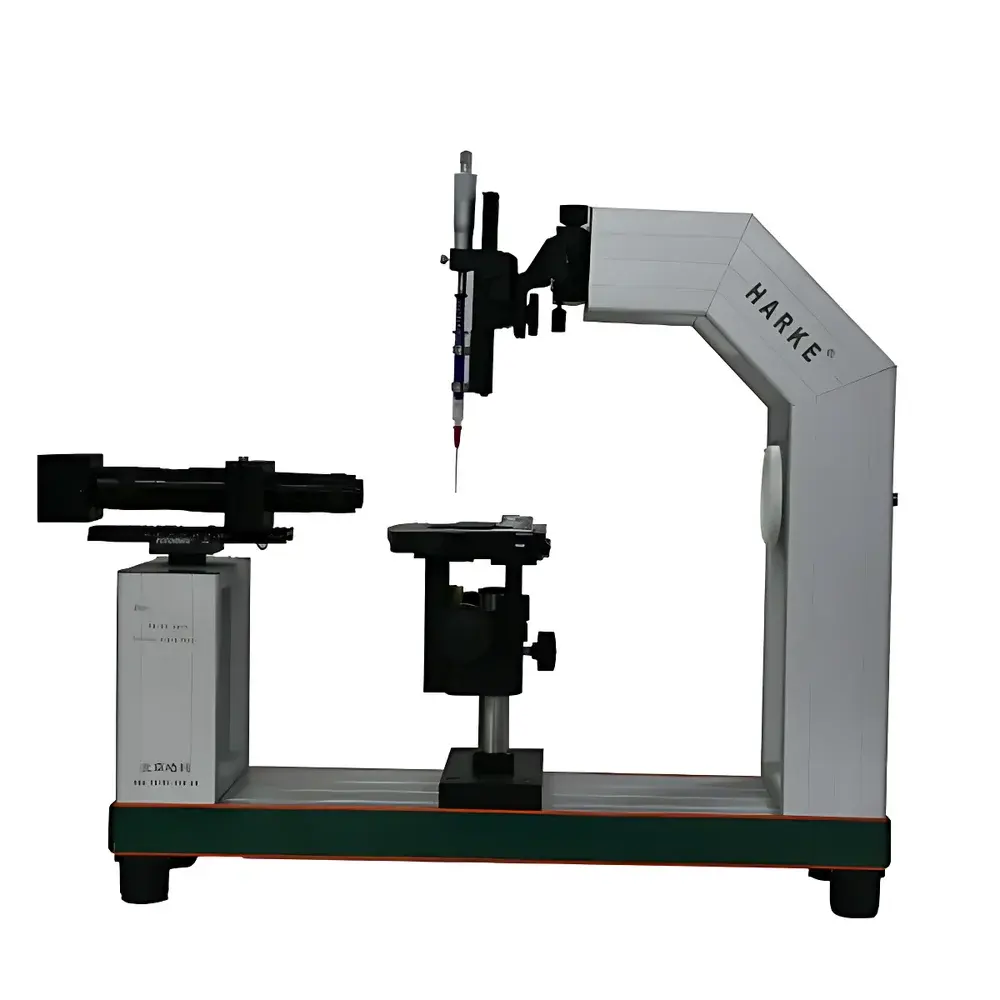
HARKE SPCA Advanced Optical Contact Angle Analyzer
| Brand | HARKE |
|---|---|
| Model | SPCA |
| Type | Benchtop Dynamic Contact Angle Measurement System |
| Measurement Principle | Optical Imaging (Drop Shape Analysis) |
| Contact Angle Range | 0–180° |
| Contact Angle Accuracy | ±0.1° |
| Contact Angle Resolution | 0.01° |
| Sample Stage Dimensions | 100 mm × 200 mm |
| Optical Magnification | 0.7×–4.5× (ZF-180 Precision Stepping Zoom Lens) |
| Camera | USB 2.0 High-Speed CMOS, 30 fps standard (optional: 100/300/1000+ fps) |
| Surface Tension Range (Pendant Drop Method) | 0–1000 mN/m |
| Surface Energy Calculation Methods | EOS, Circle, Ellipse, Young-Laplace Fitting, SCA |
| Software | HARKE-SPCA v1.0 with Audit Trail & Data Export (CSV, PNG, AVI) |
| Power Supply | 220 V / 3 A / 50 Hz |
| Weight | ~30 kg |
| Footprint | 260 mm × 700 mm |
| Vertical Lens Travel | 120 mm |
| Operating Environment | Ambient Temperature, Non-Condensing |
Overview
The HARKE SPCA Advanced Optical Contact Angle Analyzer is a precision benchtop instrument engineered for quantitative characterization of solid–liquid–gas interfacial behavior using drop shape analysis (DSA). It operates on the fundamental principle of optical imaging and geometric contour fitting to determine the contact angle θ — defined as the angle formed between the tangent to the liquid–vapor interface and the solid surface at the three-phase contact line. This parameter serves as a direct thermodynamic indicator of wettability, surface energy heterogeneity, and interfacial adhesion strength. The system supports static, advancing, receding, and dynamic contact angle measurements — critical for evaluating time-dependent wetting kinetics, hysteresis, and surface reorganization under controlled dispensing conditions. Designed for rigorous laboratory use, the SPCA integrates high-stability mechanical architecture, calibrated optical path geometry, and traceable image acquisition protocols to ensure measurement reproducibility across operators and sessions.
Key Features
- High-resolution optical train featuring the ZF-180 stepping zoom lens (0.7×–4.5× magnification), enabling precise focus control and consistent pixel-to-angle calibration across sample topographies.
- Motorized vertical lens translation (120 mm travel) with repeatable positioning accuracy, facilitating rapid adjustment for samples of varying thickness or roughness without manual realignment.
- Dual-mode dispensing unit compatible with syringe-based sessile drop, captive bubble, and dynamic Wilhelmy plate configurations — supporting both contact angle and surface/interfacial tension determination (0–1000 mN/m via pendant/sessile drop methods).
- USB 2.0 CMOS video capture system (30 fps baseline; optional ultra-high-speed variants up to 1000+ fps) synchronized with software-triggered dispensing for capturing transient wetting events such as droplet impact, spreading, or absorption.
- Modular sample stage (100 mm × 200 mm) with fine-adjustment X/Y translation and tilt compensation, accommodating substrates from silicon wafers to porous membranes and textured industrial coatings.
- Firmware-embedded calibration routines compliant with ISO 19403-2 (contact angle) and ISO 1409 (surface tension), with built-in reference standards for routine verification.
Sample Compatibility & Compliance
The SPCA accommodates rigid and flexible substrates up to 25 mm in thickness, including metals, polymers, ceramics, textiles, thin films, and biological membranes. Its open-stage design permits integration of environmental chambers (temperature/humidity control), electrochemical cells, or gas purging modules for in situ interfacial studies. All measurement algorithms adhere to internationally recognized standards: contact angle calculations follow ISO 19403-2:2017 (optical methods), surface tension analysis conforms to ISO 1409:2016 (pendant drop), and surface energy derivation implements the Owens–Wendt–Rabel–Kaelble (OWRK) and Equation of State (EOS) models per ASTM D7490 and ISO 15989. Data integrity is maintained through software-enforced audit trails, user access levels, and timestamped export logs — supporting GLP/GMP-aligned workflows and FDA 21 CFR Part 11 readiness when deployed with validated IT infrastructure.
Software & Data Management
HARKE-SPCA v1.0 software provides a unified interface for acquisition, real-time analysis, and report generation. Core functions include automated droplet contour detection (edge-enhanced Canny + active contour refinement), multi-point contact angle mapping, hysteresis loop construction, and time-resolved θ(t) curve fitting. Surface energy modules compute dispersive and polar components using multiple theoretical frameworks (e.g., Wu harmonic mean, van Oss–Chaudhury–Good). All raw images, processed data, and metadata are stored in structured project files with embedded calibration history. Export options include CSV (numerical series), PNG (annotated snapshots), AVI (time-lapse video), and XML (machine-readable results). The software supports batch processing of multi-sample datasets and integrates with LIMS via configurable API endpoints.
Applications
The SPCA is routinely deployed in quality control and R&D environments for: evaluating plasma, corona, or chemical surface treatments on polymer films and medical devices; quantifying hydrophobicity/hydrophilicity of filtration membranes and biosensor substrates; assessing inkjet printability and coating uniformity in display manufacturing; characterizing anti-fouling performance of marine coatings; validating cleaning efficacy in semiconductor wafer processing; and investigating moisture uptake kinetics in pharmaceutical tablet excipients. Its versatility extends to academic research in colloid science, soft matter physics, and biomaterials — where interfacial thermodynamics govern adsorption, capillary imbibition, and self-assembly phenomena.
FAQ
What contact angle measurement methods does the SPCA support?
Sessile drop, captive bubble, tilting plate (advancing/receding), and dynamic dispensing protocols — all implemented via software-controlled syringe actuation and frame-synchronized imaging.
Can the system measure surface energy of unknown solids?
Yes — using contact angle data from at least two probe liquids (e.g., water and diiodomethane), the software computes total surface energy and its polar/dispersive components via OWRK, Fowkes, or EOS models.
Is the software compliant with regulatory data integrity requirements?
HARKE-SPCA v1.0 includes electronic signatures, audit trail logging, and immutable result archiving — meeting foundational criteria for 21 CFR Part 11 when operated within a validated computing environment.
What is the minimum resolvable contact angle increment?
The system displays contact angles with 0.01° resolution and achieves ±0.1° measurement accuracy under ISO 19403-2 test conditions using certified reference surfaces.
Does the instrument support high-speed wetting dynamics?
Standard configuration captures at 30 fps; optional high-speed camera modules enable frame rates of 100, 300, or 1000+ fps for resolving millisecond-scale spreading or recoil events.



