
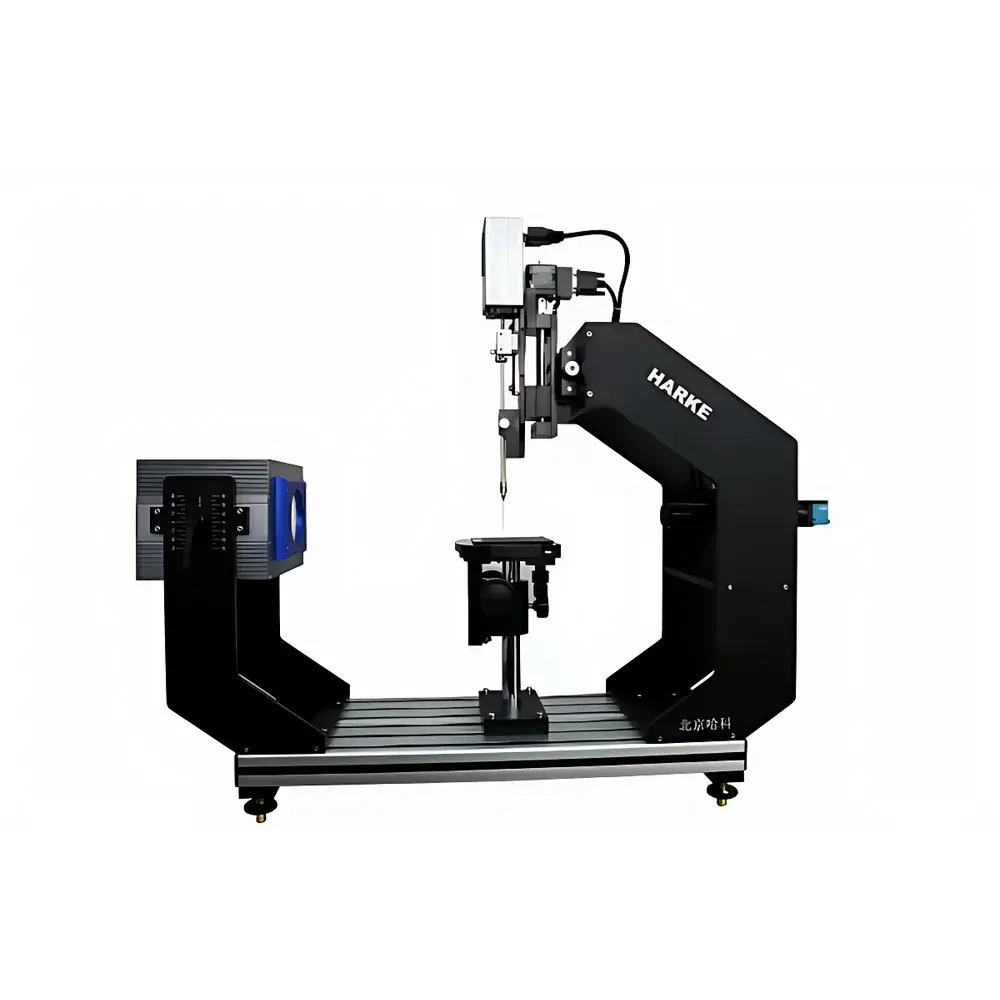
HARKE SPCA Fully Automated Contact Angle Goniometer
| Brand | HARKE |
|---|---|
| Origin | Beijing, China |
| Manufacturer Type | Direct Manufacturer |
| Instrument Category | Domestic |
| Model | HARKE-SPCA |
| Instrument Type | Benchtop Laboratory System |
| Contact Angle Measurement Range | 0–180° |
| Contact Angle Measurement Accuracy | ±0.1° |
| Contact Angle Display Resolution | 0.01° |
| Sample Stage Dimensions | 400 mm × 400 mm |
| Optical Magnification | 0.7×–4.5× |
| Surface/Interfacial Tension Measurement Method | Pendant Drop |
| Surface/Interfacial Tension Range | 0–100 mN/m |
| Surface/Interfacial Tension Accuracy | 0.01 mN/m |
| Imaging System | ZF-180 High-Resolution Stepping Zoom Lens + USB 2.0 Camera (30 fps standard |
| Software | HARKE-SPCA v1.0 |
| Surface Energy Analysis Method | Equation of State (EOS), Circle Fit, Ellipse Fit, Small-Drop Method |
| Power Supply | 220 V / 3 A / 50 Hz |
| Weight | ~30 kg |
| Footprint | 260 mm × 700 mm |
| Lens Vertical Travel | 120 mm |
| Operating Environment | Ambient Temperature |
Overview
The HARKE SPCA Fully Automated Contact Angle Goniometer is an optically based, benchtop surface characterization system engineered for precision measurement of contact angle, surface free energy, interfacial tension, and dynamic wetting behavior at solid–liquid–vapor interfaces. It operates on the principle of high-resolution digital image capture and contour-based geometric analysis of sessile, pendant, or captive droplets. By combining motorized stage control, programmable dispensing, real-time video acquisition, and advanced edge-detection algorithms, the instrument delivers repeatable, operator-independent measurements compliant with ASTM D7334, ISO 19403-2, and ISO 15989 standards. Designed for rigorous laboratory environments, the SPCA platform supports both static and dynamic interfacial property evaluation—including advancing/receding angles, roll-off (sliding) angles, contact angle hysteresis, and time-resolved wetting kinetics—without manual intervention.
Key Features
- Fully automated workflow: Motorized XYZ sample stage, auto-focus lens positioning, and programmable liquid dispensing enable unattended multi-point or time-series measurements.
- High-fidelity optical train: ZF-180 stepping zoom lens (0.7×–4.5× magnification) paired with a USB 2.0 camera (standard 30 fps; upgradeable to 1000 fps for rapid dynamic events).
- Sub-degree angular resolution: Contact angle display resolution of 0.01° with measurement accuracy of ±0.1° across the full 0–180° range.
- Large-format sample handling: 400 mm × 400 mm adjustable stage accommodates oversized substrates, wafers, coated glass panels, or irregularly shaped components.
- Multi-method surface energy analysis: Implements the Equation of State (EOS), Circle Fit, Ellipse Fit, and Small-Drop methods to decompose surface energy into polar and dispersive components per van Oss–Chaudhury–Good theory.
- Comprehensive interfacial tension quantification: Pendant drop analysis for surface/interfacial tension (0–100 mN/m, resolution 0.01 mN/m), including polarity/dispersion fraction estimation.
- Robust mechanical architecture: Precision-machined aluminum frame, anti-vibration base design, and calibrated linear actuators ensure long-term stability and positional repeatability.
Sample Compatibility & Compliance
The SPCA goniometer accommodates flat, curved, porous, fibrous, powdered, and heterogeneous surfaces—including hydrophobic/hydrophilic polymers, functionalized silicon wafers, medical device coatings, textile fibers, and pharmaceutical tablet films. Its modular design permits integration of optional accessories: tilting stage for sliding angle determination, environmental chamber for controlled humidity/temperature testing, and micro-syringe pump for continuous dosing in absorption studies. All measurement protocols align with GLP documentation requirements, and software audit trails—including user login, parameter changes, raw image timestamps, and result exports—support FDA 21 CFR Part 11 compliance when configured with electronic signature modules. Calibration verification follows traceable procedures using certified reference standards (e.g., NIST-traceable goniometric calibration slides).
Software & Data Management
HARKE-SPCA v1.0 software provides an intuitive Windows-based interface with dual-mode operation: guided wizard mode for routine QC tasks and expert mode for custom protocol development. Image processing includes adaptive thresholding, noise suppression, and spline-based droplet contour fitting. Data output supports CSV, XLSX, and XML formats; time-series curves (θ vs. t) are exportable with metadata tags. The software embeds ISO 19403-compliant surface energy calculation engines and allows batch processing of >100 images with automated report generation. Raw video files (AVI) and annotated measurement snapshots are stored with embedded EXIF metadata, enabling retrospective reanalysis without loss of original acquisition parameters.
Applications
The SPCA system serves as a core analytical tool in R&D and quality assurance laboratories across multiple sectors. In semiconductor manufacturing, it verifies uniformity of photoresist hydrophobicity and cleaning efficacy post-etch. In biomedical device development, it quantifies protein adsorption propensity via surface energy mapping of catheter or stent coatings. For packaging R&D, it evaluates corona treatment effectiveness on polyolefin films by tracking dynamic contact angle decay. In inkjet printing formulation, it correlates surfactant concentration with droplet spreading dynamics and coffee-ring formation. In battery electrode research, it characterizes slurry wettability on current collectors under inert atmosphere (with optional glovebox integration). Additional applications include adhesion promoter screening, self-cleaning surface validation, and forensic analysis of contaminant residue patterns.
FAQ
What droplet deposition methods does the SPCA support?
Sessile drop (static and dynamic), pendant drop, captive bubble, and tilting-stage roll-off configurations—all accessible via software-selectable modules.
Can the system measure contact angles on rough or textured surfaces?
Yes; advanced edge-detection algorithms and multi-frame averaging mitigate noise from topographical scattering, while the 400 × 400 mm stage enables precise positioning over localized features.
Is surface energy calculation included in the base software?
Yes; EOS, circle, ellipse, and small-drop models are embedded, with built-in databases of common probe liquids (water, diiodomethane, ethylene glycol) and customizable user-defined liquids.
Does the instrument comply with regulatory data integrity requirements?
When deployed with validated software configuration and enabled audit trail logging, it meets ALCOA+ principles and supports 21 CFR Part 11 compliance through role-based access control and electronic signature options.
What is the minimum droplet volume resolvable for accurate contact angle analysis?
With optimal lighting and contrast, reliable analysis is achievable down to ~0.5 µL using the 4.5× magnification setting and high-sensitivity camera option.
Related Products



