
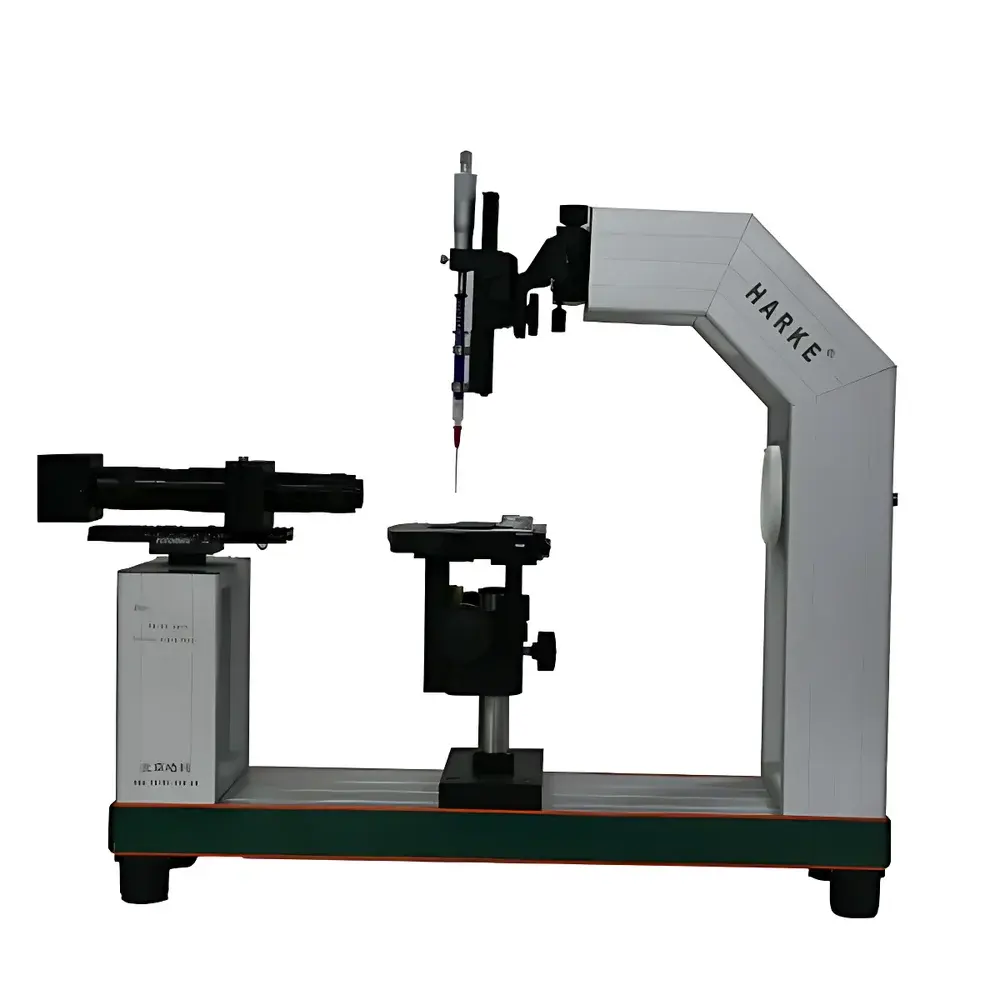
HARKE SPCA Video-Based Optical Contact Angle Analyzer
| Brand | HARKE |
|---|---|
| Origin | Beijing, China |
| Manufacturer Type | Direct Manufacturer |
| Product Category | Domestic |
| Model | HARKE–SPCA |
| Instrument Type | Benchtop Laboratory System |
| Contact Angle Measurement Range | 0–180° |
| Contact Angle Accuracy | ±0.5° |
| Fixed Sample Stage Dimensions | 100 mm × 120 mm |
| Optical Magnification | 0.7×–4.5× |
| Surface/Interfacial Tension Range | 0–1000 mN/m |
| Surface/Interfacial Tension Resolution | 0.01 mN/m |
| Frame Dimensions (L×W×H) | 1200 mm × 600 mm × 670 mm |
| Net Weight | 30 kg |
| Sample Stage Travel (X–Y–Z) | Auto Y-axis (160 mm, 0.01 mm resolution), Manual Z-axis (20 mm, 0.01 mm), Auto Syringe Positioning (±60 mm vertical, ±30 mm horizontal) |
| Lens Adjustment | ±30 mm axial travel with fine-tuning (±3 mm) |
| Camera | High-speed industrial CMOS sensor, 60 fps |
| Lens | Telecentric continuous zoom microscope |
| Illumination | Adjustable monochromatic blue LED cold light source (25,000 h lifetime) |
| Power Supply | 220 V / 60 Hz |
Overview
The HARKE SPCA Video-Based Optical Contact Angle Analyzer is a precision benchtop instrument engineered for quantitative characterization of solid–liquid–gas interfacial phenomena using the sessile drop method and dynamic drop shape analysis. It operates on the principle of high-resolution optical imaging combined with advanced edge-detection algorithms to determine contact angle (θ) at the three-phase boundary—defined as the angle formed between the tangent to the liquid–vapor interface and the solid surface. This measurement serves as a fundamental metric for evaluating wettability, surface energy heterogeneity, and interfacial thermodynamics. The system employs a telecentric zoom microscope coupled with a high-frame-rate industrial CMOS camera and a stable, spectrally controlled LED backlighting system to ensure geometric fidelity and minimal distortion across the full magnification range (0.7×–4.5×). Designed for laboratory-grade reproducibility, the HARKE SPCA supports static, advancing/receding, and dynamic contact angle measurements—including roll-off angle, sliding velocity, and time-resolved spreading kinetics—enabling rigorous assessment of surface functionalization, cleaning efficacy, coating uniformity, and material aging.
Key Features
- Benchtop modular architecture constructed from aerospace-grade aluminum alloy, ensuring mechanical stability and long-term dimensional integrity under thermal and vibrational load.
- Motorized Y-axis translation stage (160 mm travel, 0.01 mm repeatability) and programmable syringe positioning system (±60 mm vertical, ±30 mm horizontal) for automated, repeatable droplet placement and multi-point surface mapping.
- Manually adjustable Z-stage (20 mm travel, 0.01 mm resolution) and extendable support arm accommodate samples up to 50 mm in thickness, expanding compatibility beyond standard flat substrates.
- Telecentric continuous-zoom optical path eliminates perspective error and maintains constant magnification across working distance—critical for accurate contact angle calculation independent of droplet height or focus drift.
- Monochromatic blue LED illumination (peak ~450 nm) provides high-contrast silhouette imaging with negligible thermal loading, enabling extended acquisition without sample heating or evaporation artifacts.
- Integrated software platform supports ASTM D7334–22 (Standard Practice for Surface Wettability Assessment), ISO 19403–2 (Contact angle measurement by optical methods), and GLP-compliant data logging with full audit trail and electronic signature capability per FDA 21 CFR Part 11 requirements.
Sample Compatibility & Compliance
The HARKE SPCA accommodates rigid and semi-rigid planar specimens up to 100 mm × 120 mm on its fixed stage, with optional auxiliary fixtures supporting curved, textured, or porous substrates—including glass slides, polymer films, metal foils, ceramic wafers, and biomedical membranes. Its open-stage design allows direct integration with environmental chambers (humidity, temperature, gas atmosphere) for in situ interfacial studies. All measurement protocols align with internationally recognized standards: contact angle determinations conform to ISO 19403–1 through –4 series; surface free energy calculations follow Owens–Wendt–Rabel–Kaelble (OWRK) and Wu harmonic mean models; interfacial tension quantification adheres to the pendant/sessile drop method per ASTM D971 and ISO 1409. Data export formats include CSV, PDF, and XML, facilitating traceability in regulated environments (e.g., ISO 17025-accredited labs, pharmaceutical QC/QA workflows).
Software & Data Management
The proprietary HARKE Analysis Suite delivers a validated, intuitive interface for real-time image capture, automatic contour fitting (ellipse, Young–Laplace, polynomial), and multi-parameter export. Each session generates a timestamped project file containing raw images, metadata (camera settings, stage coordinates, ambient conditions), and processed results—including contact angle histograms, hysteresis plots, surface energy component breakdowns (dispersive, polar, acidic/basic), and CMC titration curves. Version-controlled reports support revision history, user-defined templates, and role-based access control. Raw data and analysis logs are stored in encrypted SQLite databases compliant with ALCOA+ principles (Attributable, Legible, Contemporaneous, Original, Accurate, Complete, Consistent, Enduring, Available). Export modules integrate directly with LIMS platforms and support automated report generation via RESTful API.
Applications
- Quantitative evaluation of plasma treatment, corona discharge, UV-ozone exposure, and chemical grafting on polymer surfaces.
- Quality control of hydrophobic/hydrophilic coatings in medical devices, microfluidic chips, and optical lenses.
- Characterization of inkjet printability, adhesive bonding strength, and anti-fouling behavior in packaging materials.
- Determination of critical micelle concentration (CMC) and adsorption isotherms for surfactant formulations used in detergents, agrochemicals, and biopharmaceutical processing.
- Stability analysis of emulsions and foams via interfacial rheology proxies—such as dilatational modulus derived from oscillating drop experiments.
- Correlation of surface energy anisotropy with macroscopic performance metrics (e.g., water repellency index, ice adhesion force, dust shedding efficiency).
- High-throughput screening of surface modification parameters during R&D process optimization.
FAQ
What calibration procedures are required before first use?
The system includes factory-calibrated reference standards (contact angle validation slides with certified θ = 60° ± 2° and 110° ± 2°) and pixel-size calibration targets. Daily verification is recommended using distilled water (theoretical θ ≈ 0° on clean glass) and diiodomethane (θ ≈ 55° on PTFE).
Can the HARKE SPCA measure dynamic contact angles on moving substrates?
Yes—the motorized Y-stage enables synchronized translation of the sample relative to the droplet, allowing controlled advancement/recession cycles and sliding angle determination at defined velocities (0.1–5 mm/s).
Is the software compatible with Windows 10/11 and networked lab environments?
The Analysis Suite runs natively on 64-bit Windows 10/11 (minimum 8 GB RAM, i5 processor). Network deployment supports concurrent licensing, centralized database hosting, and remote desktop monitoring via secure VPN tunnels.
Does the instrument meet regulatory requirements for GMP or ISO 13485 manufacturing environments?
Full IQ/OQ documentation packages are available upon request. The system supports 21 CFR Part 11 compliance via configurable electronic signatures, audit trail review, and data integrity safeguards aligned with Annex 11 and ICH GCP guidelines.
How is interfacial tension calculated from captured drop profiles?
The software applies axisymmetric drop shape analysis (ADSA) based on numerical solution of the Young–Laplace equation, incorporating density difference, gravitational acceleration, and pixel-to-length scaling to compute interfacial tension with <0.1% relative uncertainty for liquids within 1–1000 mN/m range.
Related Products



