
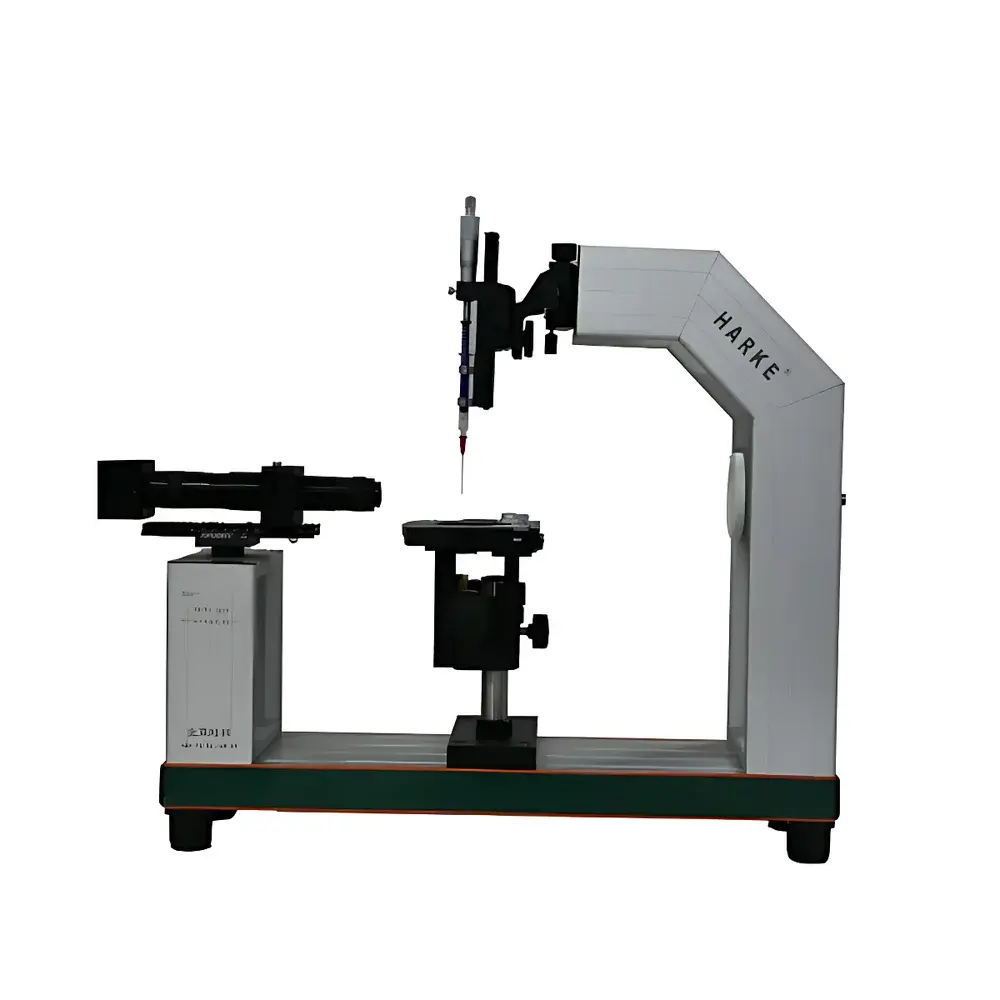
HARKE SPCA Video-Based Optical Contact Angle Meter
| Brand | HARKE |
|---|---|
| Model | SPCA |
| Type | Benchtop Video Optical Contact Angle Meter |
| Contact Angle Range | 0–180° |
| Contact Angle Accuracy | ±0.1° |
| Contact Angle Display Resolution | ±0.01° |
| Surface/Interfacial Tension Range | 0–1000 mN/m |
| Surface/Interfacial Tension Accuracy | ±0.01 mN/m |
| Sample Stage Dimensions | 100 mm × 120 mm |
| Optical System | ZF-180 High-Resolution Parfocal Zoom Lens |
| Video Capture Rate | 30 fps (optional: 100/300/1000+ fps) |
| Lens Vertical Travel | 120 mm |
| Instrument Dimensions | 260 mm × 700 mm × — mm (height not specified) |
| Weight | ~30 kg |
| Power Supply | 220 V / 3 A / 50 Hz |
| Operating Temperature | Ambient |
| Surface Energy Method | Equation of State (EOS) |
| Supported Analysis Methods | Circle, Ellipse, Young-Laplace Fitting, Sessile Drop, Captive Bubble, Immersion, Tilting Plate, Squeeze/Expansion, Rolling Drop, Dynamic Contact Angle |
| Software | HARKE-SPCA v1.0 |
| Compliance | GB/T 24368–2009 (Glass Surface Hydrophobic Contaminant Detection by Contact Angle Measurement) |
| Optional Accessories | Electrically Heated Stage, Motorized Tilt Platform |
Overview
The HARKE SPCA is a benchtop video-based optical contact angle meter engineered for high-precision quantification of interfacial wettability and surface energetics in research and quality control laboratories. It operates on the principle of sessile drop analysis—capturing high-resolution side-view images of liquid droplets dispensed onto solid substrates—and applying advanced image processing algorithms to determine contact angle via geometric fitting (circle, ellipse, or Young–Laplace contour models). Complementing static measurements, the system supports dynamic contact angle evaluation—including advancing/receding angles, roll-off behavior, and time-resolved wetting kinetics—enabling characterization of heterogeneous, anisotropic, or viscoelastic surfaces. Its dual-capability design integrates contact angle measurement with surface and interfacial tension determination using the pendant drop method, making it suitable for colloid and interface science, polymer film development, packaging material qualification, and functional coating R&D.
Key Features
- Benchtop architecture with rigid aluminum frame and precision-machined optical rail, ensuring mechanical stability during long-term imaging and thermal drift minimization.
- ZF-180 parfocal zoom lens system with calibrated magnification range, optimized for sub-pixel edge detection and consistent focus across variable working distances (lens travel: 120 mm).
- USB 2.0 high-sensitivity monochrome camera operating at 30 fps standard (upgradeable to 100/300/1000+ fps), synchronized with software-triggered syringe dispensing for repeatable droplet deposition.
- HARKE-SPCA v1.0 software platform featuring real-time droplet profile tracking, multi-method contact angle fitting (including EOS-based surface energy decomposition), and automated batch analysis for statistical reproducibility.
- Manually adjustable XYZ sample stage (100 mm × 120 mm active area) with fine-pitch micrometer controls; optional motorized tilt platform enables dynamic contact angle acquisition per ASTM D7334 and ISO 15989 protocols.
- Integrated surface/interfacial tension calculation via pendant drop shape analysis based on the Young–Laplace equation, validated against reference standards across 0–1000 mN/m range.
Sample Compatibility & Compliance
The SPCA accommodates diverse sample geometries—including rigid plates (glass, metal, silicon wafers), flexible films (PET, PE, PVDC), porous media (paper, nonwovens, filter membranes), single fibers, powders (via compressed pellets), and carbon-based substrates—without requiring vacuum or conductive coating. Its modular design permits integration of environmental modules (e.g., heated stage up to 120 °C) for temperature-dependent wettability studies. The instrument conforms to GB/T 24368–2009 for hydrophobic contaminant assessment on glass surfaces and supports method validation under GLP-compliant workflows. While not FDA 21 CFR Part 11–certified out-of-the-box, audit trails, user access logs, and electronic signature readiness can be implemented via custom software configuration aligned with ISO/IEC 17025 and USP analytical instrument qualification guidelines.
Software & Data Management
HARKE-SPCA v1.0 provides native support for raw image export (TIFF/AVI), annotated measurement reports (PDF/Excel), and metadata embedding (operator ID, timestamp, environmental notes). All contact angle and surface tension values are traceable to individual frames, with full parameter logging—including droplet volume, baseline correction mode, and fitting residuals—for retrospective analysis. The software implements EOS (Equation of State) theory for polar/apolar surface energy component derivation using contact angle data from at least two probe liquids (e.g., water, diiodomethane, ethylene glycol). Data integrity safeguards include automatic file versioning, password-protected method templates, and configurable report headers compliant with internal SOPs. Export formats are compatible with LIMS integration and third-party statistical packages (e.g., JMP, OriginLab).
Applications
- Characterization of hydrophobic/hydrophilic coatings on medical devices and implantable polymers per ISO 10993–4 biocompatibility screening protocols.
- Quality assurance of barrier films used in food and pharmaceutical packaging, including corona-treated PE, SiOx-coated PET, and ALD-deposited oxide layers.
- Surface energy mapping of additive-manufactured parts to correlate print parameters with post-processing adhesion performance.
- Dynamic wettability analysis of electrowetting-on-dielectric (EWOD) substrates for lab-on-chip microfluidic device development.
- Interfacial tension profiling of surfactant formulations at oil–water interfaces relevant to enhanced oil recovery and agrochemical emulsion stability.
- Time-resolved contact angle hysteresis assessment for self-cleaning and anti-fouling surface optimization (e.g., TiO2, fluorinated silanes).
FAQ
What measurement methods does the HARKE SPCA support?
It supports sessile drop, captive bubble, immersion, tilting plate, rolling drop, squeeze/expand, and dynamic contact angle (advancing/receding) methods, plus pendant drop for surface/interfacial tension.
Is the system compatible with non-planar or curved samples?
Yes—within the depth-of-field limits of the ZF-180 lens and stage height adjustment range; convex/concave substrates may require custom sample holders and localized baseline definition.
Can surface energy components be calculated without purchasing additional software modules?
Yes—the EOS method is fully embedded in HARKE-SPCA v1.0 and requires only contact angle data from ≥2 standard probe liquids.
Does the instrument meet international regulatory requirements for GMP environments?
Out-of-the-box, it supports audit-ready data handling; full 21 CFR Part 11 compliance requires documented configuration control, electronic signature implementation, and periodic revalidation per site-specific QMS.
What is the minimum detectable contact angle resolution?
The system displays contact angle to ±0.01°, with measurement accuracy certified at ±0.1° under ISO 27448–2 calibration conditions using NIST-traceable reference surfaces.



