
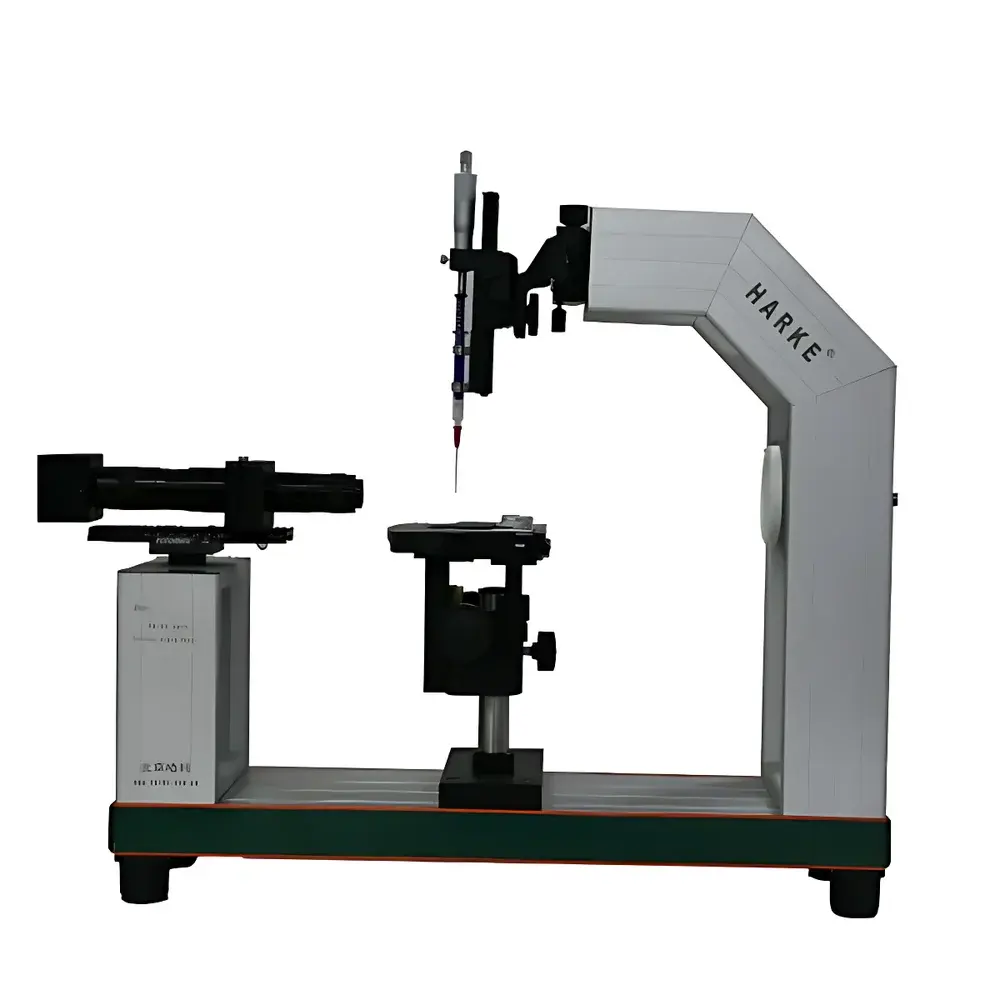
HARKE SPCA Video-Based Optical Contact Angle Meter
| Brand | HARKE |
|---|---|
| Origin | Beijing, China |
| Manufacturer Type | Direct Manufacturer |
| Instrument Type | Benchtop Laboratory System |
| Contact Angle Measurement Range | 0–180° |
| Contact Angle Accuracy | ±0.1° |
| Contact Angle Resolution | ±0.01° |
| Sample Stage Dimensions | 100 mm × 120 mm |
| Optical Zoom Magnification | 0.7×–5× |
| Surface/Interfacial Tension Range | 0–1000 mN/m |
| Surface/Interfacial Tension Accuracy | ±0.01 mN/m |
| Imaging Frame Rate | Up to 1000 fps (standard: 30 fps via USB 2.0) |
| Lens Travel | 120 mm |
| Dimensions (W×D×H) | 260 mm × 700 mm × — mm |
| Weight | ~30 kg |
| Software | HARKE-SPCA v1.0 |
| Power Supply | 220 V / 3 A / 50 Hz |
| Operating Temperature | Ambient |
| Surface Energy Method | Equation of State (EOS) |
| Analysis Algorithms | Circle Fitting, Ellipse Fitting, Sessile Drop Profile Fitting |
| Optional Modules | Peltier-based Heating Stage, Motorized Tilt Platform |
Overview
The HARKE SPCA is a benchtop video-based optical contact angle meter engineered for precise, reproducible quantification of solid–liquid interfacial behavior. It operates on the principle of sessile drop analysis using high-resolution digital imaging and advanced edge-detection algorithms. By capturing the silhouette of a liquid droplet deposited on a solid substrate under controlled ambient conditions, the instrument calculates contact angle values through geometric fitting of the droplet profile—enabling direct assessment of wettability, surface heterogeneity, and interfacial thermodynamics. Designed for routine quality control and advanced research in materials science, coatings, pharmaceuticals, and microfluidics, the SPCA integrates a motorized precision dispensing system, adjustable optical path, and modular hardware architecture to support both static and dynamic contact angle measurements—including advancing/receding angles, roll-off analysis, and time-resolved wetting kinetics.
Key Features
- Benchtop design with compact footprint (260 mm × 700 mm), optimized for standard laboratory workspaces and ISO-classified cleanrooms.
- High-fidelity optical train featuring ZF-180 fixed-position zoom lens (0.7×–5× magnification) and USB 2.0 camera capable of up to 1000 fps acquisition—enabling high-speed capture of rapid wetting events or droplet oscillation dynamics.
- Precision mechanical stage (100 mm × 120 mm) with ±0.1° angular accuracy and sub-microliter manual dosing capability for consistent droplet volume control.
- Integrated HARKE-SPCA v1.0 software suite supporting multiple analytical models: circle fit, ellipse fit, and Young–Laplace-based profile fitting for non-spherical droplets—critical for low-contact-angle or high-viscosity systems.
- Comprehensive interfacial property quantification: contact angle (0–180°, ±0.1° accuracy), surface/interfacial tension (0–1000 mN/m, ±0.01 mN/m) via pendant drop method, and solid surface energy calculation using the Equation of State (EOS) approach.
- Modular expansion readiness: native compatibility with optional Peltier-controlled heating stage (±0.1°C stability) and motorized tilt platform (0–180° programmable inclination) for dynamic wettability mapping and critical surface tension (CST) determination.
Sample Compatibility & Compliance
The HARKE SPCA accommodates flat, rigid, or flexible planar substrates up to 120 mm in width and 10 mm in thickness—including polymers, metals, ceramics, thin films, textiles, and functionalized membranes. Its open-stage architecture permits integration with environmental chambers (humidity, gas atmosphere) and custom sample holders for in situ testing. The system adheres to foundational metrological standards referenced in ASTM D7334 (Standard Practice for Surface Wettability Assessment), ISO 19403-2 (Contact Angle Measurement – Static Methods), and supports GLP-compliant documentation workflows when paired with audit-trail-enabled software configurations. While not pre-certified to FDA 21 CFR Part 11, its data export structure (CSV, PNG, XML) enables traceable integration into validated LIMS or electronic lab notebook (ELN) platforms.
Software & Data Management
HARKE-SPCA v1.0 provides intuitive graphical interface with real-time image preview, multi-point calibration tools, and batch processing for repetitive measurement sequences. All raw images, processed profiles, and numerical outputs are timestamped and stored with full metadata (camera settings, lens position, ambient temperature). Export formats include CSV (for statistical analysis in MATLAB or JMP), PNG/TIFF (publication-ready figures), and XML (machine-readable structured data). Software supports user-defined report templates compliant with internal SOPs; optional upgrade paths include automated pass/fail logic based on configurable tolerance bands and CSV-to-Excel pivot reporting for QC dashboards.
Applications
- Surface treatment validation (plasma, corona, flame, silanization) across automotive, medical device, and packaging industries.
- Coating formulation development—correlating contact angle hysteresis with pigment dispersion stability and binder migration.
- Pharmaceutical tablet film coating uniformity assessment and dissolution rate prediction.
- Microfluidic channel surface functionalization verification prior to assay deployment.
- Hydrophobic/hydrophilic barrier performance evaluation in filtration membranes and breathable fabrics.
- Fundamental research in colloid and interface science, including surfactant adsorption kinetics and nanomaterial wettability tuning.
FAQ
What measurement methods does the HARKE SPCA support?
It supports static sessile drop, dynamic advancing/receding angle, pendant drop (for surface/interfacial tension), and tilting plate methods—when equipped with the optional motorized tilt platform.
Is the system compatible with non-aqueous or volatile solvents?
Yes—provided appropriate ventilation and containment (e.g., enclosed chamber or fume hood integration) is implemented per institutional EHS guidelines.
Can the software generate GMP-compliant reports?
While the base software does not include 21 CFR Part 11 features (e.g., electronic signatures, audit trails), its structured data export enables integration into validated third-party ELN or LIMS systems that fulfill regulatory reporting requirements.
What is the minimum droplet volume resolvable?
With manual syringe control and high-magnification optics, reliable measurements can be obtained from droplets as small as 0.5 µL—subject to surface roughness and liquid volatility constraints.
Does the instrument require external calibration standards?
No routine calibration is required beyond initial lens alignment and stage leveling; however, certified contact angle reference slides (e.g., PTFE, silicon wafer) are recommended for periodic verification of angular accuracy.



