
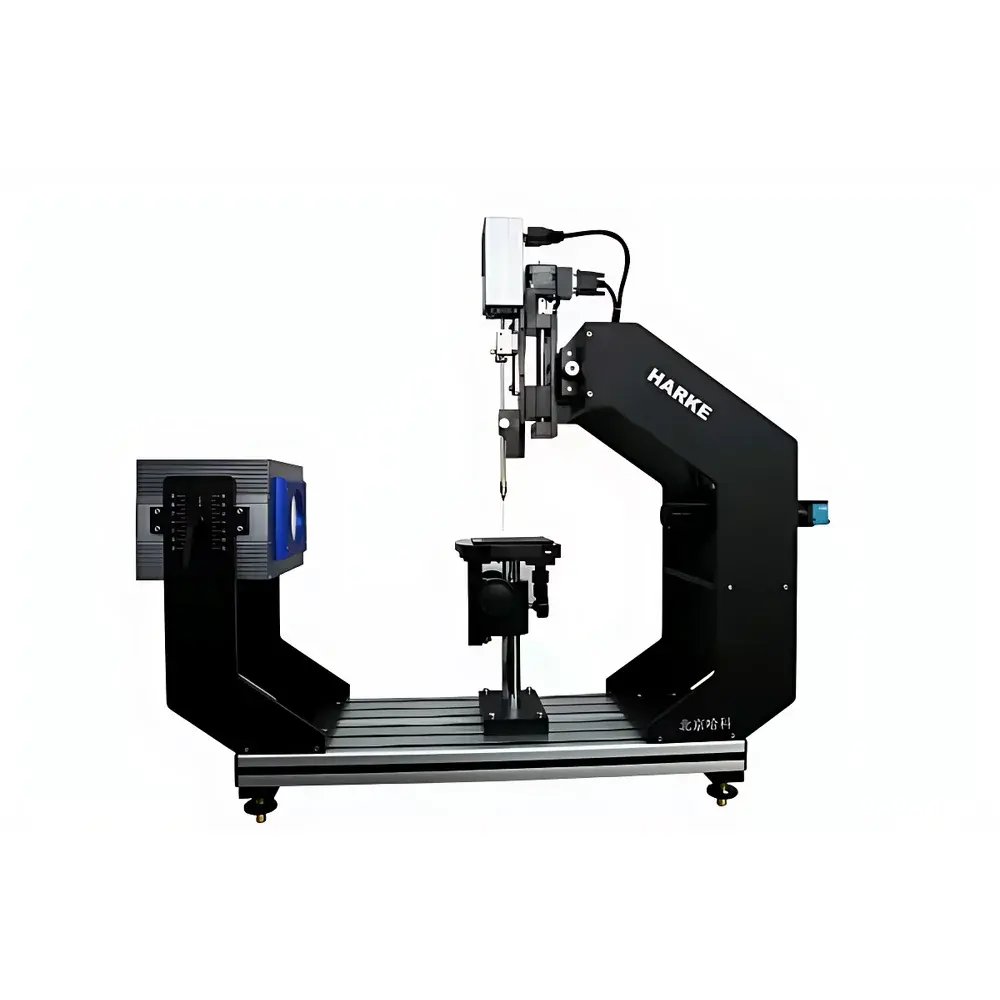
HARKE SPCA-X1 Advanced Dynamic Contact Angle Analyzer
| Brand | HARKE |
|---|---|
| Model | SPCA-X1 |
| Type | Benchtop Dynamic Contact Angle & Surface Tension Analyzer |
| Origin | Beijing, China |
| Manufacturer | HARKE Instrument Co., Ltd. |
| Contact Angle Range | 0–180° |
| Contact Angle Accuracy | ±0.1° |
| Contact Angle Resolution | ±0.01° |
| Stage Dimensions | 100 mm × 120 mm |
| Optical Zoom | 0.7×–5× Fixed-Position Zoom Lens |
| Video Capture | USB 3.0 Camera, Software-Controlled Frame Rates (40 fps standard |
| Surface/Interfacial Tension Range | 0–1000 mN/m |
| Surface/Interfacial Tension Accuracy | ±0.01 mN/m |
| Lens Vertical Travel | 30 mm |
| Syringe Stage Travel | 30 mm |
| Positioning Accuracy (X-axis) | ±0.1 mm |
| Dimensions (W×D×H) | 300 mm × 760 mm × — mm |
| Weight | 30 kg |
| Power Supply | 220 V, 3 A, 50 Hz |
| Operating Temperature | Ambient |
| Measurement Methods | Circle, Ellipse, Height-Width, Young-Laplace Fitting, SCA (Sessile Drop Curve Analysis), and 5 additional algorithmic approaches (total 8) |
| Software | SPCA 1.0 |
| Compliance | Designed for GLP-compliant workflows |
Overview
The HARKE SPCA-X1 Advanced Dynamic Contact Angle Analyzer is a precision-engineered benchtop instrument designed for quantitative characterization of solid–liquid interfacial phenomena. It operates on the principle of high-resolution sessile and pendant drop imaging combined with real-time geometric and physical modeling algorithms to determine dynamic contact angles—specifically advancing, receding, and sliding angles—as well as surface and interfacial tension values. The system employs a calibrated optical train with motorized zoom optics and a high-speed USB 3.0 camera capable of frame rates up to 1000 fps, enabling robust capture of rapid wetting/dewetting transitions. Its modular architecture supports both static and dynamic measurement protocols, including tilting-stage-based roll-off analysis and cyclic expansion–contraction methods, making it suitable for R&D labs focused on coatings, biomaterials, microfluidics, and functional surfaces where hysteresis and energy dissipation behavior are critical performance indicators.
Key Features
- Benchtop design with compact footprint (300 mm × 760 mm) optimized for standard laboratory workbenches and fume hood integration.
- Motorized 0.7×–5× fixed-position zoom lens delivering consistent magnification steps and minimal optical distortion across the full field of view.
- High-precision XYZ stage: X-axis automated translation (±0.1 mm repeatability) enables sequential multi-point contact angle mapping across heterogeneous surfaces.
- Dual-mode dispensing system with programmable syringe actuation for controlled droplet deposition and dynamic volume modulation during expansion–contraction cycles.
- Eight built-in analytical algorithms—including circle, ellipse, height-width, Young–Laplace curve fitting, and SCA-based contour analysis—each selectable based on droplet morphology and substrate roughness.
- Real-time video acquisition at 40 fps (standard), with optional hardware upgrades supporting 100, 300, or 1000 fps for transient interfacial kinetics studies.
- Integrated environmental shielding (optional enclosure) minimizes air currents and thermal drift, enhancing measurement reproducibility in ambient conditions.
Sample Compatibility & Compliance
The SPCA-X1 accommodates flat, rigid samples up to 100 mm × 120 mm in dimension and ≤25 mm in thickness. Compatible substrates include polymers, metals, ceramics, thin films, textiles (mounted on rigid carriers), and biological membranes (on glass slides). All measurements conform to ASTM D7334–22 (“Standard Practice for Surface Wettability of Materials by Contact Angle Measurements”) and ISO 19403-2:2017 (“Paints and varnishes — Determination of contact angle — Part 2: Static contact angle”). When operated with SPCA 1.0 software under configured user access controls and electronic signature settings, the system supports documentation traceability aligned with GLP and GMP quality systems. Audit trail logging, data integrity safeguards, and electronic record retention comply with FDA 21 CFR Part 11 expectations when deployed within a validated laboratory IT environment.
Software & Data Management
SPCA 1.0 is a Windows-based analytical platform engineered for scientific rigor and regulatory readiness. It provides synchronized control of camera acquisition, stage movement, syringe pump timing, and tilt-stage actuation (when integrated). Key capabilities include: automated droplet detection and baseline correction; time-resolved contact angle vs. volume or time plots; hysteresis loop generation; surface free energy calculation using Owens–Wendt, Wu, or van Oss–Chaudhury–Good models; and interfacial tension derivation via pendant drop analysis. Raw image sequences, metadata (timestamp, environmental conditions, operator ID), and processed results are stored in vendor-neutral HDF5 format, ensuring long-term accessibility and third-party interoperability. Export options include CSV, PDF reports, and PNG/TIFF image sequences compatible with MATLAB®, Python (OpenCV), and ImageJ workflows.
Applications
- Quantification of hydrophobicity/hydrophilicity gradients in plasma-treated or UV-irradiated polymer films.
- Dynamic wettability assessment of porous filtration membranes under controlled flow-induced droplet deformation.
- Surface energy mapping of inkjet-printed electrode patterns for printed electronics reliability testing.
- Stability evaluation of Pickering emulsions via interfacial tension tracking during aging or temperature ramping.
- Correlation of contact angle hysteresis with adhesion performance in pressure-sensitive adhesive formulations.
- Characterization of self-cleaning behavior in nanostructured superhydrophobic coatings using sliding angle and roll-off velocity metrics.
FAQ
What dynamic contact angle methods does the SPCA-X1 support?
The instrument supports tilt-based roll-off (advancing/receding/sliding angles), liquid volume cycling (expansion–contraction), and automated sequential deposition for spatial hysteresis profiling.
Can the system measure interfacial tension between two immiscible liquids?
Yes—using the pendant drop method, it quantifies interfacial tension across liquid–liquid systems within the 0–1000 mN/m range.
Is the software compliant with FDA 21 CFR Part 11?
SPCA 1.0 includes configurable electronic signatures, audit trail logging, and role-based access control; formal compliance requires site-specific validation per Part 11 Annex A guidelines.
What sample preparation is required?
Samples must be clean, dry, and mechanically stable; no coating or conductive treatment is needed unless specified for electrostatic mitigation in high-speed imaging.
Does the system support temperature-controlled measurements?
The base configuration operates at ambient temperature; optional Peltier stage or environmental chamber integration is available for isothermal or gradient studies.
Related Products



