
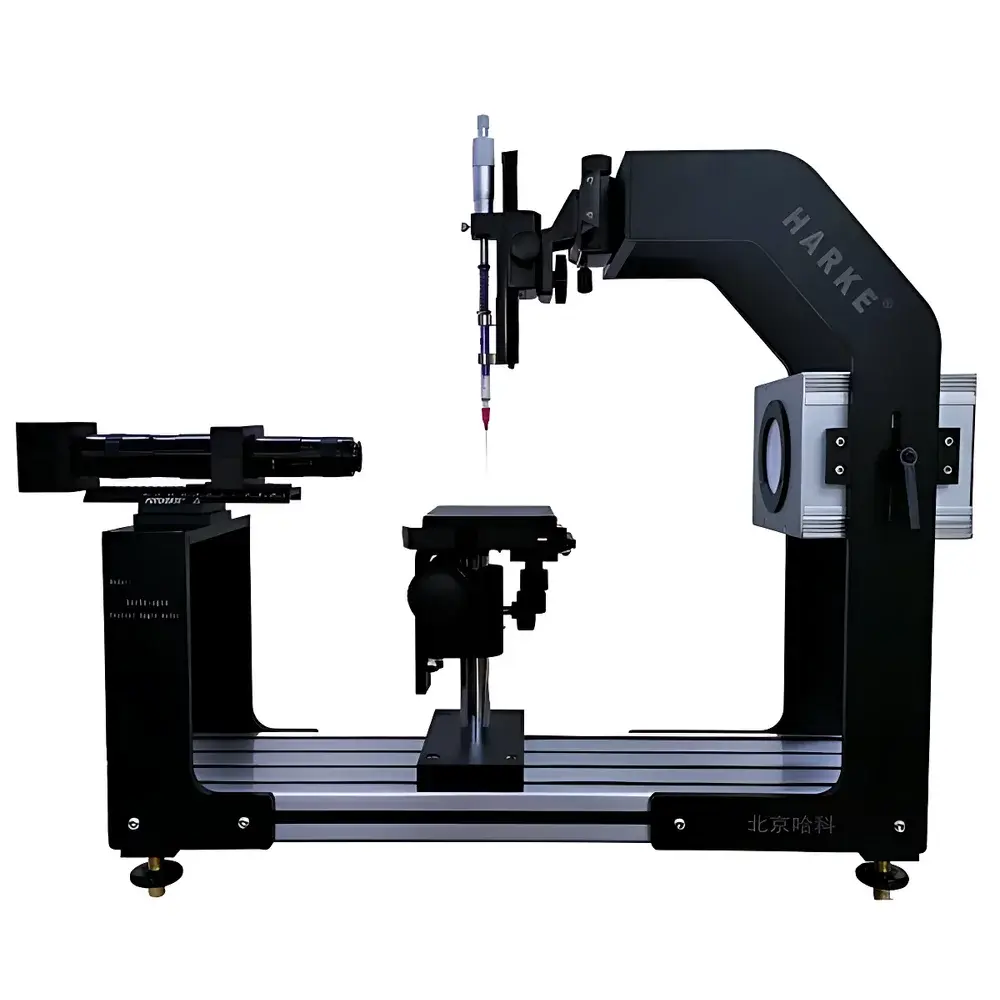
HARKE SPCA-X2 Video-Based Optical Contact Angle Analyzer
| Brand | HARKE |
|---|---|
| Origin | Beijing, China |
| Manufacturer Type | Direct Manufacturer |
| Product Category | Domestic |
| Model | SPCA-X2 |
| Instrument Type | Benchtop Laboratory System |
| Contact Angle Measurement Range | 0–180° |
| Contact Angle Measurement Accuracy | ±0.1° |
| Sample Stage Dimensions | 100 mm × 120 mm |
| Optical Magnification | 0.7×–5× (Stepped Zoom Lens) |
| Surface/Interfacial Tension Measurement Range | 0–1000 mN/m |
| Surface/Interfacial Tension Resolution | 0.01 mN/m (for values ≤100 mN/m) |
| Imaging System | USB 3.0 High-Speed Camera (Standard: 40 fps |
| Optional | 100/300/1000+ fps) |
| Software | SPCA 1.0 |
| Measurement Methods | Circle Fitting, Ellipse Fitting, Height-Width Method, and 5 Additional Algorithms (Total: 8) |
| Automated Functions | Auto-Drop Dispensing, Auto-Baseline Detection, Real-Time Drop Recognition, Delayed Capture, XY Motorized Stage Control (Dual-Axis), Video Recording & Frame-by-Frame Playback |
| Optional Modules | Dynamic Contact Angle (Advancing/Receding via Sessile Drop Expansion/Contraction or Tilting Method), Solid Surface Free Energy Calculation (Owens-Wendt, Wu, van Oss-Chaudhury-Good), Interfacial Tension (Pendant Drop Method) |
| Power Supply | 220 V AC, 3 A, 50 Hz |
| Net Weight | 30 kg |
| Footprint | 300 mm × 760 mm |
| Vertical Lens Travel | 30 mm |
| Syringe Translation Precision | ±0.1 mm |
Overview
The HARKE SPCA-X2 is a benchtop video-based optical contact angle analyzer engineered for high-reproducibility interfacial characterization of advanced composite materials, coatings, fibers, and functional surfaces. It operates on the principle of sessile drop analysis—capturing high-resolution side-view images of liquid droplets deposited on solid substrates—and quantifying contact angle through pixel-level geometric fitting algorithms. Designed specifically for R&D laboratories and QC environments handling heterogeneous, anisotropic, or low-energy composite systems (e.g., carbon-fiber-reinforced polymers, glass-fiber laminates, bio-based composites), the system integrates precision optics, motorized fluidics, and deterministic image processing to resolve subtle wettability gradients, hysteresis behavior, and time-dependent spreading dynamics. Its modular architecture supports both static and dynamic interfacial measurements in compliance with ASTM D7334 (surface energy of polymer films), ISO 19403-2 (contact angle determination), and ISO 14210 (interfacial tension via pendant drop), enabling traceable, auditable data generation suitable for GLP/GMP-aligned workflows.
Key Features
- High-stability optical train featuring a stepped magnification lens (0.7×–5×) with parfocal alignment—ensures consistent focus across zoom levels without recalibration.
- USB 3.0 industrial camera capable of up to 1000 fps (optional), synchronized with software-triggered dispensing for capturing rapid wetting transitions in thermoset resins or nanocomposite prepregs.
- Motorized syringe pump with ±0.1 mm positional repeatability and programmable dispensing volume (0.1–10 µL increments), supporting automated sequential deposition for multi-point surface heterogeneity mapping.
- SPCA 1.0 software platform implementing eight validated contact angle calculation methods—including circle, ellipse, and height-width fitting—as well as automated baseline detection robust against substrate texture or edge scattering.
- Dual-axis motorized stage (X/Y) with 100 mm × 120 mm travel range, enabling precise positioning of large-format composite panels or multi-region sampling without manual re-alignment.
- Integrated video recording with frame-accurate timestamping and playback scrubbing—critical for identifying metastable states during solvent evaporation or resin infiltration in porous composites.
- Export-ready data output in CSV, XML, and PDF formats, including full metadata (timestamp, environmental conditions, operator ID, instrument calibration status) for 21 CFR Part 11–compliant documentation.
Sample Compatibility & Compliance
The SPCA-X2 accommodates rigid and semi-rigid composite specimens up to 25 mm in thickness, including cured laminates, woven fabric preforms, injection-molded parts, and fiber-metal hybrids. Its open-stage design permits direct placement of oversized samples (e.g., aerospace-grade panels) with minimal clamping interference. All measurement protocols adhere to internationally recognized standards: contact angle determinations follow ISO 19403-2 and ASTM D7334; surface free energy calculations implement Owens-Wendt, Wu, and van Oss-Chaudhury-Good models per ISO 14210 Annex B; pendant drop interfacial tension measurements conform to ISO 14210-3. Calibration verification is supported via NIST-traceable reference liquids (e.g., ultrapure water, diiodomethane, ethylene glycol), and audit trails—including user actions, parameter changes, and raw image archives—are retained for regulatory review.
Software & Data Management
SPCA 1.0 is a Windows-native application built on a modular architecture that separates acquisition, analysis, and reporting layers. It supports role-based access control (administrator, technician, reviewer), electronic signatures, and immutable audit logs compliant with FDA 21 CFR Part 11 requirements. Raw image sequences are stored in lossless TIFF format with embedded EXIF metadata (exposure time, gain, lens position, ambient temperature). Batch processing enables parallel analysis of ≥50 droplets across multiple samples, with statistical summarization (mean, SD, CV%) automatically generated per test series. Export modules generate ISO/IEC 17025–compatible reports containing instrument identification, calibration certificates, uncertainty budgets (per GUM guidelines), and annotated screenshots—ready for inclusion in technical dossiers or quality agreements.
Applications
- Quantifying surface energy heterogeneity across carbon-fiber epoxy laminates to predict adhesive bond strength and delamination resistance.
- Evaluating plasma or corona treatment efficacy on polymeric matrix surfaces prior to coating or bonding operations.
- Characterizing time-resolved wettability evolution during resin infusion in vacuum-assisted resin transfer molding (VARTM) processes.
- Assessing hydrophobicity retention of flame-retardant textile composites after accelerated weathering cycles.
- Determining interfacial tension between bio-based resins and natural fiber reinforcements to optimize compatibility and dispersion stability.
- Validating cleaning efficacy on machined composite tooling surfaces using contact angle hysteresis as a proxy for residual contamination.
FAQ
What sample thickness can the SPCA-X2 accommodate?
The standard stage accepts specimens up to 25 mm thick; optional elevated stage kits extend this to 50 mm for thick-section composites.
Is the system compatible with non-aqueous test liquids such as solvents or resins?
Yes—chemical-resistant PTFE-coated syringes and stainless-steel needles are available for use with acetone, DMF, epoxy monomers, and other aggressive media.
Can the SPCA-X2 perform contact angle measurements under controlled humidity or temperature?
While ambient operation is standard, optional environmental chambers (±1 °C, 10–90% RH) integrate seamlessly with the stage and optical path for climate-controlled testing.
How is measurement traceability ensured for regulatory submissions?
Each measurement session logs calibration certificate IDs, operator credentials, and hardware firmware versions; raw images and processed data are archived with SHA-256 hash verification for integrity auditing.
Does the software support custom scripting or API integration?
SPCA 1.0 provides a COM interface for programmatic control via Python, MATLAB, or LabVIEW—enabling automated test sequences within larger manufacturing execution systems (MES) or LIMS environments.



