
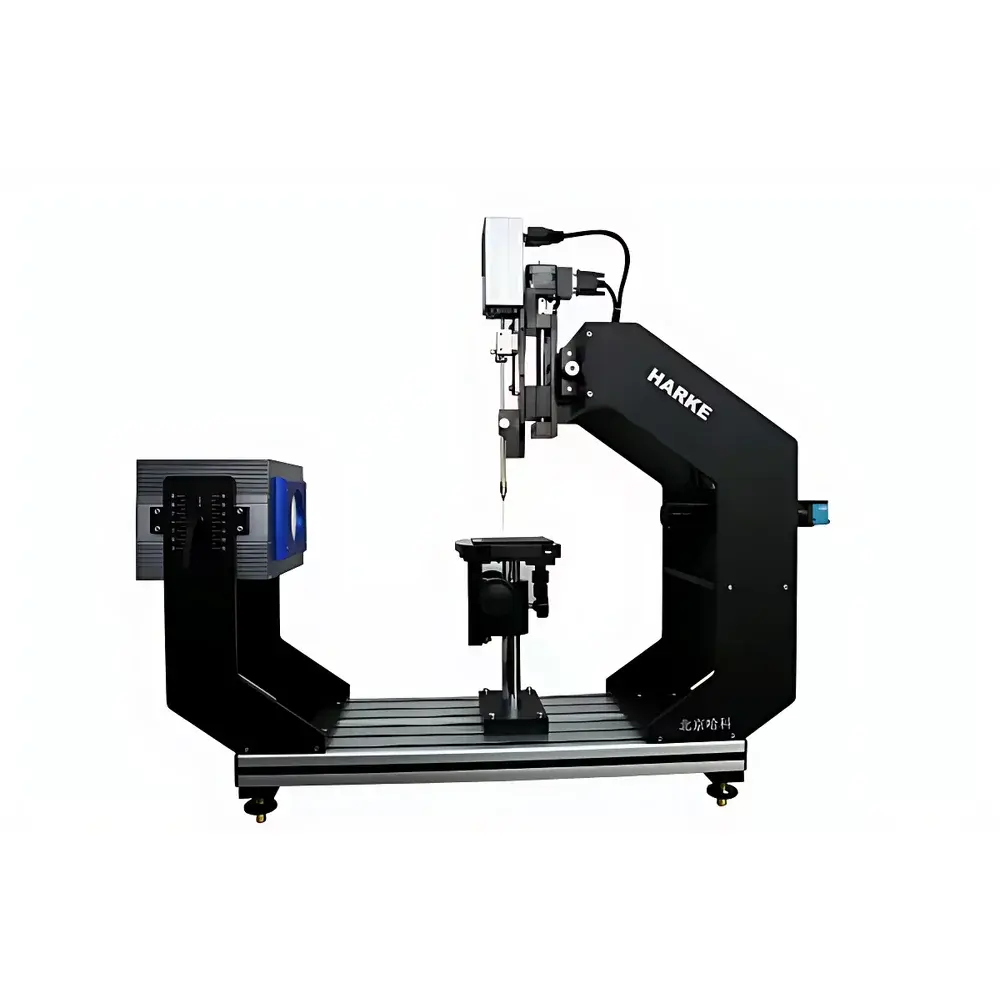
HARKE SPCA-X2 Video-Based Optical Contact Angle Meter
| Brand | HARKE |
|---|---|
| Origin | Beijing, China |
| Manufacturer Type | Direct Manufacturer |
| Instrument Type | Benchtop Laboratory System |
| Contact Angle Measurement Range | 0–180° |
| Contact Angle Accuracy | ±0.1° |
| Sample Stage Dimensions | 100 mm × 120 mm |
| Optical Magnification | 0.7×–5× (Stepped Zoom Lens) |
| Surface/Interfacial Tension Range | 0–1000 mN/m |
| Surface/Interfacial Tension Resolution | 0.01–2000 mN/m |
| Imaging Frame Rate | Up to 1000 fps (USB 3.0 Camera, Software-Controlled) |
| Measurement Methods | Circle Fitting, Ellipse Fitting, Height-Width Method, and Six Additional Algorithms |
| Software | SPCA 1.0 with Automated Droplet Recognition, Delayed Capture, Dynamic Contact Angle Tracking, and Surface Energy Analysis |
| Positioning Accuracy | ±0.1 mm (X/Y/Z axes) |
| Power Supply | 220 V, 3 A, 50 Hz |
| Operating Temperature | Ambient |
Overview
The HARKE SPCA-X2 is a precision-engineered video-based optical contact angle meter designed for rigorous surface and interfacial property characterization in academic research laboratories, quality control environments, and industrial R&D settings. It operates on the principle of sessile drop analysis using high-resolution digital imaging and advanced edge-detection algorithms to quantify the equilibrium and dynamic contact angles formed between liquid droplets and solid or porous substrates. By combining calibrated optical magnification, sub-pixel image processing, and thermally stable mechanical architecture, the SPCA-X2 delivers repeatable, traceable measurements aligned with ASTM D7334 (Standard Practice for Surface Wettability Assessment), ISO 19403 (Contact Angle Measurements), and relevant sections of USP and for surface energy evaluation in pharmaceutical and biomaterial applications.
Key Features
- Benchtop modular design with rigid aluminum frame and vibration-damped base for long-term measurement stability
- Stepped zoom optical system (0.7×–5×) enabling precise field-of-view adjustment without parallax error
- High-speed USB 3.0 camera capable of up to 1000 frames per second — essential for capturing rapid wetting dynamics, droplet oscillation, or absorption kinetics in powders and porous media
- Motorized X/Y/Z translation stages with ±0.1 mm positioning repeatability; integrated software-controlled sample stage (100 mm × 120 mm) and syringe platform
- Eight built-in contact angle calculation algorithms — including circle, ellipse, height-width, Young-Laplace fitting, and tangent methods — supporting method-specific validation per ISO 21363
- Automated droplet dispensing with programmable delay, volume ramping, and synchronized image capture for reproducible sessile and pendant drop experiments
- Integrated surface/interfacial tension analysis via pendant drop method (0–1000 mN/m range) with resolution down to 0.01 mN/m
Sample Compatibility & Compliance
The SPCA-X2 accommodates flat, curved, fibrous, granular, and anisotropic samples — from silicon wafers and polymer films to ceramic coatings, textile fibers, and pharmaceutical tablets. Its open-stage configuration allows direct integration with environmental chambers (optional), humidity controllers, or temperature-regulated stages (–20°C to 80°C, external module). All measurement data comply with GLP/GMP documentation requirements: audit trails, user access logs, electronic signatures, and raw image archiving are supported through SPCA 1.0 software, meeting FDA 21 CFR Part 11 readiness when deployed with validated IT infrastructure.
Software & Data Management
SPCA 1.0 is a Windows-native application developed in-house by HARKE’s software engineering team. It provides real-time droplet contour recognition, batch processing of time-lapse sequences, automatic baseline correction, and export of CSV, PNG, and AVI files. The software supports multi-method comparison reports, surface free energy calculation using Owens-Wendt, Wu, Fowkes, and van Oss-Chaudhury-Good models, and customizable templates for SOP-driven workflows. Raw images retain embedded metadata (timestamp, magnification, lighting intensity, calibration ID), ensuring full traceability across instrument lifecycles and third-party audits.
Applications
- Surface energy mapping of plasma-treated polymers and thin-film coatings
- Wettability screening of medical device surfaces (e.g., catheters, stents, wound dressings)
- Dynamic contact angle profiling during liquid imbibition in filter papers, soils, or battery separator membranes
- Quality assurance of hydrophobic/hydrophilic functionalization in microfluidic chip fabrication
- Interfacial tension quantification for surfactant formulation optimization in agrochemicals and personal care products
- Adhesion prediction modeling via surface energy component analysis (Lifshitz-van der Waals, acid-base contributions)
FAQ
What standards does the SPCA-X2 support for regulatory reporting?
The system supports ASTM D7334, ISO 19403-1 to -4, and ISO 21363. With SPCA 1.0 configured under controlled IT conditions, it meets documentation requirements for FDA 21 CFR Part 11 and EU Annex 11 compliance.
Can the instrument measure advancing and receding contact angles automatically?
Yes — via optional automated tilting stage or programmable syringe volume modulation (expansion/contraction method), enabling hysteresis analysis with timestamp-synchronized angle tracking.
Is the software compatible with LIMS or ELN systems?
SPCA 1.0 exports structured data (CSV, XML) and supports command-line triggers for scheduled acquisition; API integration is available upon request for enterprise-level laboratory informatics deployment.
What maintenance is required for long-term accuracy?
Annual recalibration of optical path and stage positioning is recommended. Lens cleaning with optical-grade solvents and periodic verification using certified reference goniometer standards (e.g., NIST-traceable 30°/60°/90° glass wedges) ensure sustained ±0.1° angular fidelity.
Does the system support non-aqueous liquids and volatile solvents?
Yes — the enclosed chamber option (accessory) minimizes evaporation artifacts; all fluid pathways are chemically inert (PTFE, stainless steel), compatible with alcohols, hydrocarbons, and halogenated solvents.



