
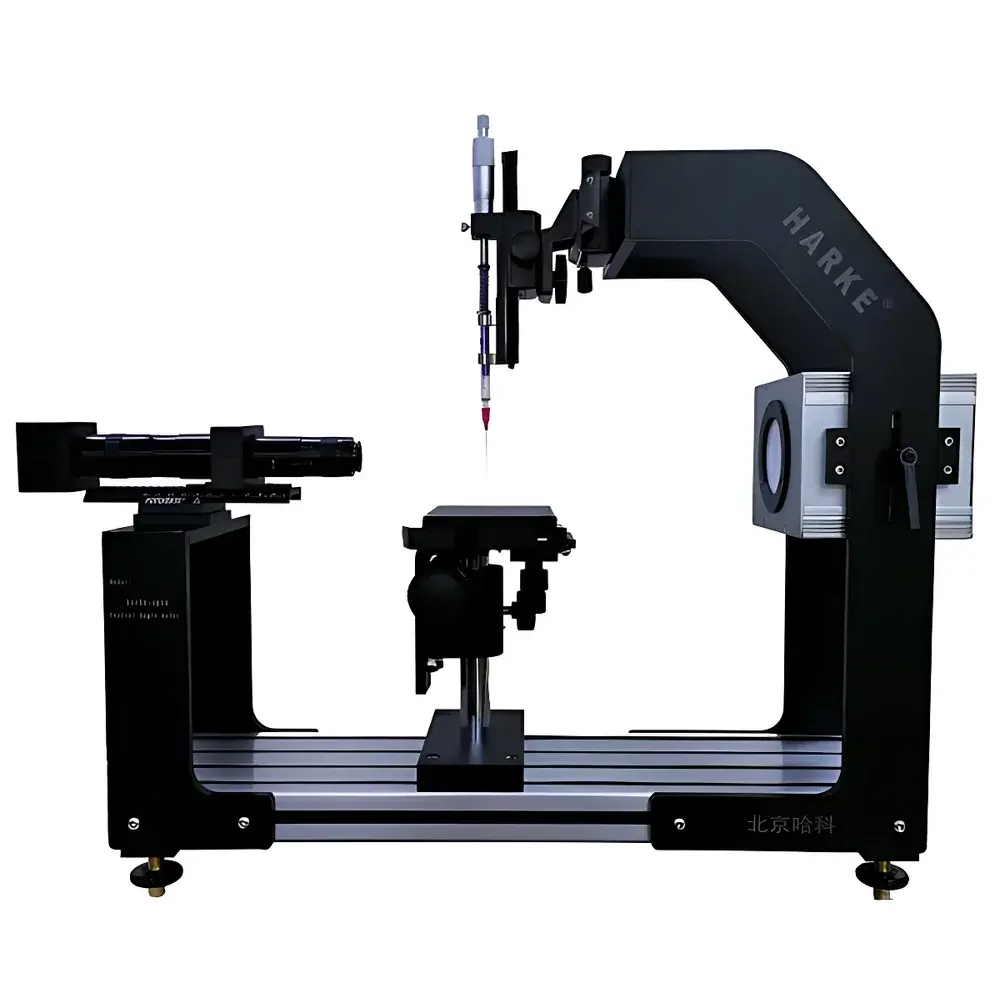
HARKE SPCAS Advanced Video Contact Angle Analyzer
| Brand | HARKE |
|---|---|
| Model | SPCAS |
| Type | Dynamic Contact Angle Measurement System |
| Origin | Beijing, China |
| Instrument Form Factor | Benchtop Laboratory System |
| Contact Angle Range | 0–180° |
| Contact Angle Accuracy | ±0.1° |
| Sample Stage Dimensions | 400 × 400 mm |
| Optical Magnification | 0.7× to 4.5× |
| Surface/Interfacial Tension Range | 0–1000 mN/m |
| Surface/Interfacial Tension Accuracy | ±0.1 mN/m |
| Imaging Frame Rate | Up to 1000 fps (optional) |
| Software | SPCA v1.0 |
| Power Supply | 220 V, 3 A, 50 Hz |
| Weight | 30 kg |
| Compliance | Designed for GLP-compliant environments |
Overview
The HARKE SPCAS Advanced Video Contact Angle Analyzer is a precision optical benchtop instrument engineered for quantitative characterization of solid-liquid-gas interfacial phenomena. It operates on the principle of high-resolution digital image capture and contour-based geometric analysis of sessile, pendant, or captive droplets—enabling direct measurement of contact angle (θ), surface free energy, interfacial tension, and dynamic wetting behavior. The system employs a motorized XYZ stage, automated liquid dispensing via syringe pump, and programmable sample tilting to support static, advancing/receding, roll-off, and time-resolved contact angle measurements. Its modular architecture allows seamless integration of optional accessories—including environmental chambers, temperature-controlled stages, and high-speed imaging modules—for advanced research in surface science, materials development, and process validation.
Key Features
- Motorized precision sample stage (400 × 400 mm) with ±0.1 mm positioning repeatability and programmable tilt capability (0–90°) for dynamic contact angle and roll-off angle analysis.
- Optical system featuring a calibrated zoom lens (0.7×–4.5× magnification) coupled with a USB 3.0 high-sensitivity camera delivering up to 1000 fps acquisition—optimized for capturing rapid wetting transitions and droplet dynamics.
- Automated liquid delivery module with micro-stepping syringe pump, enabling precise volume control (nL–µL resolution), programmable dispensing speed, and repeatable drop formation under ambient or controlled atmospheric conditions.
- SPCA v1.0 analytical software supporting eight independent fitting algorithms (Circle, Ellipse, Young-Laplace, Axisymmetric Drop Shape Analysis [ADSA], etc.) for robust contour extraction and sub-degree angular resolution.
- Comprehensive surface energy modeling suite incorporating Owens-Wendt, Wu, Fowkes, van Oss-Chaudhury-Good (vOCG), and Schultz methods—with separate polar and dispersive component quantification.
- Full compliance-ready data management: secure user authentication, electronic signatures, audit trail logging, and export formats compatible with LIMS and ELN systems—aligned with FDA 21 CFR Part 11 and ISO/IEC 17025 documentation requirements.
Sample Compatibility & Compliance
The SPCAS accommodates flat, curved, porous, fibrous, and powdered substrates—including wafers, membranes, textiles, coatings, and biomaterials—via adjustable stage height and customizable sample holders. Its open-stage design permits in situ testing under inert gas, humidity-controlled, or heated environments (with optional add-ons). All measurement protocols adhere to internationally recognized standards including ASTM D7334 (surface energy of polymer films), ISO 19403-2/-4 (contact angle and surface free energy), and USP (performance assessment of hydrophobic/hydrophilic surfaces). The system is validated for routine use in GMP-regulated QC laboratories and academic surface science facilities requiring traceable, reproducible interfacial data.
Software & Data Management
SPCA v1.0 is a Windows-based application offering real-time video capture, multi-frame batch processing, and automated report generation in PDF, CSV, and XML formats. It provides full metadata embedding—including timestamp, operator ID, instrument configuration, environmental parameters, and raw image archives—to ensure data integrity and regulatory traceability. Built-in calibration wizards validate pixel-to-length conversion, lens distortion correction, and baseline detection accuracy prior to each session. The software supports custom script automation (via Python API), scheduled measurements, and remote monitoring via secure LAN/WAN connections—facilitating unattended overnight experiments and cross-site collaboration.
Applications
- Surface treatment evaluation: plasma, corona, flame, and chemical functionalization of polymers, metals, and composites.
- Coating formulation development: optimization of adhesion, leveling, and anti-fouling performance in paints, inks, and protective films.
- Biomedical device testing: hydrophilicity/hydrophobicity assessment of catheters, stents, wound dressings, and diagnostic substrates.
- Semiconductor manufacturing: cleanliness verification, photoresist wettability mapping, and wafer surface uniformity analysis.
- Nanomaterial characterization: wetting behavior of superhydrophobic/superhydrophilic nanostructured surfaces and self-assembled monolayers (SAMs).
- Food & packaging R&D: moisture barrier performance, ink adhesion on flexible films, and biopolymer surface modification.
- Pharmaceutical solid dosage forms: tablet coating integrity, excipient wettability, and dissolution kinetics correlation studies.
FAQ
What measurement methods does the SPCAS support?
It supports sessile drop, pendant drop, captive bubble, tilting plate (roll-off), and dynamic advancing/receding angle methods—each configurable via software-defined protocols.
Can the system measure surface energy of heterogeneous or rough surfaces?
Yes—through multi-liquid probe selection and advanced models (e.g., vOCG, Schultz), with built-in correction options for surface roughness and chemical heterogeneity.
Is the software compliant with FDA 21 CFR Part 11?
SPCA v1.0 includes role-based access control, electronic signature workflows, immutable audit trails, and data encryption—fully supporting Part 11 implementation when deployed on validated IT infrastructure.
What is the minimum droplet volume resolvable for accurate contact angle calculation?
With optimal lighting and substrate contrast, reliable measurements are achievable down to ~0.5 µL using the standard syringe pump; lower volumes (nL range) require optional piezoelectric dispensing.
Does the system support environmental control during measurement?
Yes—integrated ports allow connection to external humidity generators, gas purging manifolds, or temperature-controlled chambers (accessories sold separately).



