
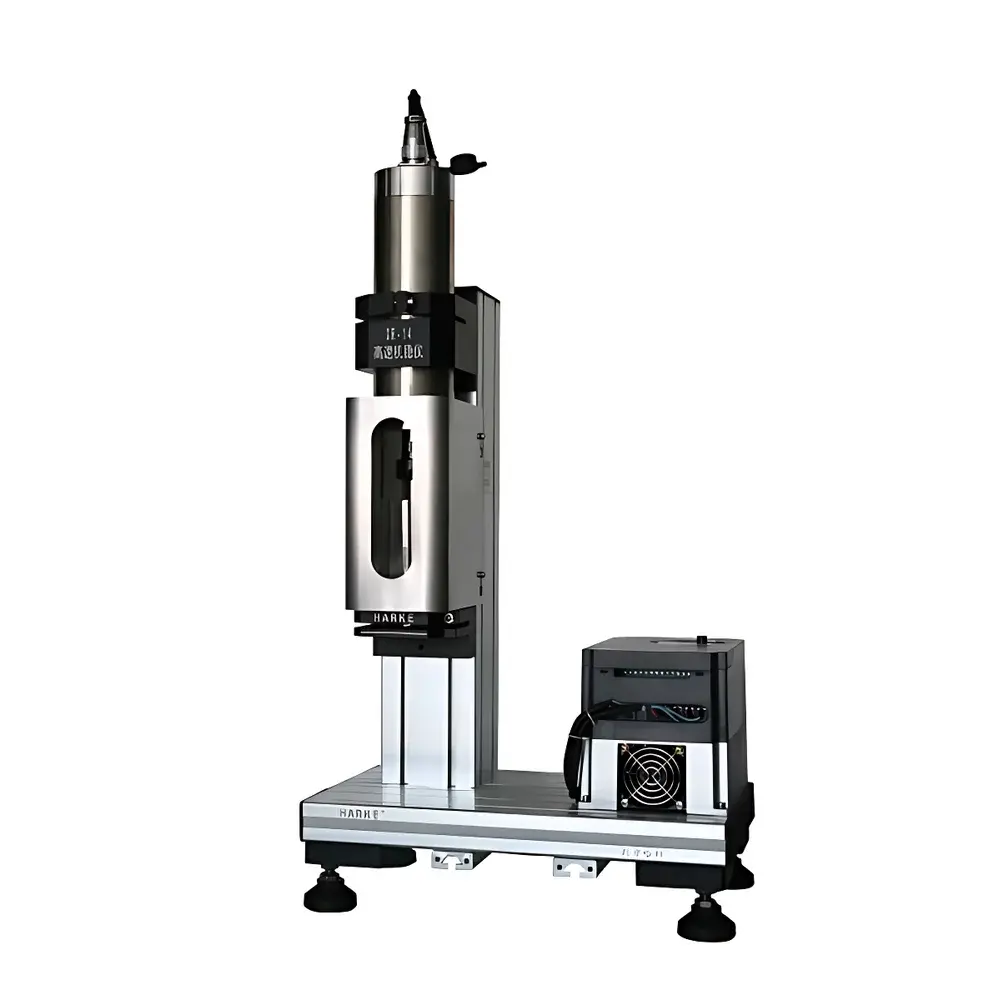
HARKE XR-14R High-Speed Mechanical Stability Tester
| Brand | HARKE |
|---|---|
| Origin | Beijing, China |
| Manufacturer Type | Direct Manufacturer |
| Country of Origin | China |
| Model | XR-14R |
| Price | Upon Request |
| Speed Range | 3,000–20,000 rpm (preset at 14,000 ± 200 rpm) |
| Speed Stability | ≤ ±100 rpm at 14,000 rpm |
| Stirring Disk Dimensions (Natural Latex) | Ø20.83 ± 0.03 mm × 1.57 ± 0.05 mm |
| Stirring Disk Dimensions (Synthetic Latex) | Ø36.12 ± 0.03 mm × 1.58 ± 0.05 mm |
| Sample Container | ID 58 ± 0.25 mm, Height 127 mm, Wall Thickness 2.5 mm |
| Disk-to-Bottom Distance | 13 ± 1 mm |
| Operating Voltage | 220 V ± 10%, 5 A |
| Ambient Temperature Range | 10–40 °C |
| Compatible Media | Natural or synthetic latex, pH 1–14 |
| Cooling Interface | Dual-port water circulation connection for motor thermal management |
Overview
The HARKE XR-14R High-Speed Mechanical Stability Tester is a precision-engineered instrument designed specifically for quantifying the mechanical stability of natural and synthetic latex dispersions under standardized high-shear conditions. It operates on the principle of controlled high-speed rotational agitation—employing a vertically oriented, motor-driven stirring disk that applies consistent tangential shear stress to the latex sample within a defined cylindrical container. This method replicates industrial-scale mechanical processing stresses (e.g., pumping, homogenization, and high-speed mixing), enabling users to assess colloidal integrity, coagulum formation kinetics, and dispersion resilience over time. The instrument complies fully with ISO 2006:2017 (“Rubber—Natural rubber—Determination of mechanical stability of latex”), ensuring traceable, inter-laboratory comparable results required for quality control, formulation development, and regulatory documentation in rubber and polymer manufacturing.
Key Features
- High-fidelity speed control: Digital frequency converter enables precise setting across 3,000–20,000 rpm, with factory-calibrated operation at 14,000 ± 200 rpm and real-time stability maintained within ±100 rpm during continuous duty.
- Dual-disk configuration: Interchangeable stainless-steel stirring disks—optimized dimensions (Ø20.83 mm for natural latex; Ø36.12 mm for synthetic latex)—ensure compliance with ISO 2006 geometric specifications and minimize edge effects during shear application.
- Thermally managed motor architecture: Brushless synchronous high-speed motor with integrated dual-port water-cooling interface supports extended operational cycles; automatic thermal shutdown protocol activates when localized motor temperature exceeds 60 °C.
- ISO-conforming sample geometry: Precision-machined glass container (ID 58 ± 0.25 mm, height 127 mm, wall thickness 2.5 mm) and fixed 13 ± 1 mm disk-to-bottom clearance guarantee reproducible shear field distribution and volume consistency.
- Robust mechanical design: Rigid base frame with micrometer-adjustable vertical lift mechanism ensures repeatable positioning and eliminates axial runout; safety interlock-compatible transparent shield prevents operator exposure during operation.
Sample Compatibility & Compliance
The XR-14R accepts both natural rubber latex (NRL) and synthetic latex emulsions (e.g., SBR, NBR, CR) across the full pH range of 1–14. Its mechanical configuration satisfies all dimensional, rotational, and timing requirements stipulated in ISO 2006, including disk geometry tolerances, container specifications, and speed verification methodology using non-contact optical tachometry. The instrument is routinely deployed in GLP-compliant QC laboratories supporting ISO/IEC 17025 accreditation, and its operational parameters are documented to support audit readiness for FDA 21 CFR Part 11–aligned environments where electronic records and signature integrity are mandated. No modifications to hardware or firmware are required to meet routine inspection criteria under ASTM D1076 (Standard Specification for Natural Rubber Latex) or GB/T 8298 (Chinese national standard for latex stability testing).
Software & Data Management
The XR-14R operates as a stand-alone electromechanical system with embedded digital frequency control—no proprietary software or PC interface is required for basic operation. Speed setpoints, runtime duration, and status indicators (e.g., “RUN”, “STOP”, “OVERTEMP”) are displayed via the integrated LED interface on the variable-frequency drive (VFD). For laboratory integration, analog output signals (0–10 V DC) from the VFD can be routed to external data loggers or SCADA systems for time-stamped speed and thermal monitoring. All calibration events—including tachometer verification against reference standards (e.g., NIST-traceable optical sensor), disk dimensional validation, and container ID/height metrology—are documented per internal SOPs aligned with ISO/IEC 17025 clause 6.4. Audit trails for maintenance, recalibration, and user access are retained manually in lab notebooks or digitally in LIMS platforms.
Applications
- Quantitative assessment of mechanical stability index (MSI) in raw natural rubber latex prior to compounding or centrifugation.
- Formulation screening of stabilizers (e.g., ammonia, sodium caseinate, surfactants) in synthetic latex systems for tire tread, dipped goods, or adhesives.
- Batch release testing in GMP-regulated rubber glove or condom manufacturing facilities.
- Accelerated aging studies correlating shear-induced coagulum formation with storage time and temperature profiles.
- Root-cause analysis of premature coagulation in latex processing lines—supporting failure mode and effects analysis (FMEA).
FAQ
What standards does the XR-14R comply with?
The instrument meets all physical and operational requirements of ISO 2006:2017 and is compatible with test protocols referenced in ASTM D1076, GB/T 8298, and JIS K6220.
Is the stirring disk interchangeable between natural and synthetic latex tests?
Yes—two calibrated disks are supplied: one for natural latex (Ø20.83 mm) and one for synthetic latex (Ø36.12 mm), each meeting ISO 2006 dimensional tolerances.
Can the instrument operate continuously for extended durations?
Yes, provided the optional water-cooling circuit is connected and activated when motor surface temperature reaches 60 °C, as indicated by the thermal sensor feedback loop.
How is speed accuracy verified during routine use?
Users perform periodic non-contact optical tachometry using the included reflective tape and handheld laser tachometer—cross-referenced against the VFD display and recorded per internal calibration schedule.
Does the XR-14R require annual third-party calibration?
While not mandatory, annual verification of disk geometry, container dimensions, rotational speed accuracy, and thermal cutoff threshold is recommended to maintain ISO 2006 conformance and support ISO/IEC 17025 audits.




