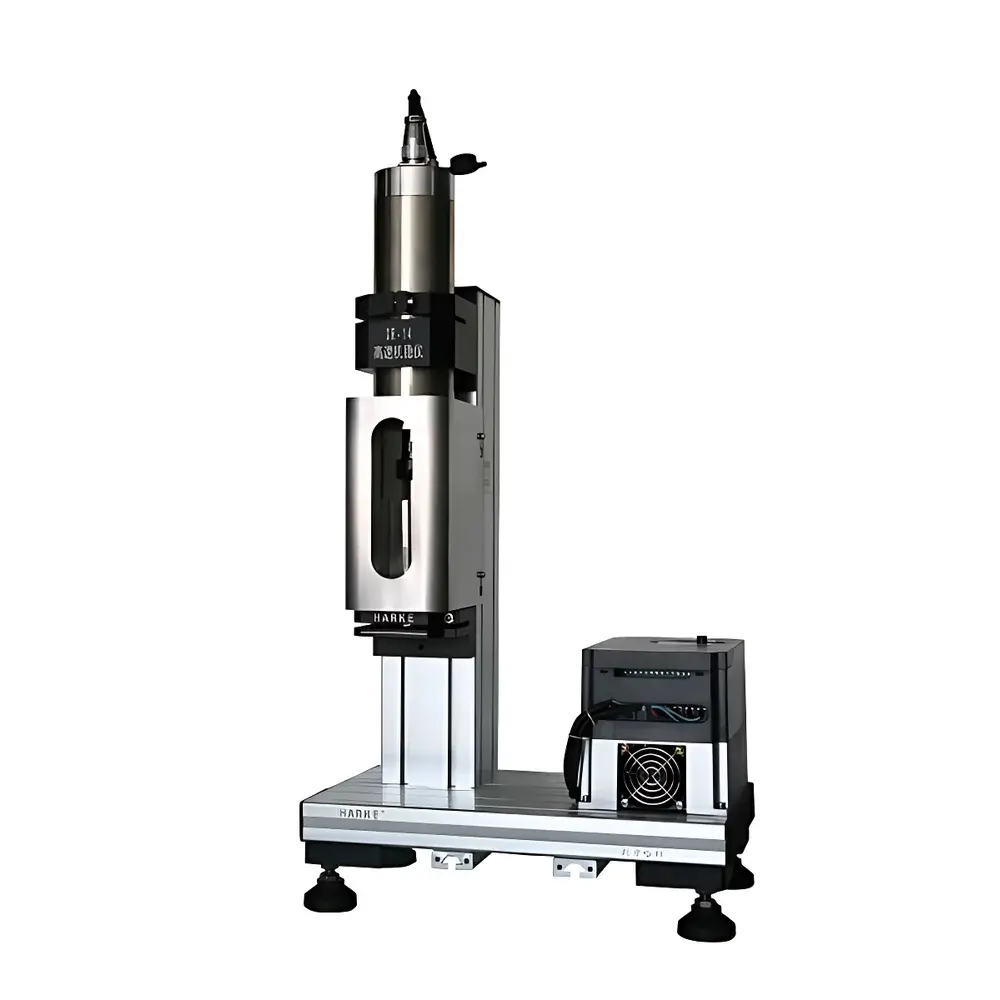
HARKE XR-14RT High-Speed Mechanical Stability Tester for Latex
| Brand | HARKE |
|---|---|
| Model | XR-14RT |
| Application | Mechanical stability testing of natural and synthetic latex |
| Compliance | ISO 2006 |
| Speed Range | 3,000–20,000 rpm (standard test speed: 14,000 ± 200 rpm) |
| Speed Stability | ≤ ±100 rpm at 14,000 rpm |
| Stirring Disk Dimensions (Natural Latex) | Ø20.83 ± 0.03 mm × 1.57 ± 0.05 mm |
| Stirring Disk Dimensions (Synthetic Latex) | Ø36.12 ± 0.03 mm × 1.58 ± 0.05 mm |
| Sample Container | ID 58 ± 0.25 mm × H 127 mm, wall thickness 2.5 mm |
| Disk-to-Bottom Distance | 13 ± 1 mm |
| Power Supply | 220 V ± 10%, 5 A |
| Operating Temperature | 10–40 °C |
| pH Compatibility | 1–14 |
| Cooling Option | Optional recirculating water cooling (activated at ≥60 °C motor surface temperature) |
Overview
The HARKE XR-14RT High-Speed Mechanical Stability Tester is a precision-engineered instrument designed specifically for evaluating the mechanical stability of natural and synthetic latex dispersions under standardized high-shear conditions. It operates on the principle of controlled high-speed rotational agitation—using a precisely dimensioned metal stirring disk rotating coaxially within a cylindrical sample container—to induce shear-induced coagulation. The time-dependent formation of coagulum is quantified per ISO 2006, enabling objective assessment of colloidal integrity, surfactant efficacy, and formulation robustness. Unlike generic rheometers or viscometers, the XR-14RT replicates the mechanical stress profile encountered during industrial processing steps such as pumping, homogenization, and high-speed coating—making it indispensable for R&D laboratories, quality control departments, and technical service units in the rubber, glove, foam, and dipped goods manufacturing sectors.
Key Features
- Stable high-speed operation at 14,000 ± 200 rpm with speed fluctuation ≤ ±100 rpm—engineered to meet ISO 2006 repeatability requirements.
- Wide adjustable speed range (3,000–20,000 rpm) via industrial-grade frequency converter, supporting method development and comparative studies across shear regimes.
- Dual-certified stirring disks: one optimized for natural latex (Ø20.83 ± 0.03 mm, t = 1.57 ± 0.05 mm), another for synthetic latex (Ø36.12 ± 0.03 mm, t = 1.58 ± 0.05 mm), ensuring geometry-specific hydrodynamic consistency.
- Precision-machined sample container (ID 58 ± 0.25 mm, height 127 mm, wall thickness 2.5 mm) with fixed 13 ± 1 mm disk-to-bottom clearance—guaranteeing reproducible shear gradient distribution.
- Brushless high-efficiency synchronous motor with low-noise, long-life design; thermal management via optional recirculating water cooling (activated automatically when motor surface temperature reaches ≥60 °C).
- Integrated digital speed display and push-button start/stop controls with real-time frequency readout (1 Hz ≈ 60 rpm), facilitating rapid verification and traceable parameter logging.
Sample Compatibility & Compliance
The XR-14RT accepts both natural rubber latex (NRL) and synthetic latex systems—including styrene-butadiene (SBR), nitrile (NBR), and vinyl acetate copolymers—within pH 1–14. Its mechanical design conforms strictly to the dimensional, kinematic, and operational specifications defined in ISO 2006:2017 (“Rubber latex — Determination of mechanical stability”). All critical components—including disk geometry, container tolerances, and rotational axis alignment—are validated against this standard to ensure inter-laboratory comparability. The instrument supports GLP-compliant workflows through documented calibration intervals, operator-accessible speed verification (using reflective tape and handheld tachometer), and physical traceability of test conditions. While not inherently 21 CFR Part 11 compliant, its deterministic analog control architecture allows integration into validated environments where electronic records are managed externally.
Software & Data Management
The XR-14RT operates as a stand-alone electromechanical system without embedded firmware or proprietary software. All operational parameters—including setpoint frequency, runtime duration, and manual speed verification values—are recorded manually or entered into laboratory information management systems (LIMS) or electronic lab notebooks (ELN). This architecture eliminates software validation overhead while maintaining full auditability: each test is associated with a unique run identifier, operator initials, ambient temperature/humidity (10–40 °C operating envelope), and raw coagulum mass or volume measurements obtained post-test using standardized filtration or centrifugation protocols. For automated data capture, third-party USB tachometers or analog voltage outputs (via optional signal interface module) may be integrated with SCADA or custom Python-based acquisition scripts.
Applications
- Quantifying mechanical stability index (MSI) of field-grade natural rubber latex prior to ammoniated preservation or centrifugal concentration.
- Evaluating surfactant package performance in synthetic latex formulations intended for extrusion, foaming, or dip molding processes.
- Screening anti-coagulant additives under accelerated shear stress to predict shelf-life and process tolerance.
- Supporting ASTM D1076 and ISO 2006 conformance testing for supplier qualification and incoming raw material inspection.
- Correlating mechanical stability data with downstream processing defects—e.g., gel particles in dipped gloves or uneven film formation in foam lattices.
- Method transfer between QC labs and contract testing facilities due to strict adherence to international geometric and kinematic specifications.
FAQ
What standards does the XR-14RT comply with?
The instrument fully satisfies the mechanical, dimensional, and operational requirements specified in ISO 2006:2017 for mechanical stability testing of rubber latex.
Can the XR-14RT be used for non-rubber colloidal systems?
While calibrated and validated for latex, its shear profile may be applicable to other aqueous polymer dispersions—but method adaptation and re-validation per ISO/IEC 17025 would be required.
Is speed calibration traceable to national standards?
Yes: users perform periodic verification using a NIST-traceable handheld optical tachometer aligned with the reflective tape affixed to the stir shaft.
Does the instrument require routine maintenance beyond cleaning?
Annual inspection of motor bearings, torque verification of shaft clamping hardware, and calibration of the frequency converter output against a calibrated power analyzer are recommended.
How is temperature control implemented during extended runs?
When motor surface temperature reaches 60 °C, the optional recirculating water cooling circuit—connected via dual quick-coupling ports on the motor housing—is activated to maintain thermal stability without interrupting operation.