
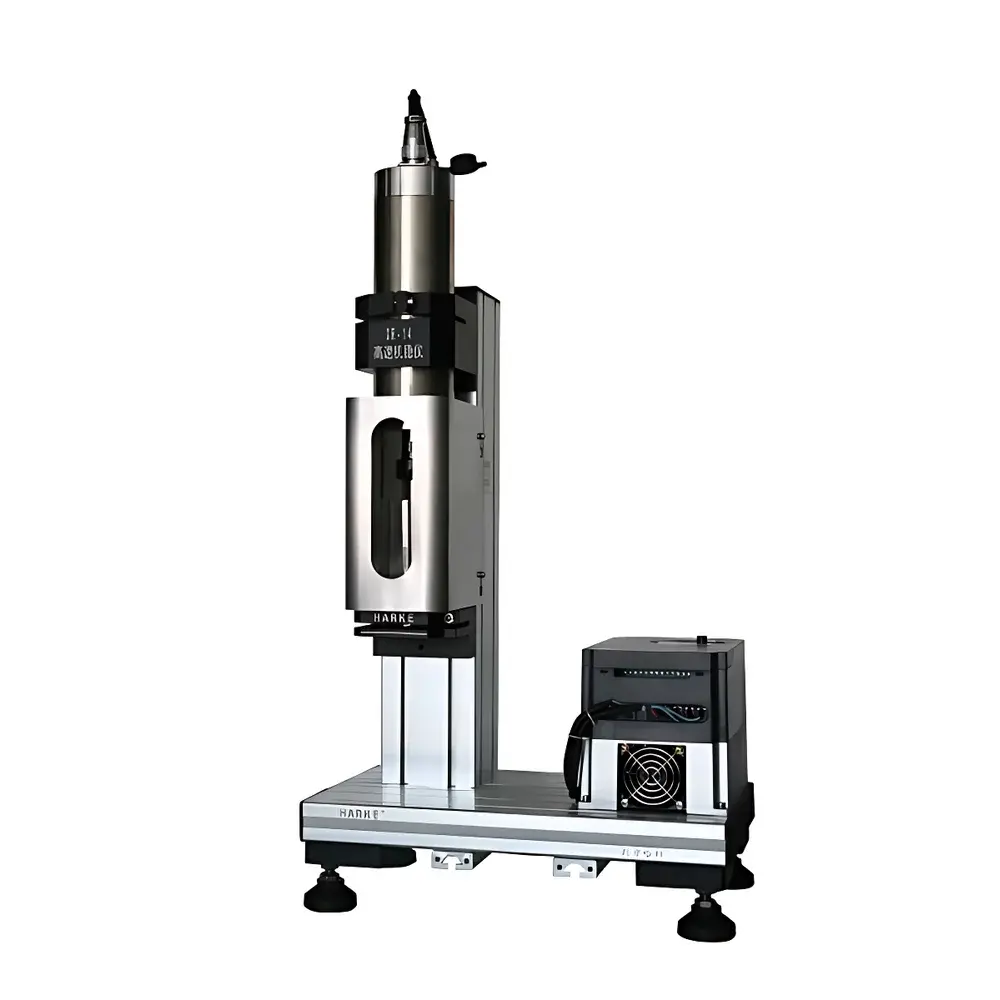
HARKE XR-14T High-Speed Mechanical Stability Tester for Latex
| Brand | HARKE |
|---|---|
| Model | XR-14T |
| Origin | Beijing, China |
| Manufacturer | HARKE Instrument Co., Ltd. |
| Type | Domestic Production |
| Speed Range | 3,000–20,000 rpm (standard test speed: 14,000 ± 200 rpm) |
| Stirring Disk Dimensions (Natural Latex) | Ø20.83 ± 0.03 mm × 1.57 ± 0.05 mm |
| Stirring Disk Dimensions (Synthetic Latex) | Ø36.12 ± 0.03 mm × 1.58 ± 0.05 mm |
| Container Internal Diameter | 58 ± 0.25 mm |
| Container Height | 127 mm |
| Wall Thickness | 2.5 mm |
| Disk-to-Bottom Distance | 13 ± 1 mm |
| Power Supply | 220 V ± 10%, 5 A |
| Operating Temperature | 10–40 °C |
| pH Compatibility | 1–14 |
| Cooling Option | Circulating water jacket (optional) |
| Compliance | ISO 2006 |
Overview
The HARKE XR-14T High-Speed Mechanical Stability Tester is an engineered laboratory instrument designed specifically for the quantitative assessment of mechanical stability in natural and synthetic latex dispersions. It operates on the principle of controlled high-shear agitation: a precision-machined metal stirring disk rotates at a defined angular velocity within a standardized cylindrical container, subjecting the latex sample to reproducible hydrodynamic shear stress. The resulting coagulum formation—measured gravimetrically or turbidimetrically after a fixed duration—is directly correlated with colloidal stability under mechanical stress. This method forms the technical basis of ISO 2006, the internationally recognized standard for mechanical stability testing of rubber latex, and is routinely applied in quality control laboratories of latex producers, R&D centers developing polymer emulsions, and regulatory testing facilities validating formulation robustness.
Key Features
- Stable high-speed operation: Maintains rotational speed at 14,000 ± 200 rpm with speed fluctuation ≤ 100 rpm during continuous duty, ensuring measurement repeatability across sequential tests.
- Wide adjustable speed range: Programmable from 3,000 to 20,000 rpm via industrial-grade frequency converter, enabling method development beyond ISO 2006’s nominal 14,000 rpm requirement.
- Dual-disk configuration: Includes two ISO-compliant stirring disks—one for natural latex (Ø20.83 ± 0.03 mm, thickness 1.57 ± 0.05 mm) and one for synthetic latex (Ø36.12 ± 0.03 mm, thickness 1.58 ± 0.05 mm)—ensuring material-specific shear profile fidelity.
- Calibrated geometry: Precision-machined glass container (ID 58 ± 0.25 mm, height 127 mm, wall thickness 2.5 mm) and fixed disk-to-bottom clearance (13 ± 1 mm) guarantee consistent shear field distribution per ISO 2006 Annex A.
- Thermally managed motor: Brushless synchronous high-speed motor with optional circulating water cooling (via dual inlet/outlet ports) permits extended operation without thermal derating—critical for batch testing or accelerated stability protocols.
- Integrated digital speed monitoring: Real-time frequency display (Hxxx.x format) synchronized with calibrated tachometric verification using reflective tape and non-contact optical tachometer, supporting traceable speed validation per GLP requirements.
Sample Compatibility & Compliance
The XR-14T accommodates both natural rubber latex (NRL) and synthetic latex systems—including styrene-butadiene (SBR), nitrile (NBR), and acrylic emulsions—within a pH range of 1 to 14. Its mechanical design conforms strictly to the dimensional, rotational, and procedural specifications outlined in ISO 2006:2019 “Rubber latex — Determination of mechanical stability”. All critical components—including disk geometry, container tolerances, and axial positioning mechanism—are manufactured and verified against ISO 2006 Annex A metrological criteria. The system supports audit-ready documentation workflows compatible with ISO/IEC 17025-accredited laboratories and satisfies foundational instrumentation requirements for GMP-aligned QC environments where mechanical stability data informs release decisions for medical-grade or industrial-grade latex products.
Software & Data Management
The XR-14T operates as a hardware-controlled benchtop instrument without embedded firmware or proprietary software. Speed setpoint, runtime initiation, and termination are executed manually via front-panel controls on the integrated frequency converter. However, its analog-compatible tachometric output and standardized electrical interface allow seamless integration into third-party data acquisition systems (e.g., LabVIEW, MATLAB, or SCADA platforms) when equipped with optional analog voltage output modules. For regulated environments, users may implement external electronic lab notebooks (ELNs) or LIMS to record operator ID, sample ID, speed setpoint, actual measured rpm (validated by tachometer), test duration, ambient temperature, and post-test coagulum mass—fulfilling traceability requirements under FDA 21 CFR Part 11 when paired with appropriate access controls and audit trail configurations.
Applications
- Quality assurance of raw natural rubber latex prior to compounding or dipping processes.
- Formulation screening of surfactant packages, stabilizers, and preservatives in synthetic latex synthesis.
- Batch-to-batch consistency verification for medical glove manufacturers requiring ASTM D3577 or ISO 10993-5 compliance.
- Accelerated aging studies correlating mechanical stability loss with storage time or temperature exposure.
- Technical support for ISO 2006-certified test reports issued by independent contract laboratories.
- Research into colloidal destabilization mechanisms under laminar-to-turbulent transition regimes in emulsion systems.
FAQ
What standards does the XR-14T comply with?
The instrument fully meets the mechanical, dimensional, and operational requirements specified in ISO 2006:2019 for mechanical stability testing of rubber latex.
Can the XR-14T be used for non-rubber emulsions such as PVA or PVAc dispersions?
Yes—provided the dispersion falls within the specified pH range (1–14) and viscosity limits compatible with the defined shear geometry, it may be evaluated using validated internal protocols aligned with ISO 2006 methodology.
Is calibration certification included with shipment?
Each unit ships with a factory verification report documenting disk dimensions, container tolerances, and speed accuracy at 14,000 rpm; NIST-traceable calibration of disk geometry and container ID is available upon request.
What maintenance is required for long-term reliability?
Routine cleaning of the stirring disk and container with distilled water after each test is mandatory to prevent latex residue buildup; annual inspection of motor bearings and frequency converter cooling fans is recommended for continuous-use environments.
Does the instrument support automated timing or data logging?
No—the XR-14T is a manually operated instrument; however, its analog tachometer output enables external time-stamped data capture when interfaced with compatible DAQ hardware and software.
Related Products





