
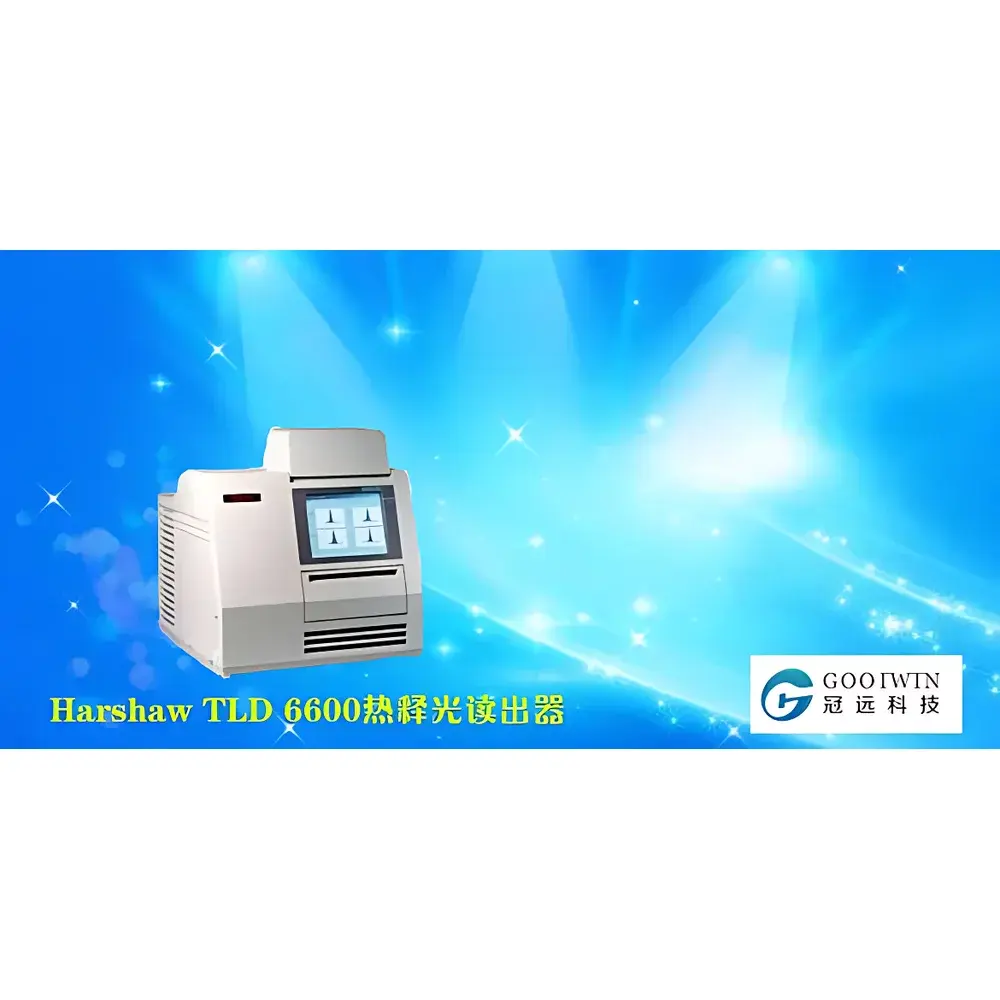
Harshaw TLD 6600 Personal Thermoluminescent Dosimeter Reader
| Brand | UNION |
|---|---|
| Origin | Germany |
| Manufacturer Type | Authorized Distributor |
| Import Status | Imported |
| Model | TLD 660 |
| Price Range | USD 27,000 – 41,000 |
Overview
The Harshaw TLD 6600 is a high-precision, automated thermoluminescent dosimeter (TLD) reader engineered for routine personal radiation dose monitoring in occupational health and regulatory compliance settings. It operates on the fundamental principle of thermoluminescence: when previously irradiated crystalline phosphors (e.g., LiF:Mg,Ti or CaF₂:Dy) are heated under controlled conditions, trapped electrons recombine with lattice defects, emitting ultraviolet–visible photons proportional to the absorbed radiation dose. The TLD 6600 quantifies this emitted light using a calibrated photomultiplier tube (PMT) system coupled with precise temperature ramping and glow-curve deconvolution algorithms. Designed to report Hp(10)—the personal dose equivalent at 10 mm depth in the ICRU slab phantom—the instrument delivers a conservative, standardized estimate of effective dose for whole-body exposure assessment. Its architecture meets the metrological requirements for secondary standard-level dosimetry laboratories operating under ISO/IEC 17025 accreditation frameworks.
Key Features
- Automated sample handling with carousel capacity for up to 72 TLD chips or badges per run, minimizing manual intervention and inter-operator variability.
- Programmable heating profile control: linear ramp rates from 1°C/s to 20°C/s, with plateau hold options and real-time temperature feedback via Pt-100 sensor.
- Low-noise PMT detection system with spectral response optimized for 380–550 nm emission bands typical of common TLD materials.
- Integrated background subtraction and pre-heat annealing cycles to eliminate residual signal and ensure reproducible readout conditions.
- Rugged, EMI-shielded enclosure compliant with IEC 61000-6-3 (EMC emissions) and IEC 61000-6-2 (immunity), suitable for shared laboratory environments.
- Self-diagnostic firmware with event logging, calibration history tracking, and hardware fault alerts aligned with GLP audit requirements.
Sample Compatibility & Compliance
The TLD 6600 supports standard 3.2 mm × 3.2 mm and 4.5 mm × 4.5 mm TLD chips, as well as card-type personal dosimeters (e.g., Harshaw 8814, 8845) and ring badges. It is validated for use with LiF:Mg,Ti (TLD-100), LiF:Mg,Cu,P (TLD-100H), and CaF₂:Dy phosphors. The system adheres to international standards including IEC 61066 (performance criteria for TLD readers), ISO 21909 (radiation protection — passive neutron dosimetry), and ASTM E1192 (standard practice for calibration of personnel dosimetry systems). For regulatory reporting, it generates dose records traceable to national primary standards (e.g., PTB, NIST), supporting compliance with EURATOM Directive 2013/59, US NRC Part 20, and IAEA Safety Standards Series No. GSR Part 3.
Software & Data Management
The bundled WinREMS v5.x software provides full control of acquisition parameters, glow-curve analysis (including peak separation via Gross–Weinberg deconvolution), and dose calculation using material-specific calibration coefficients. All operations—including user logins, parameter changes, and result exports—are time-stamped and stored with immutable audit trails, satisfying FDA 21 CFR Part 11 requirements for electronic records and signatures. Data export formats include CSV, XML (for HL7-compatible dose registries), and PDF reports compliant with ICRP Publication 116 dose quantity definitions. Optional integration with centralized dosimetry management platforms (e.g., DOSIWEB, RadPro) enables automated batch processing and regulatory submission workflows.
Applications
- Routine monitoring of nuclear medicine technologists, radiopharmaceutical production staff, and industrial radiographers.
- Neutron dose assessment in mixed-field environments (e.g., reactor facilities, accelerator labs) when paired with paired-element TLD configurations and correction algorithms.
- Environmental surveillance programs requiring long-term stability and low minimum detectable dose (MDD < 0.05 mSv for Hp(10) with LiF:Mg,Cu,P).
- Reference dosimetry for radiotherapy QA audits and intercomparison exercises organized by IAEA/WHO networks.
- Research into TLD fading kinetics, annealing optimization, and energy dependence corrections across photon, beta, and thermal neutron spectra.
FAQ
What is the minimum detectable dose (MDD) for Hp(10) using LiF:Mg,Cu,P chips?
The MDD is typically 0.03–0.05 mSv per readout cycle under optimal annealing and background suppression conditions.
Does the TLD 6600 support automatic glow-curve peak identification?
Yes—WinREMS includes adaptive peak-finding algorithms based on derivative analysis and least-squares fitting of multi-peak models.
Can the system be integrated into an existing LIMS environment?
Yes—via ODBC-compliant database connectors and configurable XML web service endpoints for bidirectional data exchange.
Is firmware update capability available remotely?
Firmware updates require local USB installation and verification via digital signature; remote execution is disabled for security and regulatory integrity.
How does the TLD 6600 handle fading correction for delayed readouts?
It applies time-dependent correction factors derived from material-specific fading studies, configurable per batch and storage condition (temperature/humidity).




