
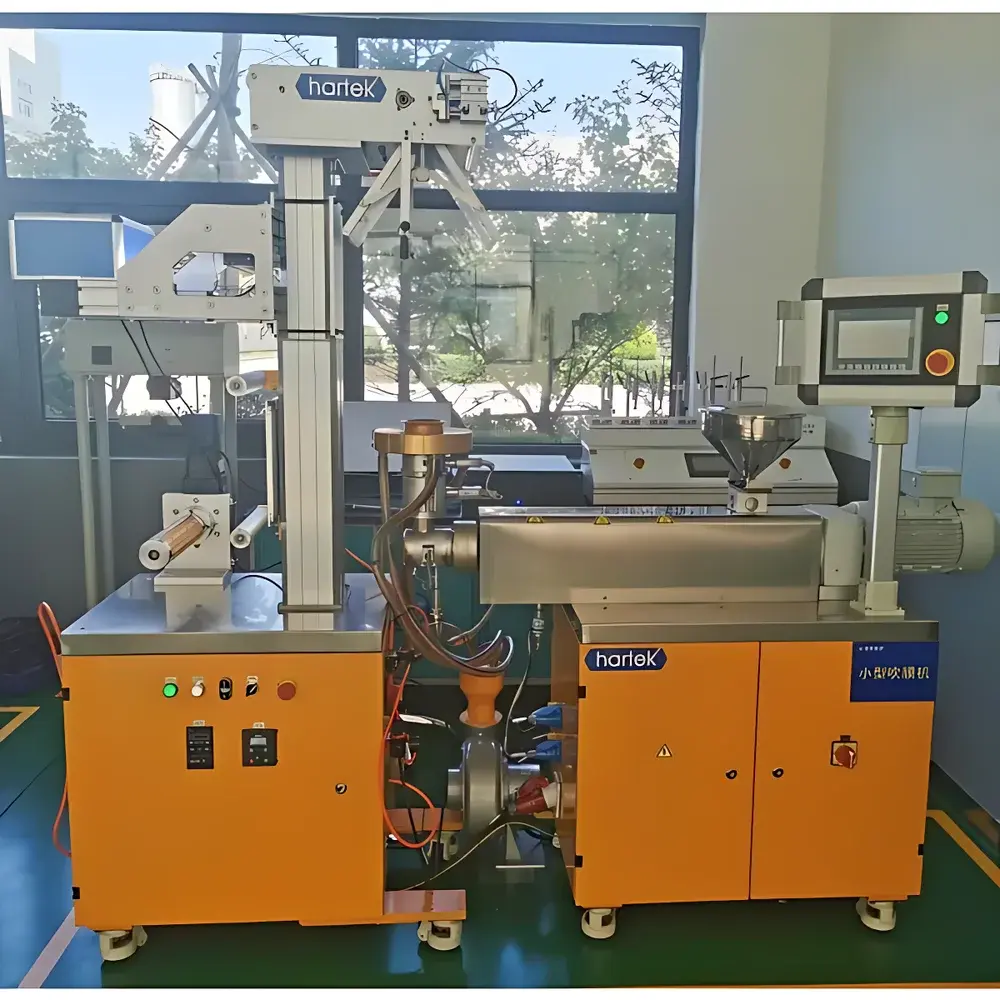
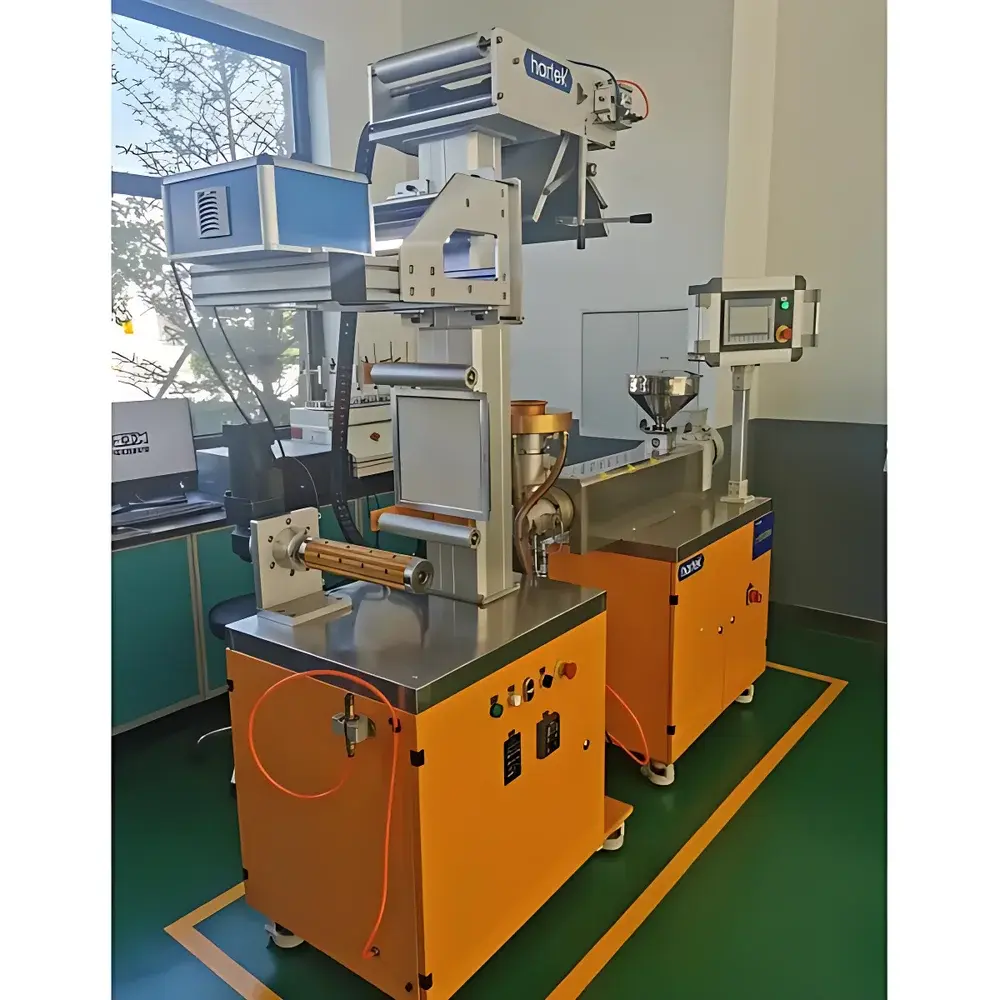
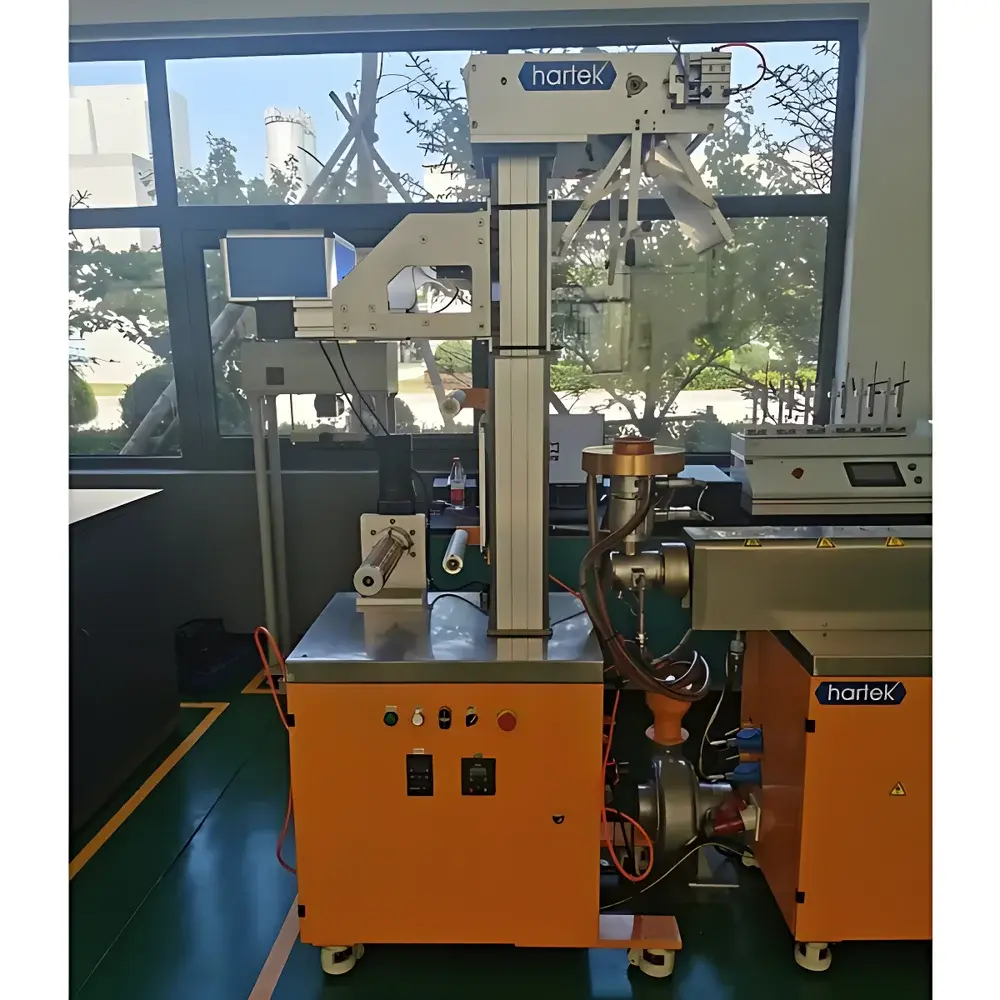
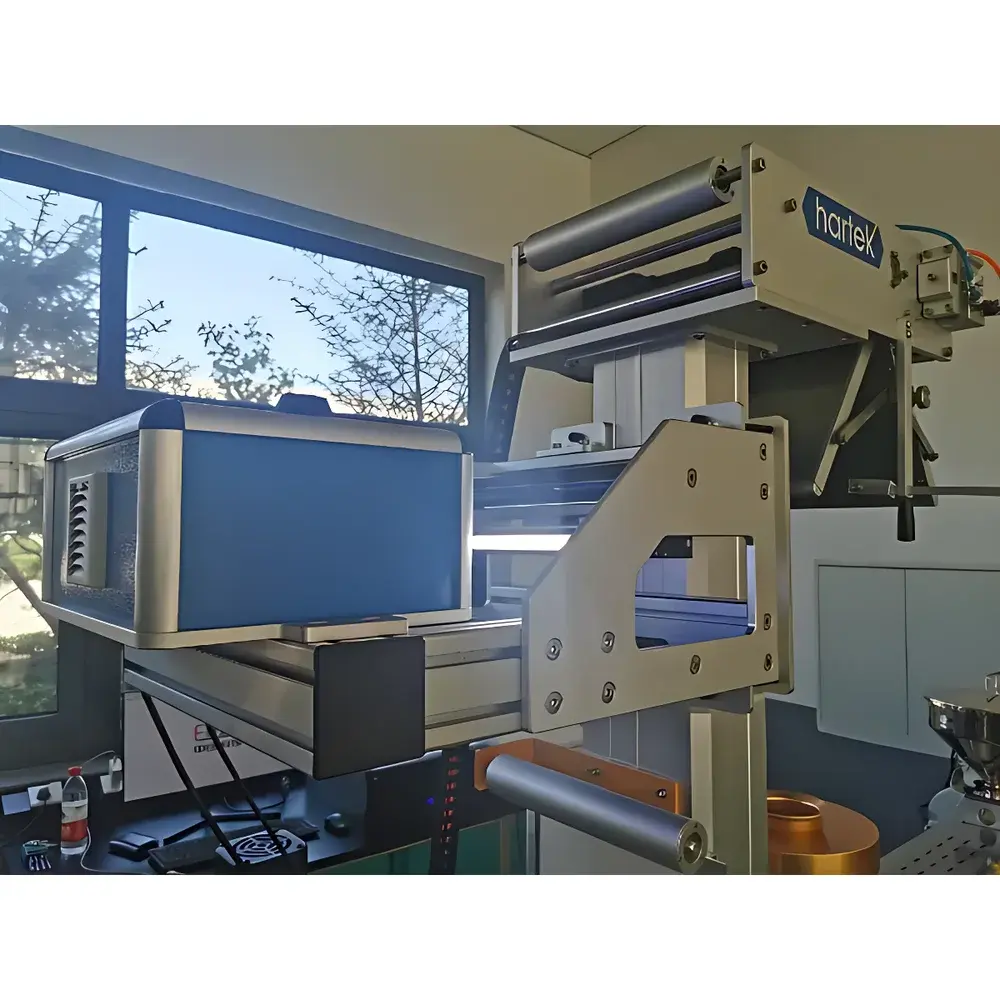
Hartek HTBS-20A Blown Film Defect Detection Experimental Line
| Brand | Hartek |
|---|---|
| Origin | Guangdong, China |
| Manufacturer Type | OEM Manufacturer |
| Country of Origin | China |
| Model | HTBS-20A |
| Price Range | USD 14,000 – 28,000 |
| Screw Diameter | 20 mm |
| L/D Ratio | 28:1 |
| Max Screw Speed | 120 rpm |
| Heating/Cooling | Electric Heating / Air Cooling |
| Max Barrel Temperature | 350 °C |
| Temperature Control Accuracy | ±1.0 °C |
| Melt Pressure Range | 0–35 MPa |
| Melt Pressure Accuracy | ±0.2 % F.S. |
| Haul-off Speed | 0–8 m/min (infinitely variable) |
| Film Lay-flat Width | 160 mm |
| Net Weight | 503 kg |
| Overall Dimensions (L×W×H) | 2980 × 944 × 2630 mm |
Overview
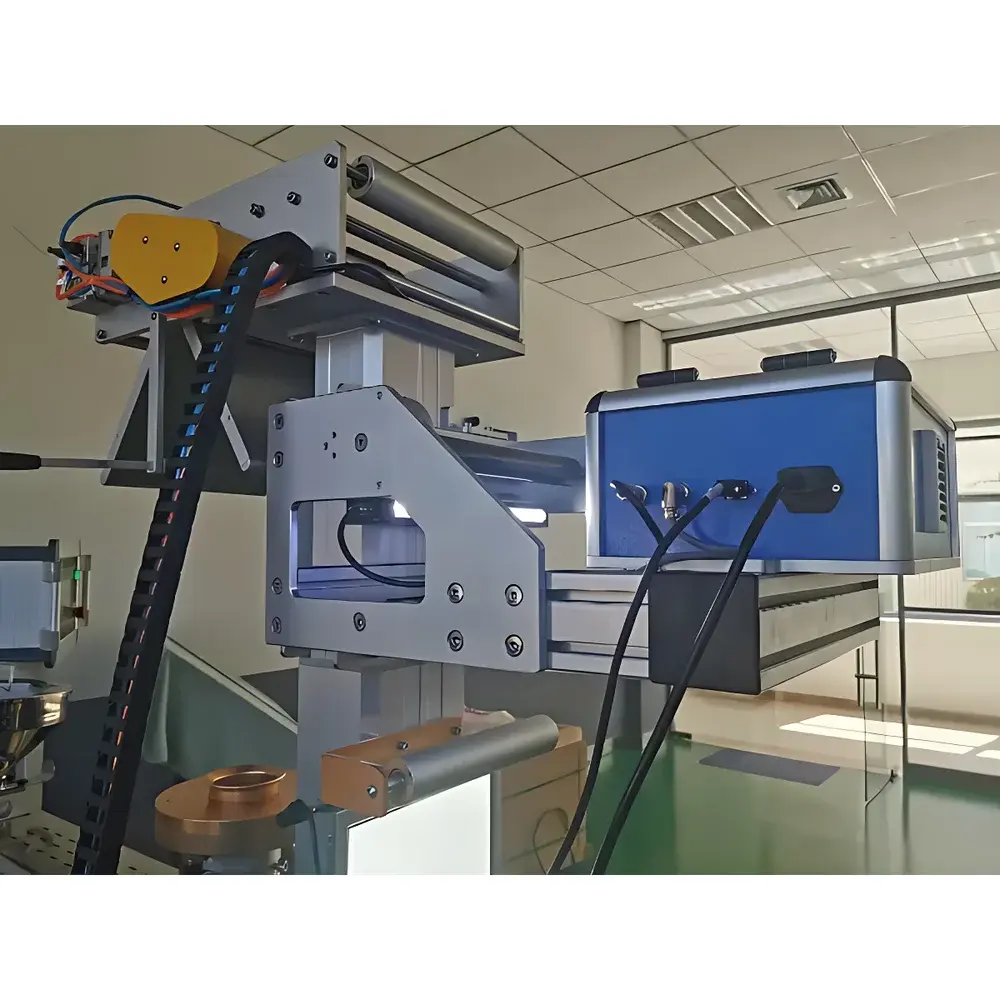
The Hartek HTBS-20A Blown Film Defect Detection Experimental Line is a fully integrated, bench-scale blown film extrusion and inline optical inspection platform engineered for R&D laboratories and quality assurance departments in polymer science, packaging development, and masterbatch formulation. It combines a precision single-screw extruder with a concentric annular die, bubble stabilization system, air-ring cooling, dual-zone haul-off unit, constant-tension winder, and a high-resolution, real-time surface defect detection module. The system operates on the principle of coaxial bubble extrusion followed by synchronized optical scanning—utilizing high-intensity LED backlighting and CMOS line-scan imaging—to capture surface anomalies across the full lay-flat width during continuous operation. Designed for method development and process validation—not production—it enables controlled study of melt rheology, bubble stability, frost line behavior, and defect genesis under reproducible thermal and mechanical conditions.
Key Features
- Fully integrated Siemens PLC-based control architecture with 10.1-inch industrial touchscreen HMI for coordinated management of extrusion parameters (temperature zones, screw speed), haul-off velocity, winding tension, and inspection trigger logic.
- 20 mm diameter screw with 28:1 L/D ratio, nitrided alloy steel construction, and segmented barrel heating zones (up to 350 °C) with ±1.0 °C closed-loop PID control per zone.
- Dual independent servo-motor-driven haul-off rollers featuring hard-chrome plating and mirror-finish polishing to minimize film slippage and surface marking.
- Constant-tension pneumatic winder with torque-controlled braking and automatic edge-guidance, supporting rapid sample changeover and repeatable roll formation.
- Optical defect detection module calibrated for both transparent and opaque polymeric films (LDPE, LLDPE, PP, EVA, PA, PETG); detects gel particles, black specks, contaminants, wrinkles, pinholes, and die-line streaks at ≥50 µm spatial resolution across 160 mm lay-flat width.
- Modular mechanical design permits component-level substitution—e.g., alternative die geometries, auxiliary cooling nozzles, or static charge neutralizers—to support method scalability and cross-platform correlation studies.
Sample Compatibility & Compliance
The HTBS-20A accommodates virgin resins, filled compounds, and color-concentrated masterbatches (up to 40 wt% pigment loading). Its extrusion train meets ISO 1133-1 for melt flow rate consistency verification; temperature profiles are traceable to NIST-calibrated thermocouples. The optical inspection subsystem complies with ASTM D7209–18 (Standard Practice for Optical Inspection of Plastic Film Surfaces) and supports audit-ready data export compliant with GLP documentation requirements. All electrical enclosures conform to IEC 60204-1; CE marking is available upon request with optional third-party Notified Body certification.
Software & Data Management
The embedded control software logs timestamped operational parameters—including melt pressure (0–35 MPa, ±0.2 % F.S.), zone temperatures, screw RPM, haul-off speed, and winding tension—at 10 Hz sampling frequency. Defect detection output includes annotated image sequences, defect location mapping (X/Y coordinates relative to film edge), size distribution histograms (area-based classification), and pass/fail binary reporting per defined acceptance criteria. Raw data exports to CSV and HDF5 formats; metadata conforms to ISA-88 batch record structure. Optional integration with LIMS via OPC UA enables automated report generation aligned with FDA 21 CFR Part 11 electronic signature and audit trail requirements.
Applications
- Evaluation of resin thermal stability and melt homogeneity during bubble formation—correlating extrudate appearance with rheological behavior and degradation onset.
- Quantitative assessment of masterbatch dispersion efficiency through statistical analysis of gel count, black speck density, and spatial clustering metrics across multiple extrusion runs.
- Empirical optimization of blow-up ratio (BUR), take-up ratio (TUR), and frost line height to minimize orientation-induced defects (e.g., gauge variation, dart impact inconsistency).
- Validation of additive package compatibility—e.g., slip agents, antistats, or UV stabilizers—by monitoring their effect on surface defect morphology and frequency under accelerated throughput conditions.
- Development of internal QC protocols for incoming resin qualification, using standardized test conditions to establish baseline defect thresholds prior to full-scale production ramp-up.
FAQ
Can the HTBS-20A be used for multilayer coextrusion trials?
No—the current configuration supports monolayer extrusion only. Dual- or triple-layer capability requires retrofitting with multi-manifold feedblocks and independent metering gear pumps, which are available as factory-engineered options.
Is the optical detection system validated against certified reference standards?
Yes. The system includes NIST-traceable calibration targets (ISO 12233 slanted-edge and ISO 15739 grayscale patches) for spatial resolution and contrast sensitivity verification prior to each test session.
What level of technical support is provided for method transfer to production-scale lines?
Hartek provides detailed scale-up guidelines—including dimensionless number correlations (e.g., Capillary Number, Deborah Number) and geometric similarity constraints—alongside raw process data packages for direct comparison with commercial line DCS logs.
Does the system meet explosion-proof requirements for flammable solvent-based coating applications?
Not by default. Intrinsically safe variants with ATEX/IECEx-certified components are available upon special order, subject to full hazard classification review and mechanical redesign.
Can third-party rheometers or inline viscometers be interfaced with the control system?
Yes—via Modbus TCP or analog 4–20 mA inputs. Hartek provides documented API specifications and commissioning support for integration with Anton Paar, TA Instruments, or RheoSense hardware.





