
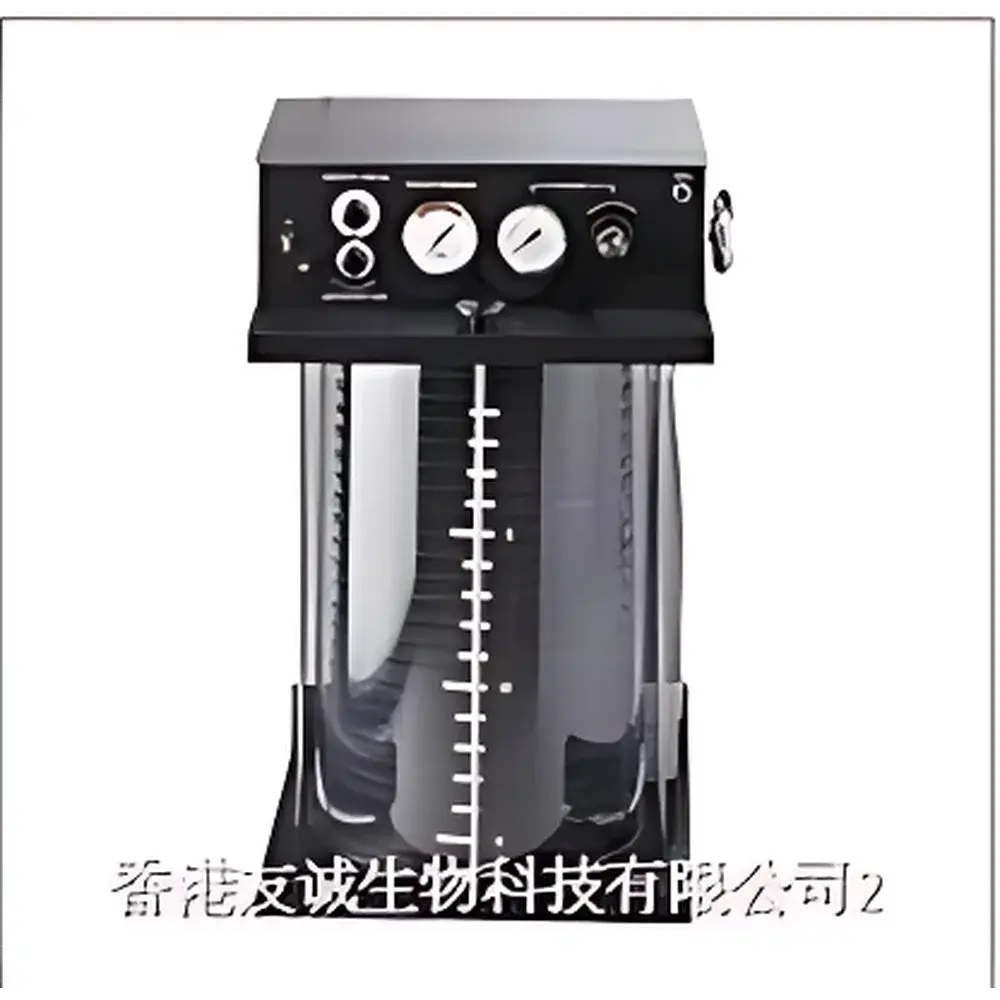
Harvard Apparatus DHV1000 Large-Animal Ventilator
| Brand | Harvard Apparatus |
|---|---|
| Origin | USA |
| Model | DHV1000 |
| Dimensions | 76.2 cm H × 40.6 cm W × 40.6 cm D |
| Weight | 20.4 kg |
| Power Supply | 100–220 V, 50/60 Hz |
| Compliance | MRI-compatible variant available |
| Included Accessories | 116.8 cm ventilator-to-bag hose (5.1 cm ID), 61 cm O₂ hose with DISS female connectors, power pack (P/N 32411B10), bellows assembly (P/N 32423C7), custom mounting bracket, descending bellows mechanism |
Overview
The Harvard Apparatus DHV1000 is a precision-engineered large-animal ventilator designed specifically for physiological support during surgical and critical care procedures in subjects exceeding 115 kg (250 lbs), including swine, bovine, equine, and other large veterinary models. Built upon five decades of clinical anesthesia device development, the DHV1000 integrates fail-safe pneumatic architecture with microprocessor-based electronic control to deliver consistent, pressure- and volume-targeted ventilation. Its core operating principle relies on time-cycled, pressure-limited or volume-controlled modes—configured via intuitive front-panel controls—ensuring stable gas exchange, precise tidal volume delivery (adjustable up to 3,000 mL), and reliable inspiratory/expiratory timing across extended experimental durations. Unlike general-purpose small-animal ventilators, the DHV1000 features reinforced airflow pathways, high-capacity valves, and a robust descending bellows system engineered to accommodate the elevated minute ventilation demands and airway compliance characteristics typical of large species.
Key Features
- Pneumatically actuated, electronically regulated time-cycled ventilation engine with dual-mode operation: pressure-controlled (PCV) and volume-controlled (VCV)
- Dedicated MRI-compatible configuration available—non-ferromagnetic construction, RF-shielded electronics, and fiber-optic signal transmission to eliminate electromagnetic interference
- Integrated descending bellows assembly (P/N 32423C7) providing visual and mechanical feedback on delivered tidal volume and circuit integrity
- Custom-designed mounting bracket kit enabling secure, vibration-dampened installation on surgical tables, imaging gantries, or ICU carts
- Front-panel rotary encoder and LED display for real-time adjustment and monitoring of rate (5–60 bpm), I:E ratio (1:1 to 1:4), peak inspiratory pressure (0–60 cmH₂O), and tidal volume (200–3000 mL)
- Redundant safety systems including high-pressure limit alarm, low-pressure disconnect alarm, apnea detection, and automatic breath termination upon circuit leak or obstruction
- Compliance with essential electrical safety standards (IEC 60601-1, UL 60601-1) and electromagnetic compatibility directives (IEC 60601-1-2)
Sample Compatibility & Compliance
The DHV1000 supports intubated and non-invasive ventilation protocols across diverse large-animal models, including porcine (≥80 kg), bovine (≥200 kg), caprine (≥50 kg), and equine (foal to adult). Its airflow capacity (up to 120 L/min) and pressure range (−5 to +60 cmH₂O) are validated for use with standard veterinary endotracheal tubes (ID 8–12 mm), Bain circuits, and circle absorber systems. The device meets requirements for Good Laboratory Practice (GLP) and Good Manufacturing Practice (GMP)-aligned preclinical studies, and its audit trail–capable firmware supports regulatory submissions under FDA 21 CFR Part 11 when integrated with compliant data acquisition platforms. All accessories—including the 116.8 cm, 5.1 cm ID ventilator hose and DISS-standard O₂ supply line—are manufactured to ISO 8536 and ASTM F1850 specifications for medical gas delivery.
Software & Data Management
While the DHV1000 operates as a standalone analog-digital hybrid ventilator without embedded PC connectivity, it features a standardized analog output port (0–10 V DC) compatible with third-party data acquisition systems (e.g., LabChart, PowerLab, Spike2) for synchronized recording of airway pressure, flow, and trigger signals. Optional digital interface modules (sold separately) enable RS-232 or USB communication for remote parameter logging, protocol scripting, and integration into centralized vivarium monitoring networks. Firmware updates are performed via secure bootloader protocol; version history and calibration logs are retained internally for traceability during GLP audits.
Applications
- Long-duration intraoperative ventilation during orthopedic, cardiovascular, and neurosurgical procedures in swine and bovine models
- Respiratory pharmacology studies assessing bronchodilator or neuromuscular blocker efficacy in large-animal PK/PD models
- MRI-guided functional imaging experiments requiring silent, non-magnetic ventilation support
- Veterinary ICU applications involving post-operative recovery, ARDS modeling, or sepsis-induced respiratory failure
- Regulatory toxicology studies conducted under OECD Test Guidelines 407, 408, and 452 where respiratory endpoints must be rigorously controlled
- Development and validation of novel airway devices, endotracheal tube coatings, or closed-loop ventilation algorithms
FAQ
Is the DHV1000 suitable for neonatal or small-animal use?
No—the DHV1000 is explicitly engineered for subjects ≥115 kg. For rodents, rabbits, or juvenile models, Harvard Apparatus recommends the VT Plus or Inspira ASV series.
Does the ventilator include built-in gas analyzers or capnography?
No—gas analysis requires external modules (e.g., Harvard Apparatus CapnoScan or Datex-Ohmeda S/5). The DHV1000 provides analog outputs compatible with such systems.
Can tidal volume be calibrated in-house?
Yes—calibration follows ASTM E2612 procedures using a certified dry gas meter and NIST-traceable reference standards; full instructions are provided in the Service Manual (Rev. 4.2).
What maintenance intervals are recommended?
Bellows inspection every 6 months; full pneumatic valve service annually; filter replacement every 90 days under continuous use—per IEC 62304 Class B software lifecycle guidance.
Is technical support available outside North America?
Yes—Harvard Apparatus maintains authorized service centers in EU, APAC, and LATAM regions; all units ship with multilingual operator manuals and CE/FCC/IC certifications.




