
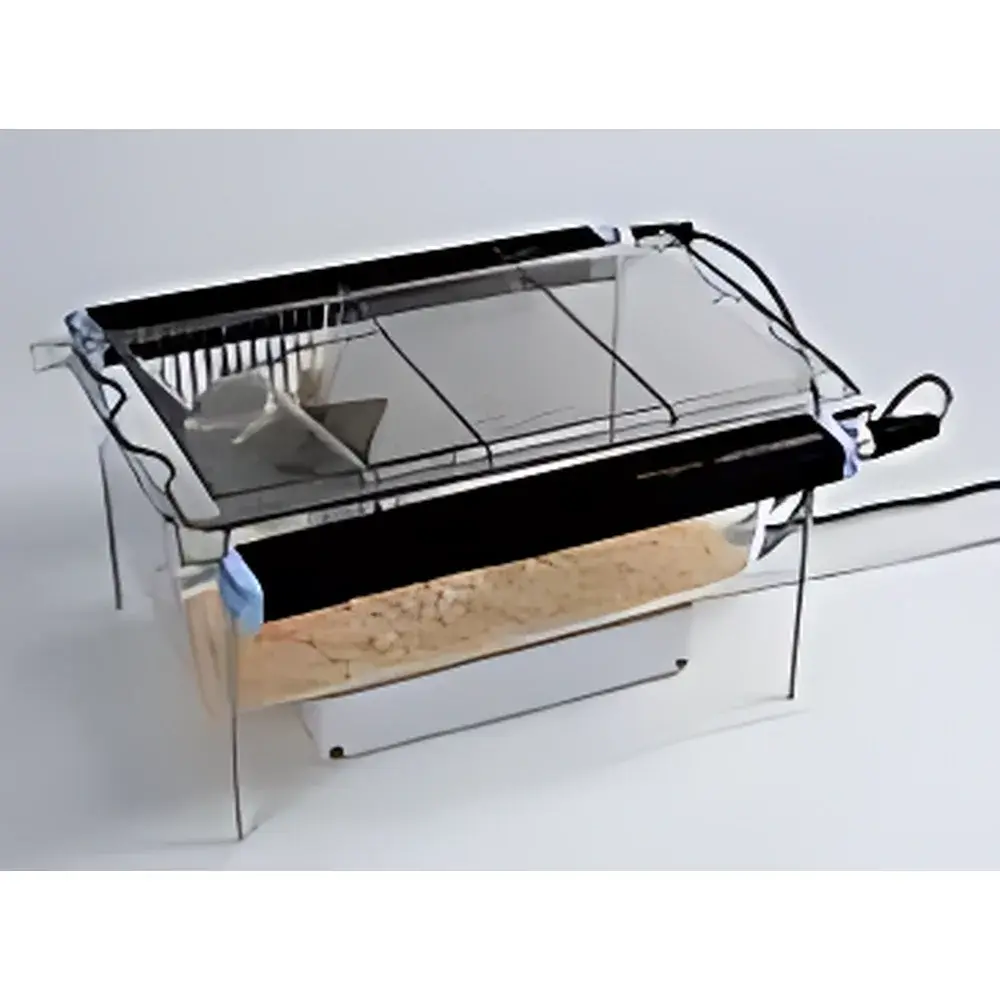
Harvard Apparatus HOMECAGE Automated Home Cage Monitoring System
| Brand | Harvard Apparatus |
|---|---|
| Origin | USA |
| Manufacturer Type | Authorized Distributor |
| Product Origin | Imported |
| Model | HOMECAGE |
| Price Range | USD 1,400 – 7,000 |
Overview
The Harvard Apparatus HOMECAGE Automated Home Cage Monitoring System is a non-invasive, video-based behavioral phenotyping platform engineered for continuous, long-term assessment of spontaneous locomotor activity and circadian rhythm patterns in rodents under undisturbed housing conditions. Unlike traditional open-field or forced-exploration assays, the HOMECAGE system operates directly within standard vivarium-grade housing cages—eliminating the need for surgical implantation, tethering, cage modification, or environmental transfer. It leverages high-resolution top-down infrared (IR) imaging combined with real-time computer vision algorithms to quantify spatial position, posture transitions (rearing, hanging, stretching), gait dynamics, and micro-movements—including ear flicks, whisker twitches, and limb tremors—at sub-second temporal resolution. The system is calibrated for both mouse (C57BL/6, BALB/c, etc.) and rat (Sprague-Dawley, Wistar) models, supporting longitudinal studies across developmental, pharmacological, neurodegenerative, and chronobiological research domains.
Key Features
- True home-cage paradigm: No handling stress, no cage retrofitting—standard IVC or static cages are fully compatible.
- Multi-parameter behavioral classification: Automated detection of rearing, hanging, climbing, rapid locomotion, slow exploration, immobility (including freezing episodes), and fine motor events (e.g., grooming initiation, head shakes, paw tremors).
- Configurable activity thresholds: Users define custom velocity and displacement thresholds to classify behavioral states—static (sleep-like immobility), low-activity (quiet wakefulness), and high-activity (exploratory or hyperlocomotion)—with adjustable sensitivity per experiment.
- Real-time visualization & playback: Synchronized video + trajectory overlay enables live monitoring and post-hoc frame-accurate review; manual annotation and correction tools ensure ground-truth validation.
- Event-tagging capability: Researchers may insert time-stamped behavioral markers during acquisition (e.g., “drug injection”, “light onset”, “novel object presentation”) for synchronized analysis with physiological or environmental metadata.
- Robust architecture: IR-illuminated imaging ensures consistent performance across light/dark cycles; hardware is compliant with ISO 14644-1 Class 7 cleanroom-compatible lab environments.
Sample Compatibility & Compliance
The HOMECAGE system supports single-housed and group-housed rodents (up to 4 mice or 2 rats per cage, depending on cage dimensions and experimental design). It is validated for use with standard polycarbonate or polysulfone cages (e.g., Allentown, Tecniplast, or Lab Products models) and accommodates common bedding substrates (corn cob, paper pulp, aspen shavings) without optical interference. All software modules comply with ALARA principles and support GLP-aligned data integrity workflows, including user-access controls, electronic signatures, and audit trails traceable to FDA 21 CFR Part 11 requirements. Behavioral metrics align with standardized ontologies referenced in the Mouse Phenome Database (MPD) and the NIH Behavioral Assessment Core guidelines.
Software & Data Management
The proprietary HOMECAGE Analysis Suite (v4.2+) runs on Windows 10/11 (64-bit) and provides export-ready outputs in CSV, HDF5, and MATLAB (.mat) formats. Raw video streams are stored losslessly using H.265 compression; motion trajectories are saved as XY-coordinate time series with timestamps accurate to ±10 ms. Built-in batch processing allows automated quantification of total distance traveled, zone occupancy, circadian power spectra (via Lomb-Scargle periodogram), bout duration analysis, and inter-event intervals. Data files include embedded metadata (animal ID, cage ID, protocol version, calibration timestamp) to ensure FAIR (Findable, Accessible, Interoperable, Reusable) compliance. Integration with third-party platforms (e.g., ActiGraph, Spike2, or custom Python/R pipelines) is supported via documented RESTful API endpoints.
Applications
- Circadian biology: Quantification of free-running period, phase shifts, and amplitude dampening in Clock mutant or jet-lag models.
- Neuropsychiatric modeling: Longitudinal tracking of hypoactivity in depression-related assays (e.g., chronic mild stress), hyperactivity in ADHD models, or stereotypy in autism spectrum disorder (ASD) transgenic lines.
- Neurodegeneration: Early detection of gait fragmentation, reduced rearing frequency, or altered sleep-wake consolidation in α-synuclein or tauopathy models.
- Pharmacology: Dose-response profiling of CNS-active compounds (e.g., benzodiazepines, antipsychotics, stimulants) with temporal resolution down to 5-minute bins.
- Toxicology & safety pharmacology: ICH S7A-compliant assessment of spontaneous activity as a core endpoint in regulatory nonclinical studies.
FAQ
Does the HOMECAGE system require surgical implantation or transponder tagging?
No. The system relies exclusively on passive video tracking and requires no animal manipulation beyond routine cage handling.
Can it distinguish between multiple animals in the same cage?
Yes—multi-animal tracking is supported for up to four mice using identity-preserving centroid association algorithms; performance depends on coat-color contrast and cage floor texture.
Is the software validated for regulatory submissions?
While not pre-certified by FDA or EMA, the software architecture meets key elements of 21 CFR Part 11 and ISO/IEC 17025:2017 Annex A.3 for analytical instrument software used in regulated environments.
What is the minimum recommended camera-to-cage distance?
Optimal imaging is achieved at 60–90 cm vertical clearance; field-of-view calibration is performed automatically during system setup using a supplied reference grid.
How is lighting controlled during dark-phase recording?
The system integrates with programmable LED arrays (optional accessory) emitting <450 nm near-infrared light—undetectable by rodent photoreceptors and compliant with NIH Guide for Care and Use of Laboratory Animals Section IV.C.3.





