
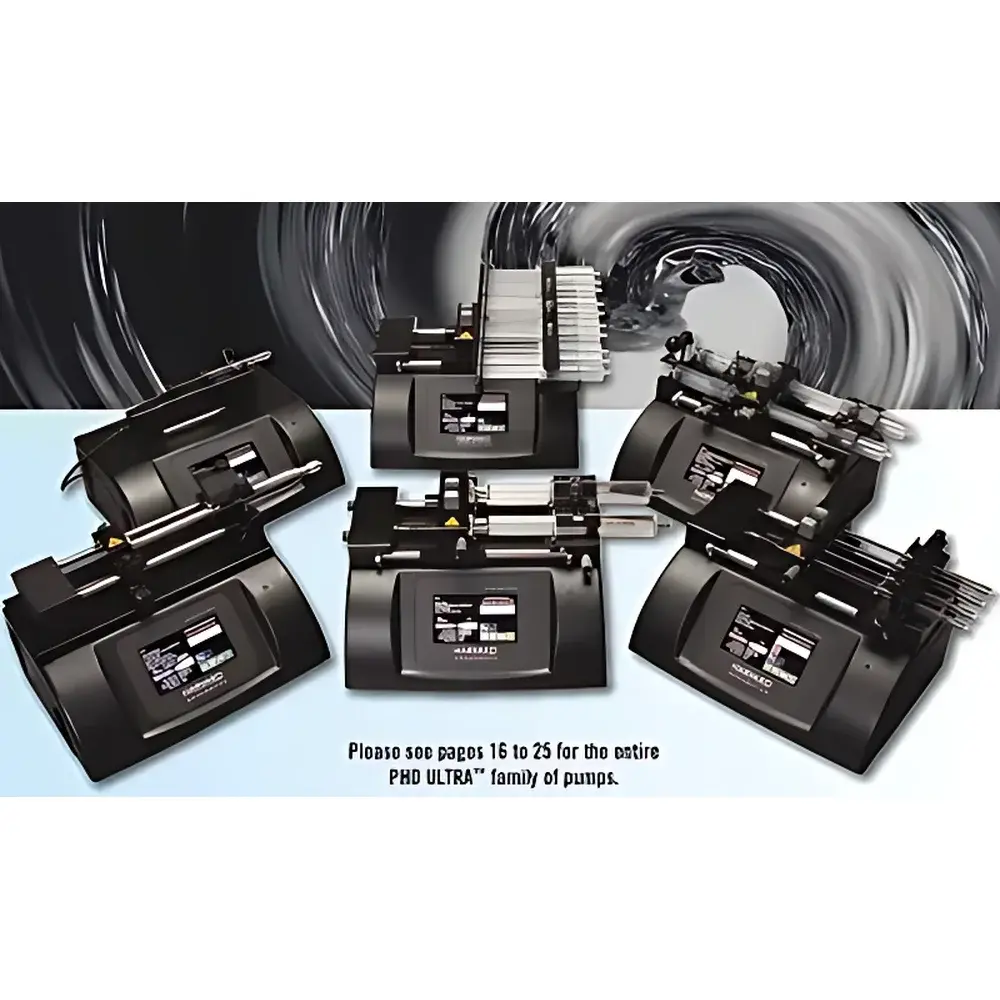
Harvard Apparatus PHD ULTRA Infusion/Withdrawal Syringe Pump
| Brand | Harvard Apparatus |
|---|---|
| Origin | USA |
| Model | PHD ULTRA Infusion/Withdrawal |
| Flow Rate Range | 1.50 pL/min to 216.0 mL/min |
| Maximum Linear Force | 34 kg |
| Syringe Compatibility | Plastic, Glass, Stainless Steel |
| Interface | USB |
| Configuration Options | Standalone, Remote, Satellite, Module |
Overview
The Harvard Apparatus PHD ULTRA Infusion/Withdrawal Syringe Pump is a high-precision, dual-directional fluid handling system engineered for exacting laboratory and preclinical research applications. Operating on a micro-stepping motor-driven linear actuation principle, the pump delivers programmable, bidirectional flow—capable of both precise infusion and controlled withdrawal—with nanoliter-to-milliliter volumetric accuracy. Its architecture supports closed-loop feedback via integrated position sensing, enabling reproducible delivery across extended operational cycles without drift. Designed for integration into automated workflows—including electrophysiology rigs, microdialysis systems, and microfluidic platforms—the PHD ULTRA meets the stringent demands of quantitative dosing in neuroscience, pharmacokinetics, and analytical chemistry laboratories.
Key Features
- Dual-mode operation: Independent control of infusion and withdrawal protocols within a single pump head, eliminating the need for mechanical reconfiguration or valve switching.
- Ultra-low flow capability: Sustained delivery down to 1.50 pL/min—achieved through sub-micron step resolution and optimized lead-screw mechanics—enabling picoliter-scale dosing for single-cell injection or tracer studies.
- High-force linear actuation: 34 kg maximum push force ensures compatibility with high-viscosity fluids (e.g., polymer solutions, suspensions, hydrogels) and large-bore syringes up to 60 mL capacity.
- Multi-configuration flexibility: Available as standalone unit, remote-controlled variant (via USB-hosted command set), satellite module (for synchronized multi-pump networks), or OEM-ready syringe pump module for embedded instrumentation.
- Material-compatibility design: Pump heads accept syringes fabricated from plastic (e.g., polypropylene), borosilicate glass, and stainless steel—supporting chemical resistance, sterilization, and pressure-rated applications per ISO 8536-4 and USP .
- USB 2.0 interface with ASCII-based command protocol (PHD Command Language), enabling direct integration with LabVIEW, MATLAB, Python (pySerial), and custom SCADA environments.
Sample Compatibility & Compliance
The PHD ULTRA accommodates standard Luer-lock and Luer-slip syringes ranging from 0.5 µL microsyringes to 60 mL industrial barrels. Its modular mounting system supports third-party syringe adapters and custom plunger interfaces. Fluid path integrity is maintained through non-lubricated, chemically inert drive mechanisms; no internal seals contact the fluid stream. The device complies with IEC 61010-1:2010 for electrical safety in laboratory equipment and conforms to electromagnetic compatibility requirements per FCC Part 15 Class B and EN 61326-1. For regulated environments, audit-trail-capable software extensions support 21 CFR Part 11–compliant electronic records when paired with validated host applications.
Software & Data Management
Harvard Apparatus provides the PHD ULTRA Control Software—a Windows-based application supporting real-time flow monitoring, multi-step program sequencing, and time-stamped event logging. All parameters—including target volume, flow rate, direction, acceleration ramp, and pause intervals—are programmable with sub-second temporal resolution. Export formats include CSV and XML for downstream analysis in statistical packages (e.g., GraphPad Prism, R). For automated environments, the pump responds to industry-standard serial commands (e.g., “RUN”, “STOP”, “DIR INFUSE”, “VOL 10uL”) over USB virtual COM port, facilitating deterministic synchronization with external triggers (TTL, analog voltage) and time-critical experimental paradigms.
Applications
- Neuroscience: Intracerebral microinjection of viral vectors, tracers, or pharmacological agents with spatial and temporal precision in rodent stereotaxic surgery.
- Microdialysis: Continuous analyte sampling and retrodialysis calibration using matched infusion/withdrawal rates to maintain equilibrium at the probe membrane.
- Microfluidics: Priming, flushing, and reagent metering in lab-on-a-chip devices requiring stable low-flow conditions and pulseless delivery.
- Preclinical PK/PD: Controlled intravenous or subcutaneous dosing in conscious or anesthetized animal models, aligned with GLP-aligned study protocols.
- Materials science: Precise deposition of nanoparticle suspensions or conductive inks during additive manufacturing or thin-film fabrication.
FAQ
What syringe sizes are supported by the PHD ULTRA?
The pump accepts syringes from 0.5 µL to 60 mL, including glass, plastic, and stainless-steel variants compliant with ISO 8536 standards.
Does the PHD ULTRA support gradient or multi-phase flow programming?
Yes—via user-defined step sequences, the pump can execute up to 999 discrete flow segments with independent rate, volume, and direction parameters per step.
Is the USB interface compatible with Linux or macOS systems?
While native software is Windows-only, the ASCII command protocol is OS-agnostic; developers may implement cross-platform control using standard serial libraries.
Can the PHD ULTRA be used in sterile or cleanroom environments?
The pump housing meets IP20 ingress protection; optional stainless-steel front panel and autoclavable syringe adapters are available for ISO Class 5–7 environments.
How is calibration traceability maintained?
Each unit ships with NIST-traceable calibration documentation; users may perform field verification using gravimetric or fluorometric methods per ASTM E2790 or ISO 8655-6 guidelines.



