
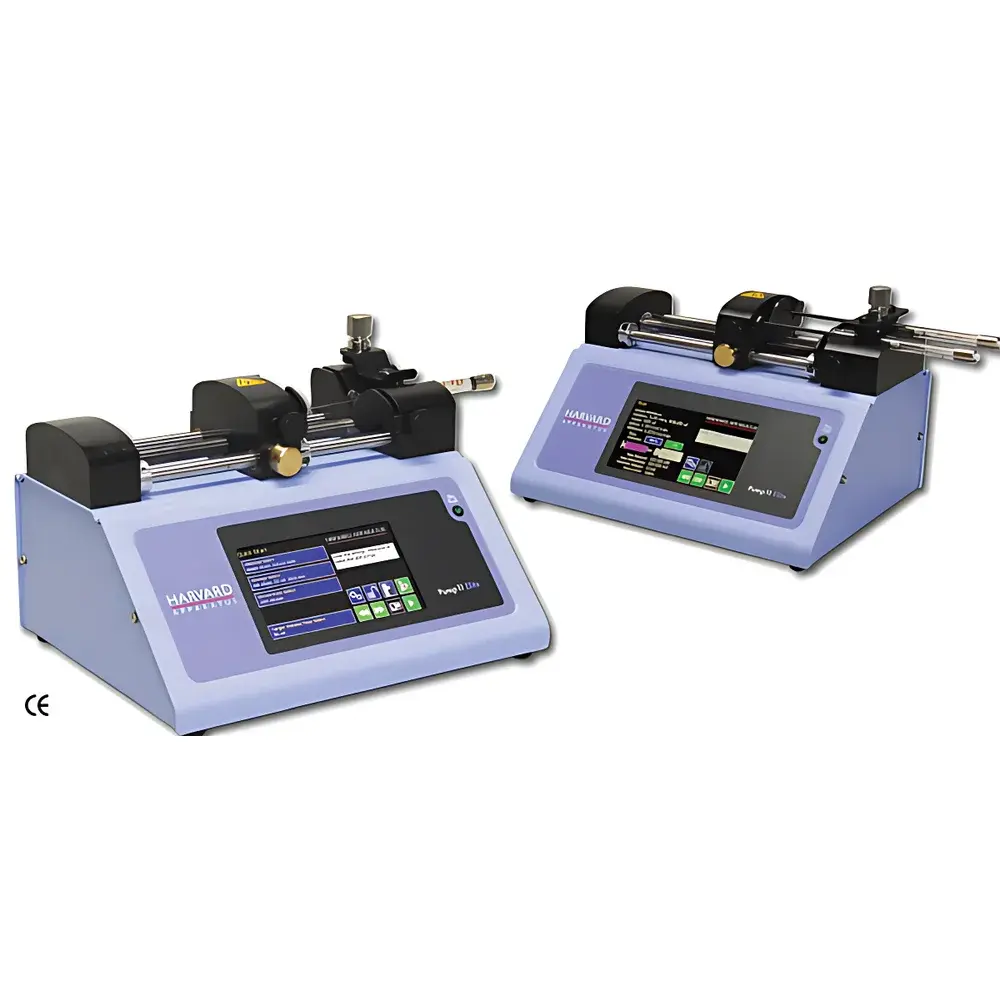
Harvard Apparatus Pump 11 Elite Syringe Pump
| Brand | Harvard Apparatus |
|---|---|
| Origin | USA |
| Model | Pump 11 Elite |
| Configuration | Single- or Dual-Channel, Infusion-Only or Programmable Infusion/Withdrawal |
| Accuracy | ±0.5% |
| Repeatability | ±0.05% |
| Compatible Syringe Volumes (Single Channel) | 0.5 µL to 50/60 mL |
| Compatible Syringe Volumes (Dual Channel) | 0.5 µL to 10 mL |
| Flow Rate Range (Single Channel) | 1.26 pL/min to 88.4 mL/min |
| Flow Rate Range (Dual Channel) | 1.26 pL/min to 26.02 mL/min |
| Display | 4.3-inch WQVGA TFT Color Touchscreen |
| Communication Interfaces | RS-485, IEEE-1394 (FireWire), USB 2.0, TTL/IO via 15-pin D-sub connector |
| Footswitch Support | Yes |
| Linear Force Output | 16 kg (at 100% drive power) |
| Syringe Material Compatibility | Glass and Polypropylene (Luer-lock and non-Luer syringes) |
Overview
The Harvard Apparatus Pump 11 Elite is a high-precision, microprocessor-controlled syringe pump engineered for demanding laboratory applications requiring nanoliter-to-milliliter volumetric delivery with exceptional accuracy and long-term stability. Based on closed-loop stepper motor actuation and real-time position feedback, the Pump 11 Elite operates on the principle of linear displacement control—converting rotational motion into precise axial movement of the syringe plunger. This architecture eliminates reliance on flow-rate calibration curves or fluid-property assumptions, ensuring consistent volumetric delivery across diverse viscosities, temperatures, and syringe geometries. Designed and manufactured in the United States, the system meets stringent engineering standards for biomedical research, electrophysiology, microfluidics, analytical chemistry, and preclinical drug delivery studies where trace-level dosing integrity is critical.
Key Features
- True volumetric precision: ±0.5% accuracy and ±0.05% repeatability over full operating range—validated per ISO 8536-4 and ASTM D3418 methodologies.
- Dual operational modes: Select between dedicated infusion-only operation or fully programmable bidirectional infusion/withdrawal protocols with independent ramping, pausing, and stepwise sequencing.
- Intuitive 4.3-inch WQVGA color touchscreen interface with gesture-responsive navigation, real-time flow profile visualization, and on-device parameter logging.
- Modular hardware architecture supporting single- or dual-channel configurations—each channel independently controllable with synchronized or asynchronous timing.
- High-force linear drive system delivering up to 16 kg of sustained push/pull force, enabling compatibility with high-backpressure applications including capillary microinjection and HPLC sample loading.
- Comprehensive I/O ecosystem: TTL-triggered start/stop, analog voltage input for external flow modulation, RS-485 daisy-chaining for multi-pump networks, IEEE-1394 (FireWire) for deterministic timing-critical experiments, and USB 2.0 for configuration backup and firmware updates.
Sample Compatibility & Compliance
The Pump 11 Elite accommodates standard Luer-lock and non-Luer syringes fabricated from borosilicate glass or medical-grade polypropylene, with volume ranges spanning 0.5 µL to 60 mL per channel (subject to mechanical stroke limits). Its force-tuned actuation mechanism ensures reliable performance with low-compliance tubing (e.g., fused silica, PEEK, stainless steel) and high-viscosity media (up to 50,000 cP at 25°C). The device conforms to IEC 61000-6-3 (EMC emission) and IEC 61000-6-2 (immunity) standards. It supports GLP/GMP-aligned workflows through optional audit-trail-enabled software (PumpWare Pro), which logs all parameter changes, run timestamps, operator IDs, and error events in compliance with FDA 21 CFR Part 11 requirements when deployed with validated system configurations.
Software & Data Management
Pump 11 Elite integrates natively with Harvard Apparatus’ PumpWare software suite (Windows-based), offering protocol-driven experiment design, real-time remote monitoring, and export of time-stamped flow, volume, pressure (when paired with optional pressure sensors), and status data in CSV or HDF5 formats. PumpWare Pro adds electronic signature support, role-based access control, and automated report generation compliant with ISO/IEC 17025 documentation practices. All communication interfaces—including USB, RS-485, and FireWire—support SCPI command syntax, enabling seamless integration into LabVIEW, MATLAB, Python (via PySerial or PyFireWire), and custom C/C++ acquisition frameworks.
Applications
- Chronic intracerebral or intrathecal drug infusion in rodent neuroscience models
- Controlled reagent addition in stopped-flow kinetics and enzyme assay platforms
- Calibration and validation of mass spectrometry autosamplers and LC-MS injection systems
- Microfluidic chip priming, gradient generation, and cell culture medium perfusion
- Electrophysiological patch-clamp experiments requiring ultra-low-noise solution exchange
- Automated titration systems in environmental water quality analysis and pharmaceutical dissolution testing
FAQ
What syringe sizes are supported in dual-channel mode?
Dual-channel operation supports syringes from 0.5 µL to 10 mL per channel; maximum combined volume is constrained by mechanical stroke length and synchronization logic—not total capacity.
Can the Pump 11 Elite be integrated into a GMP-regulated manufacturing environment?
Yes—when used with PumpWare Pro, validated IQ/OQ protocols, and documented change control procedures, it satisfies key elements of Annex 11 and FDA 21 CFR Part 11 for computerized system validation.
Is pressure sensing capability built-in?
No—pressure monitoring requires an external transducer (e.g., Harvard Apparatus PHD Ultra Pressure Module) connected via analog input; the pump itself regulates volumetric displacement, not pressure.
Does the device support continuous infusion over 72+ hours without interruption?
Yes—tested for uninterrupted operation exceeding 120 hours at mid-range flow rates with ambient temperature stabilization and periodic syringe reseating verification per maintenance guidelines.
How is calibration traceability maintained?
Factory calibration is NIST-traceable; users may perform in-house verification using gravimetric or photometric methods per ASTM E2798, with results stored in PumpWare’s calibration log archive.



