
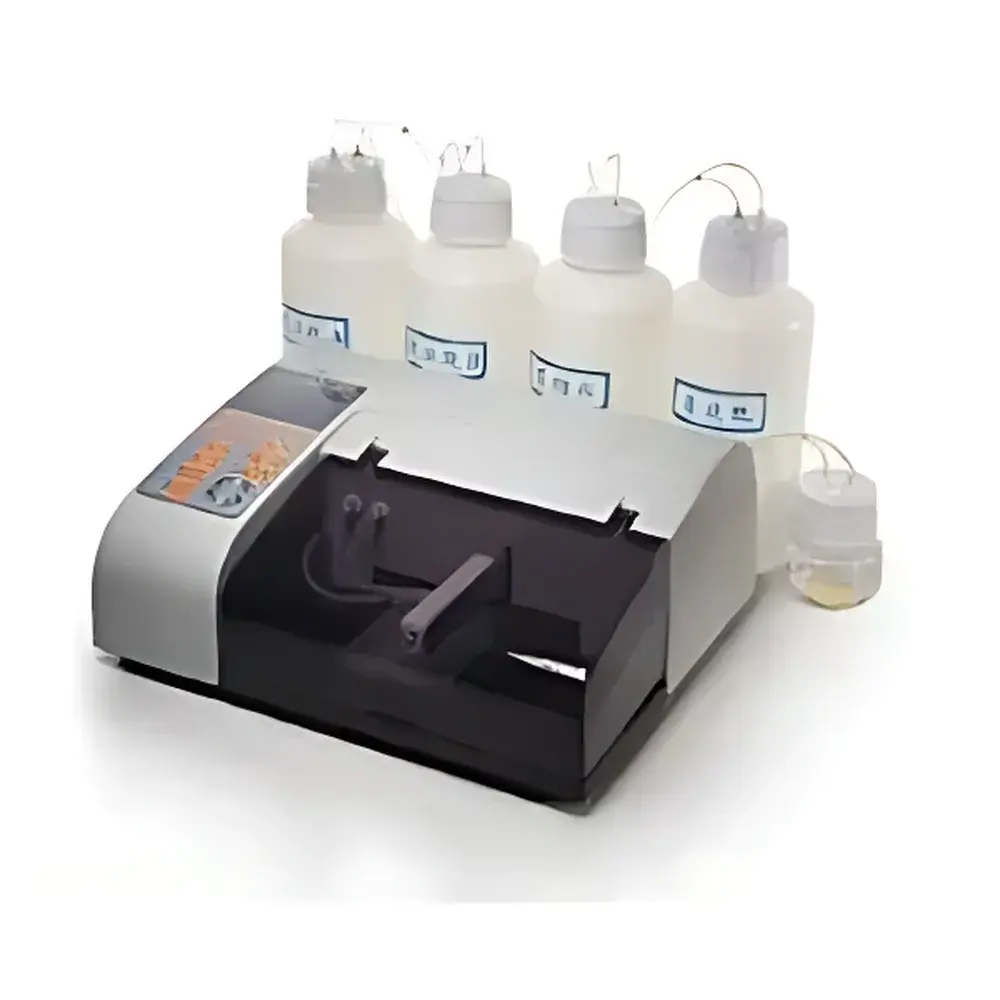
Heales PW-812 Automated Microplate Washer
| Brand | Heales |
|---|---|
| Origin | Shenzhen, China |
| Model | PW-812 |
| Instrument Type | Multifunctional Plate Washer |
| Wash Head Configuration | 8-channel and 12-channel dual-needle design |
| Wash Solution Channels | 3 (2 detergent solutions + 1 deionized water |
| Soaking Time Range | 0–999 seconds/minutes/hours (user-selectable unit) |
| Wash Cycles | 1–999 cycles adjustable |
| Residual Liquid Volume per Well | <0.7 µL |
| Orbital Shaking Function | Medium speed |
| Plate Compatibility | 96-well and 48-well microplates with flat, U-bottom, V-bottom, and round-bottom well geometries |
| Dispense Volume Range | 50–950 µL/well (50 µL increments) |
| extended range | 0–6000 µL/well (25 µL increments) |
| Dispense Precision | CV <1.5% across 96 wells |
| Aspiration Time | 0.1–99.9 s (0.1 s resolution) |
| Rinse Line Flush Duration | 0–240 s |
| Auto-Rinse Interval for DI Water | 0–20 s |
| Wash Head Positioning Modes | 5 preset vertical alignment options (horizontal, left, center, right, bottom-touch) |
Overview
The Heales PW-812 is a programmable, dual-needle automated microplate washer engineered for high-throughput immunoassay, ELISA, and cell-based assay workflows in clinical diagnostics, pharmaceutical QC, and academic research laboratories. It operates on the principle of precise aspiration and dispense fluidics—utilizing positive-pressure peristaltic pumping for solution delivery and vacuum-driven aspiration through independently controlled wash heads. Unlike centrifugal or orbital甩干-style washers, the PW-812 employs a contact-based, bottom-touch capable wash head architecture that ensures consistent liquid removal across heterogeneous plate formats—including flat-bottom, U-bottom, V-bottom, and round-bottom 96-well and 48-well plates. Its modular wash channel design supports up to five independent fluid paths, enabling sequential or parallel use of multiple detergents, buffers, and rinse agents without cross-contamination—a critical requirement for multiplexed assay protocols requiring stringent carryover control.
Key Features
- Dual-needle 8-channel and 12-channel wash heads with five-position vertical calibration (horizontal, left, center, right, bottom-touch) for adaptive plate geometry alignment
- Three dedicated fluid channels (expandable to five) supporting two wash reagents and one deionized water rinse—each with independent flow-rate and timing control
- Precision dispense system delivering 50–950 µL/well in 50 µL increments; extended mode enables 0–6000 µL/well at 25 µL resolution with CV <1.5% across all 96 wells
- Aspiration time fully adjustable from 0.1 to 99.9 seconds in 0.1-second increments, ensuring optimal removal of viscous or high-protein samples
- Programmable soaking, shaking, and bubble-disruption wash modes with independent timing controls (0–999 s/min/hr)
- Residual volume consistently maintained below 0.7 µL per well under standardized aspiration conditions, verified per ISO 20776-2:2021 Annex D guidelines for microplate washer performance validation
- Integrated DI water auto-rinse cycle (0–20 s interval) to prevent crystallization and salt deposition in fluidic pathways during extended operation
Sample Compatibility & Compliance
The PW-812 accommodates standard ANSI/SLAS-compliant 96-well and 48-well microplates regardless of well bottom geometry. Its mechanical design conforms to IEC 61000-6-2 (immunity) and IEC 61000-6-3 (emission) standards for laboratory instrumentation. While not certified for GMP manufacturing environments out-of-the-box, the device supports audit-ready operation when paired with validated SOPs: its parameter logging capability (via optional RS232/USB interface) permits traceable record retention aligned with FDA 21 CFR Part 11 principles for electronic records and signatures. All fluid-contact components—including silicone tubing, stainless-steel needles, and PTFE-coated valves—are compliant with USP Class VI biocompatibility requirements and resistant to common ELISA wash buffers (e.g., PBS-Tween, Tris-HCl, glycine-HCl).
Software & Data Management
The PW-812 features an embedded LCD interface with intuitive menu navigation and real-time status feedback (aspiration pressure, fluid level alerts, error codes). Protocol storage capacity includes up to 99 user-defined methods, each preserving full parameter sets: dispense volume, soak duration, shake intensity, aspiration delay, and channel assignment. Optional PC connectivity enables method import/export via CSV, facilitating lab-wide protocol harmonization. Though lacking native LIMS integration, the instrument’s ASCII-based serial output allows seamless ingestion into third-party laboratory information systems supporting ASTM E1384-compliant data exchange formats. Audit trail functionality—including operator ID tagging and timestamped parameter changes—is available when configured with external logging software meeting GLP documentation requirements.
Applications
- Routine ELISA plate washing in clinical microbiology and serology labs performing infectious disease screening (e.g., HIV, HBV, HCV)
- High-sensitivity chemiluminescent immunoassays (CLIA) where low residual volume minimizes background signal interference
- Cell-based assays involving adherent or suspension cultures requiring gentle yet thorough buffer exchange
- Preparation of plates for downstream mass spectrometry or qPCR analysis where carryover of detergents or salts must be minimized
- Validation studies supporting ISO 15197:2013 (in vitro diagnostic devices for blood glucose monitoring) where washer reproducibility directly impacts assay precision
FAQ
What plate formats does the PW-812 support?
It accepts ANSI/SLAS-standard 96-well and 48-well plates with flat, U-bottom, V-bottom, and round-bottom configurations.
Can the instrument be validated for regulated environments?
Yes—when operated with documented SOPs and external electronic record-keeping, it meets foundational requirements for GLP and ISO 17025-compliant laboratories.
How is carryover minimized between wash cycles?
Through independent channel isolation, post-cycle DI water flush, and bottom-touch aspiration positioning calibrated to minimize meniscus retention.
Is maintenance documentation provided?
Comprehensive service manuals, tubing replacement schedules, and preventive maintenance checklists are included with shipment and accessible via Heales’ technical support portal.
What troubleshooting support is available for fluidic blockages?
The instrument includes diagnostic self-tests for pump pressure, aspiration vacuum, and valve actuation—coupled with a structured fault tree guide covering common causes of clogging, leakage, and sensor misalignment.




