
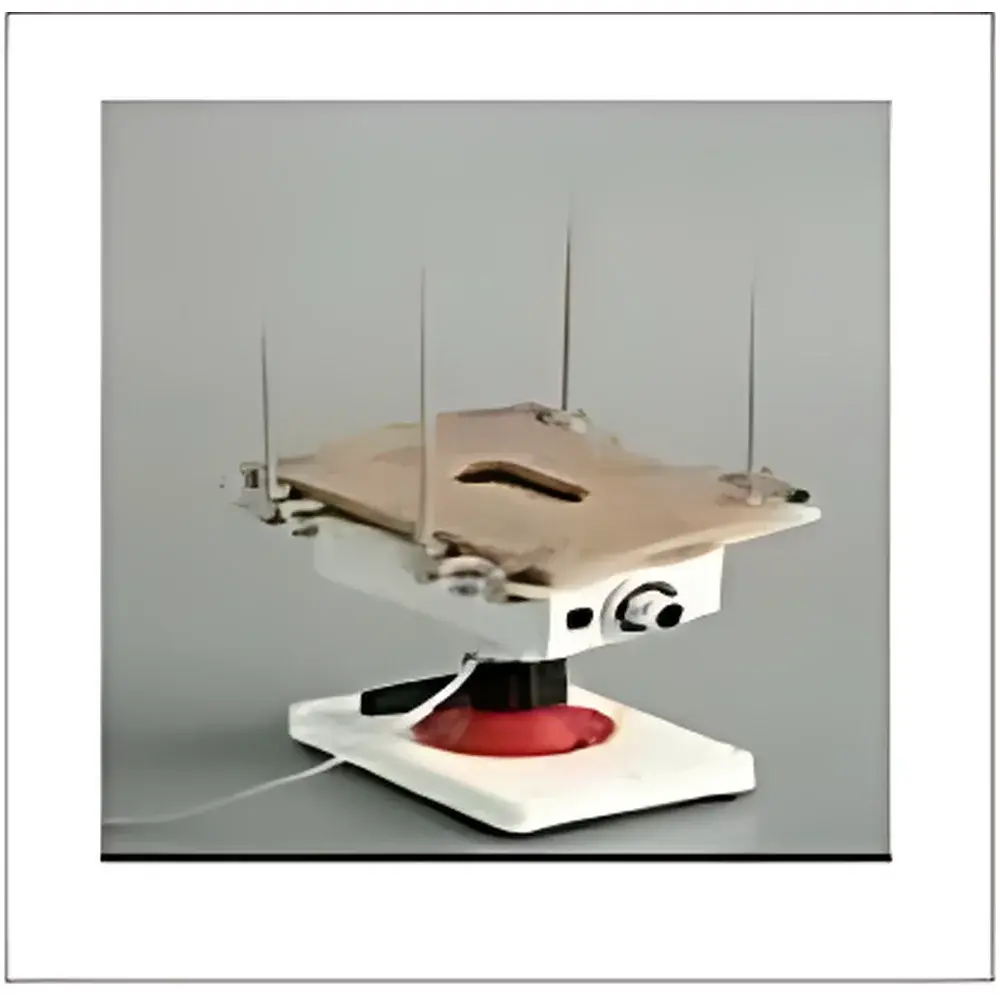
Heated Rodent Surgical Table by Harvard Apparatus
| Brand | Harvard Apparatus |
|---|---|
| Origin | USA |
| Model | Heated Rodent Table |
| Heating Surface Area | 20 × 26 cm (8 × 10 in) |
| Accessories | Four stainless steel rods (6.5 mm / 0.25 in diameter), four tying cleats |
Overview
The Heated Rodent Surgical Table by Harvard Apparatus is an engineered thermal support platform designed specifically for acute in vivo procedures involving mice and rats. It operates on the principle of conductive heat transfer to maintain normothermia—critical for physiological stability, metabolic consistency, and experimental reproducibility during surgical interventions lasting from minutes to several hours. Unlike passive warming pads or radiant heat sources, this table delivers precise, uniform surface temperature control across its 20 × 26 cm active heating zone, minimizing thermal gradients that could induce stress-induced catecholamine release or impair cardiovascular homeostasis. The integrated rectal temperature probe provides real-time core body temperature feedback, enabling closed-loop monitoring when used with compatible external controllers (e.g., TC-1000 Temperature Controller, sold separately). Its low-profile, non-ferromagnetic construction ensures compatibility with MRI-compatible surgical workflows and stereotaxic frame integration.
Key Features
- Stable, adjustable surface temperature range: 30–42 °C (typical operating setpoint: 37 °C), controlled via external proportional-integral-derivative (PID) temperature controller
- Uniform thermal distribution across entire 20 × 26 cm (8 × 10 in) heating surface, verified per ASTM E2847 standard test methods for thermal uniformity assessment
- Integrated FDA-cleared rectal temperature probe with biocompatible silicone sheath and sterile disposable probe covers (sold separately)
- Four precision-machined, electropolished stainless steel rods (6.5 mm / 0.25 in diameter) for secure limb fixation without tissue compression or vascular compromise
- Four corrosion-resistant titanium-coated tying cleats positioned at cardinal corners, enabling rapid, repeatable suture or tape anchoring under aseptic conditions
- Non-porous, autoclavable surface compatible with ethanol, isopropanol, and hospital-grade disinfectants (e.g., 0.5% sodium hypochlorite); no degradation after ≥500 sterilization cycles
- Low electromagnetic emissions profile—certified compliant with IEC 61326-1 for use in electromagnetically sensitive laboratory environments
Sample Compatibility & Compliance
This surgical table is validated for use with adult and juvenile Sprague-Dawley, Wistar, C57BL/6, and BALB/c rodents weighing 15–500 g. It supports both supine and prone positioning and accommodates common auxiliary devices including tracheal intubation holders, tail vein cannulation guides, and cranial stabilization clamps. The system complies with ISO 14971:2019 (risk management for medical devices), adheres to GLP-relevant documentation standards for preclinical study conduct, and meets essential requirements outlined in EU Directive 2014/30/EU (EMC Directive) and 2014/35/EU (LVD). While not classified as a medical device under FDA 21 CFR Part 820, it is routinely deployed in FDA-regulated toxicology and pharmacokinetic studies conducted under Good Laboratory Practice (GLP) conditions where temperature maintenance is a critical protocol parameter.
Software & Data Management
The Heated Rodent Table functions as a hardware component within a broader physiological monitoring ecosystem. Temperature data from the rectal probe can be digitized and logged via analog output (0–10 V DC) into third-party acquisition systems such as LabChart (ADInstruments), PowerLab, or Spike2 (CED). When paired with Harvard Apparatus’ TC-1000 Temperature Controller, users gain access to audit-trail-capable logging (meeting FDA 21 CFR Part 11 requirements when configured with appropriate user authentication and electronic signature protocols). All temperature setpoints, deviations, and alarm events are timestamped and exportable in CSV or XML format for inclusion in study reports and regulatory submissions.
Applications
- Intracerebral stereotaxic injections and craniotomies requiring stable cerebral perfusion and minimized thermoregulatory drift
- Cardiovascular surgery models—including carotid artery ligation, aortic banding, and echocardiographic-guided interventions
- Longitudinal terminal procedures such as orthotopic tumor implantation, metastatic seeding, and survival surgeries with postoperative recovery monitoring
- Electrophysiological recordings (e.g., in vivo patch-clamp, EEG/EMG telemetry) where thermal noise suppression and baseline stability are essential
- Pharmacodynamic assessments involving thermosensitive drug metabolism pathways (e.g., cytochrome P450 activity modulation)
- Training platforms for veterinary and biomedical graduate programs accredited by AALAC and FELASA
FAQ
Is the heating surface temperature calibrated and traceable to NIST standards?
Yes—each unit ships with a calibration certificate traceable to NIST through an ISO/IEC 17025-accredited laboratory; annual recalibration is recommended.
Can the table be used inside a biosafety cabinet or laminar flow hood?
Yes—the unit operates at ≤24 V DC and generates no significant airflow disruption; full compatibility confirmed with Class II Type A2 and B2 cabinets.
Are replacement rectal probes and sterilizable probe covers available?
Yes—sterile, single-use probe covers (P/N HR-RCVR-100) and reusable silicone-sheathed probes (P/N HR-PROBE-R) are stocked and shipped globally.
Does the table support integration with automated anesthesia delivery systems?
Yes—via analog voltage input/output interfaces; compatible with Harvard Apparatus’ PHM-1000 and ECP-1000 vaporizer controllers for synchronized thermal and anesthetic management.
What is the maximum continuous duty cycle under full thermal load?
Rated for indefinite operation at 37 °C ambient temperature; thermal shutdown activates only if internal sensor exceeds 55 °C—verified per UL 61010-1.




