
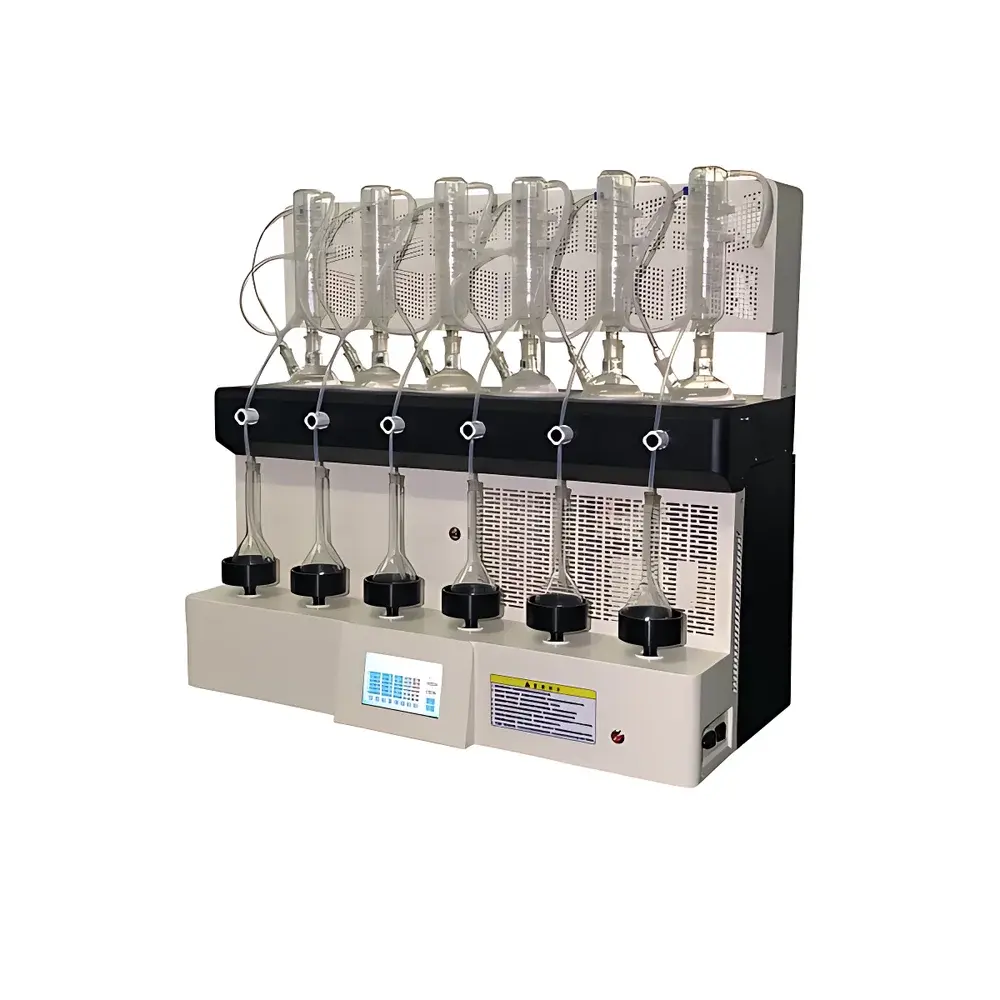
HEB-06S Integrated Intelligent Sub-boiling Distillation System by Jihepu
| Brand | Jihepu |
|---|---|
| Origin | Shandong, China |
| Model | HEB-06S |
| Instrument Type | Sub-boiling Distillation Apparatus |
| Heating Units | 6 independent channels |
| Max Power | 3600 W (adjustable) |
| Heating Method | Far-infrared ceramic heating (no open flame) |
| Single-channel Power Range | 0–500 W |
| Temperature Control | 5–35 °C (refrigeration system) |
| Refrigeration Capacity | 1700 W |
| Distillation Rate | 2–12 mL/min |
| Endpoint Detection | Load-cell-based mass sensing (1–500 g, ±0.5 g repeatability) |
| Display | 7-inch color touch screen |
| Distillation Vessel Options | 250 mL × 6 or 500 mL × 6 (standard), custom configurations available |
| Receiving Vessel Flexibility | Universal support for volumetric flasks, Erlenmeyer flasks, graduated cylinders, etc. |
| Compliance Standards | HJ 503–2009, HJ 484–2009, HJ 537–2009, HJ 745–2015 |
Overview
The HEB-06S Integrated Intelligent Sub-boiling Distillation System is an engineered solution for precise, reproducible, and fully automated distillation in environmental, clinical, food safety, and research laboratories. Designed to comply with established Chinese environmental analytical standards—including HJ 503–2009 (phenols), HJ 484–2009 (cyanides), HJ 537–2009 (ammonia nitrogen), and HJ 745–2015 (soil cyanides)—the system implements sub-boiling distillation principles to minimize analyte loss, oxidation, and contamination during volatile compound isolation. Unlike conventional boiling-point distillation, sub-boiling operation maintains the distillate source below its atmospheric boiling point, significantly reducing co-distillation of non-volatile interferences and enhancing recovery fidelity. The HEB-06S integrates six independently controlled far-infrared ceramic heating modules, a closed-loop refrigerated condensation system, real-time mass-based endpoint detection, and intelligent anti-suckback protection—enabling unattended operation while maintaining >95% analyte recovery across validated method matrices.
Key Features
- Independent 6-channel heating control: Each of the six far-infrared ceramic heating units operates at 0–500 W with bowl-shaped radiation geometry, delivering uniform thermal distribution without open flame or electrical spark hazards. Integrated thermal shielding minimizes ambient heat loss and improves energy efficiency.
- Sub-boiling distillation architecture: Optimized for low-temperature, high-selectivity volatilization—ideal for thermally labile analytes such as phenols, cyanides, ammonia, and SO₂—reducing decomposition and improving method robustness.
- Mass-sensing endpoint control: High-resolution load-cell transducers monitor distillate mass in real time; users define target collection mass (1–500 g) with ±0.5 g repeatability. Upon reaching setpoint, heating terminates automatically and visual/audible alerts activate.
- Dual-mode refrigerated condensation: Combines air-cooled finned heat exchangers with a built-in compressor (1700 W cooling capacity) to maintain condenser temperatures between 5–35 °C. Eliminates dependency on external tap water or chiller units—critical for high-throughput or water-restricted environments.
- Intelligent anti-suckback protection: Vacuum pressure monitoring via electromagnetic valve ensures automatic pressure equalization prior to system shutdown, preventing backflow of distillate into the boiling flask—a common cause of sample contamination and analytical error.
- Modular receiving interface: No fixed receiver geometry; accommodates standard volumetric flasks (e.g., 100 mL, 250 mL), conical flasks, graduated cylinders, or custom vessels. Adjustable tray design supports heterogeneous vessel configurations across all six channels.
Sample Compatibility & Compliance
The HEB-06S is validated for use in regulatory-compliant workflows requiring trace-level quantification of volatile analytes in aqueous and solid-phase matrices. It supports digestion-distillation sequences for soil and sediment analysis per HJ 745–2015 and enables direct distillation of wastewater, drinking water, and biological extracts per HJ 503–2009 and HJ 537–2009. Its sub-boiling methodology aligns with ISO 6439 (water quality—determination of cyanide), ASTM D129–19 (sulfur in petroleum products), and USP (loss on drying), serving as a platform-compatible alternative where gentle thermal separation is required. All wetted surfaces are borosilicate glass (ground-glass joints per ISO 385), ensuring chemical inertness and minimizing adsorption losses. The system does not incorporate data integrity features compliant with FDA 21 CFR Part 11; however, raw endpoint mass logs and runtime metadata can be exported for GLP/GMP audit trail reconstruction.
Software & Data Management
Operation is managed via a 7-inch capacitive touch interface running embedded Linux firmware. Parameters—including heating power per channel, refrigeration setpoint, distillation duration (0–200 min), and target mass—are configured pre-run and stored with timestamped session IDs. The system records real-time mass accumulation curves, heating status, refrigeration temperature, and endpoint confirmation signals. Data export is supported via USB flash drive in CSV format; no network connectivity, remote access, or cloud synchronization is implemented. For laboratories operating under ISO/IEC 17025 or CAP accreditation requirements, manual documentation of calibration events (load cell verification, temperature probe validation) and preventive maintenance logs is recommended to satisfy traceability obligations.
Applications
- Quantitative isolation of phenolic compounds (e.g., 4-aminoantipyrine-reactive phenols) from municipal wastewater and industrial effluents.
- Distillation-assisted liberation of free and weak-acid dissociable cyanide species prior to titrimetric or spectrophotometric detection.
- Ammonia nitrogen recovery from digested water samples using steam distillation followed by acid titration (HJ 537–2009).
- SO₂ residue extraction from wine, fruit juices, and preserved foods via acidified distillation and subsequent iodometric analysis.
- Kjeldahl nitrogen determination workflows requiring clean distillate collection without bumping or foaming artifacts.
- Moisture content analysis in oils and fats where traditional oven drying induces oxidation—leveraging azeotropic distillation with toluene or xylene.
FAQ
What distillation principle does the HEB-06S employ?
It utilizes sub-boiling (low-temperature) distillation, maintaining the sample below its atmospheric boiling point to enhance selectivity and reduce thermal degradation of volatile analytes.
Can the system be used for EPA Method 375.4 (cyanide)?
Yes—its performance aligns with the distillation requirements of EPA 375.4 when operated within the specified temperature and flow parameters; method-specific validation remains the user’s responsibility.
Is external cooling water required?
No—the integrated compressor-based refrigeration system (1700 W capacity) and air-cooled heat exchanger eliminate dependence on municipal water or external chillers.
How is calibration of the mass-sensing endpoint verified?
Users perform periodic verification using NIST-traceable weights (100 g, 250 g, 500 g) placed directly on each receiving tray; deviation beyond ±0.5 g requires service recalibration.
Are consumables or proprietary parts required?
No—glassware components (flasks, condensers, adapters) conform to standard ISO/DIN dimensions; replacement parts are commercially available through scientific glassware suppliers.



