
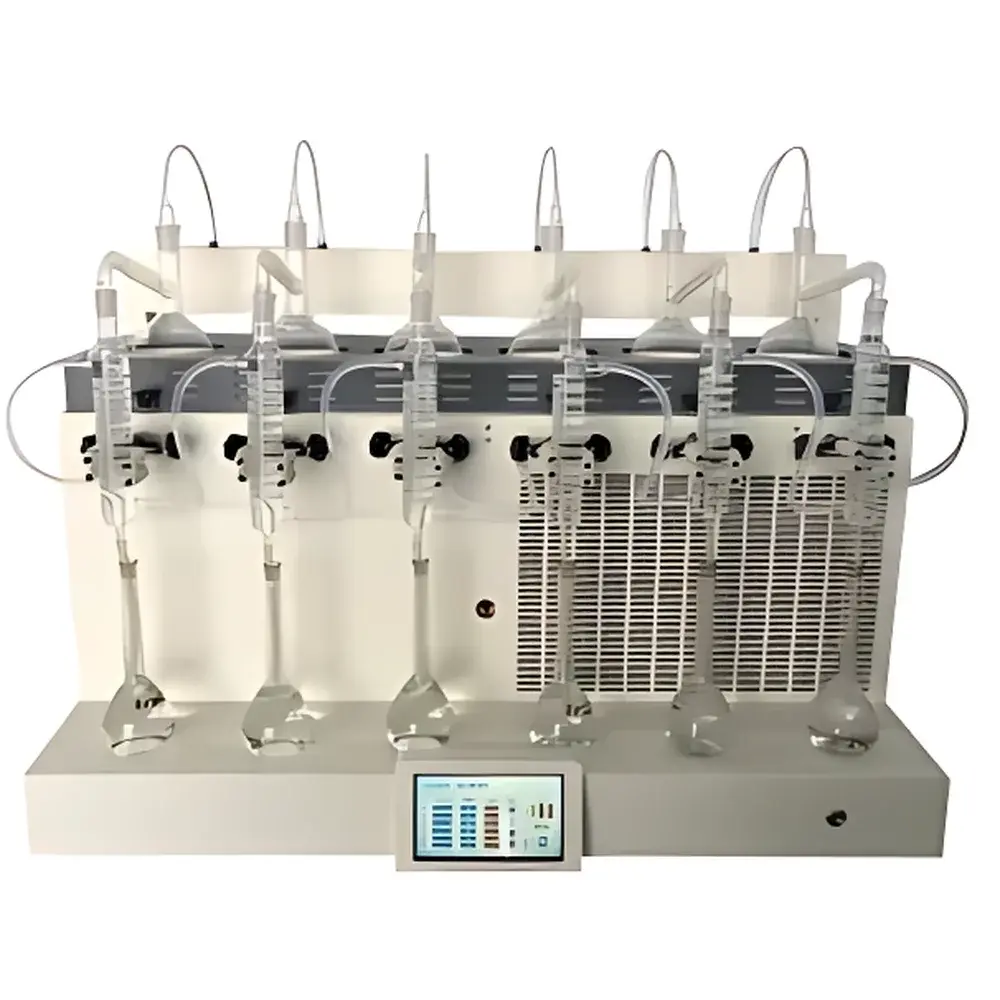
HEB-601 Fully Automated Integrated Distillation System
| Brand | Jihepu (Jinan Hepu) |
|---|---|
| Origin | Shandong, China |
| Model | HEB-601 |
| Heating Method | Far-infrared ceramic heating |
| Number of Independent Heating Zones | 1–6 (individually controllable) |
| Display | LCD touch screen |
| Heating Power per Zone | 100–800 W (adjustable) |
| Total Rated Power | 3600 W |
| Voltage/Frequency | 220 V / 50 Hz |
| Heating Time to Setpoint | 3–8 min |
| Distillation Rate | 10–15 mL/min |
| Endpoint Control | Time-based auto-stop (0–200 min adjustable) |
| Cooling System | Closed-loop internal recirculation with built-in refrigeration compressor |
| Anti-suckback Protection | Solenoid vacuum valve integrated |
| Distillation Flask Capacity | Standard 500 mL × 6 (custom sizes available) |
| Receiving Flask Capacity | Standard 250 mL × 6 (custom sizes available) |
| Distillate Recovery Rate | ≥95% (validated per accredited laboratory protocols) |
| Compliance | Designed for EPA Method 410.2, ISO 6439, ISO 5667-16, and GB/T 5750.5–2023 applications |
Overview
The HEB-601 Fully Automated Integrated Distillation System is an engineered solution for standardized, reproducible distillation in analytical laboratories performing regulatory-compliant water, wastewater, soil extract, and biological matrix analysis. It operates on the principle of controlled thermal separation under atmospheric or slightly reduced pressure, utilizing far-infrared ceramic heating elements to deliver uniform, flameless energy transfer—eliminating hot-spot formation and minimizing thermal degradation of volatile analytes. Unlike conventional open-bath or mantle-based systems, the HEB-601 integrates temperature regulation, real-time endpoint logic, and active cooling within a single compact chassis. Its design conforms to core operational requirements of environmental testing standards including EPA Method 410.2 (phenols), EPA Method 415.3 (cyanide), ISO 6439 (ammonia nitrogen), and Chinese national standard GB/T 5750.5–2023 (drinking water quality analysis). The system supports method validation through documented recovery performance (≥95% for phenol, cyanide, ammonia-N, Kjeldahl nitrogen, and moisture-in-oil determinations) and is routinely deployed in GLP-compliant laboratories undergoing CNAS or CMA accreditation.
Key Features
- Fully independent control of up to six distillation channels—each with programmable power (100–800 W), real-time temperature monitoring, and individual endpoint timing.
- Far-infrared ceramic heating modules provide rapid thermal response (3–8 min to setpoint), consistent heat flux distribution, and intrinsic waterproofing—ensuring safety in humid or spill-prone lab environments.
- Integrated closed-loop refrigeration cooling system eliminates dependency on external tap water or chiller units; maintains condenser efficiency across extended runs without flow-rate fluctuations or ambient temperature drift.
- Intelligent anti-suckback protection via solenoid vacuum isolation valves—critical for low-boiling, high-volatility analytes (e.g., HCN, C6H5OH) where receiver immersion below absorbent liquid level poses contamination or assay failure risk.
- High-resolution LCD touch interface with multilingual menu navigation (English default), method storage capability (≥100 user-defined protocols), and real-time status logging (power, time elapsed, active channel status).
- Modular flask compatibility: accepts standard 500 mL round-bottom flasks (ISO 22648 compliant) and 250 mL receiving vessels; optional adapters support alternative geometries (e.g., 1000 mL digestion flasks, 50 mL volumetric receivers).
Sample Compatibility & Compliance
The HEB-601 is validated for aqueous, semi-aqueous, and oil-based matrices requiring precise volatilization prior to colorimetric, titrimetric, or instrumental detection. It accommodates samples per EPA 410.2 (total phenols), EPA 415.3 (free and total cyanide), ISO 5667-16 (ammonia in surface waters), and ISO 6439 (Kjeldahl nitrogen in wastewater). All wetted components—including heating blocks, condenser jackets, and vapor pathways—are constructed from borosilicate glass (DIN 7080) and PTFE-sealed joints, ensuring chemical inertness toward acidic digestates, alkaline absorbers (e.g., NaOH for cyanide trapping), and organic solvents. The system meets electrical safety requirements per IEC 61010-1 and electromagnetic compatibility per EN 61326-1. While not FDA 21 CFR Part 11–certified out-of-box, audit-ready electronic logs (timestamped start/stop, power profile, user ID) can be exported in CSV format for integration into LIMS or QA documentation workflows.
Software & Data Management
The embedded firmware supports traceable operation through non-volatile memory storage of run parameters and outcomes. Each distillation cycle records channel-specific data: initiation timestamp, set duration, actual runtime, final power output, and manual override flags. Export is facilitated via USB 2.0 port (no proprietary drivers required); files are structured as plain-text CSV with ISO 8601 timestamps and SI-unit annotations. No cloud connectivity or remote access functionality is included—consistent with institutional cybersecurity policies governing analytical instrumentation. For laboratories implementing electronic record retention per ISO/IEC 17025:2017 Clause 7.5.2, the HEB-601’s local log integrity is reinforced by write-once EEPROM architecture and absence of automatic overwrites.
Applications
- Environmental monitoring labs quantifying phenolic compounds in industrial effluents using 4-aminoantipyrine spectrophotometry.
- Public health laboratories determining free cyanide in drinking water per APHA Standard Methods 4500-CNB.
- Wastewater treatment facilities measuring ammonia nitrogen prior to nitrification process control.
- Food and feed testing laboratories performing Kjeldahl nitrogen determination in protein content assays.
- Petrochemical QA/QC departments extracting moisture from lubricating oils via ASTM D95–05 (reapproved 2020) methodology.
- Academic research groups conducting method development for simultaneous multi-analyte distillation with post-distillate fraction collection.
FAQ
Does the HEB-601 support pressure-controlled distillation?
No. It operates exclusively at ambient pressure with optional slight vacuum assist (≤−0.05 MPa) only for enhanced volatility of high-boiling-point analytes—no integrated pressure sensor or feedback loop is provided.
Can the system be calibrated for temperature accuracy?
Yes. Each heating zone includes a factory-calibrated PT100 sensor; users may perform field verification using NIST-traceable thermometers inserted into dummy flasks filled with glycerol or silicone oil.
Is maintenance of the internal refrigeration unit user-serviceable?
Compressor and refrigerant circuit servicing requires authorized technical personnel; however, condenser coil cleaning and coolant level inspection are accessible via front-panel service ports.
What is the expected service life of the ceramic heating elements?
Rated for ≥10,000 operational hours under nominal load (500 W average); lifespan extends significantly when operated below 70% maximum power rating.
Are third-party LIMS integrations supported?
Direct API or HL7 interfaces are not implemented; however, exported CSV logs are compatible with common LIMS ingestion modules supporting delimited-file import protocols.



