
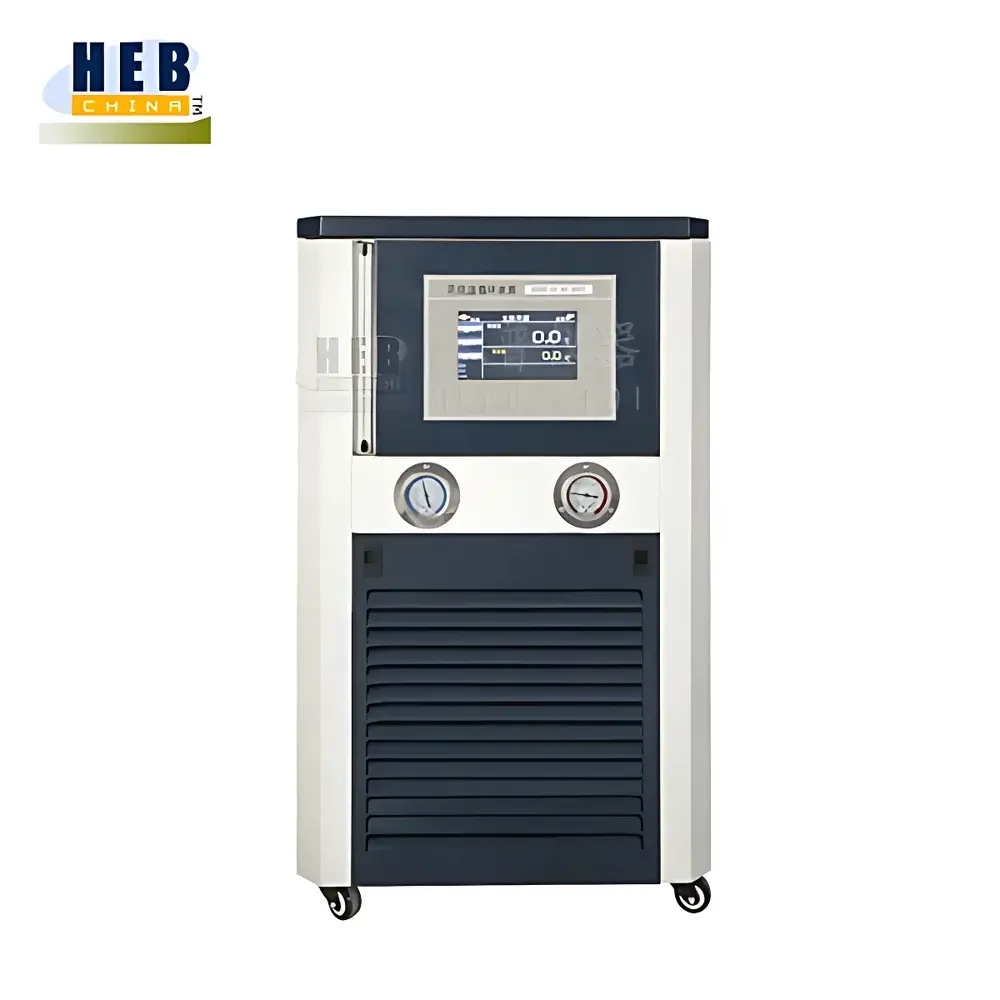
Hebei Jihepu GDSZ-20/20 High-Low Temperature Circulating Chiller
| Brand | Hebei Jihepu |
|---|---|
| Model | GDSZ-20/20 |
| Temperature Range | -20 °C to +200 °C |
| Ambient Operating Conditions | 5–35 °C, ≤70% RH |
| Power Supply | 220 V AC / 50 Hz |
| Heating Power | 3000 W |
| Compressor | 1.5 HP (1103 W), R22 refrigerant |
| Refrigeration Capacity | 3486 W at 20 °C |
| Circulation Pump | 100 W, 4–6 m head, 20–40 L/min flow rate, max pressure 0.4 MPa |
| Plate Heat Exchanger Area | 0.53 m² |
| Temperature Control Accuracy | ±0.1 °C |
| Sensor | PT100 |
| Display | LCD with keypad interface |
| Safety Protections | Delay start, overcurrent, overheat, and overtemperature cutoffs |
| External Port | 3/4″ NPT (6-point thread) × 2, supplied with two 2 m stainless steel braided hoses |
| Fluid Compatibility | Premium-grade silicone oil (Class I) |
| Dimensions (W×D×H) | 710 × 780 × 1055 mm |
| Net Weight | 115 kg |
| Shipping Volume | 0.56 m³ |
| Gross Weight | 131 kg |
Overview
The Hebei Jihepu GDSZ-20/20 High-Low Temperature Circulating Chiller is a dual-mode thermal management system engineered for precise, stable, and repeatable temperature control across demanding laboratory and pilot-scale applications. It operates on a closed-loop circulation principle, integrating mechanical compression refrigeration and resistive electric heating within a single integrated architecture. The unit employs a hermetically sealed R22 refrigeration circuit—comprising a 1.5 HP compressor, air-cooled condenser, expansion valve, pressure safety switch, and a high-efficiency 0.53 m² plate heat exchanger—to achieve rapid cooling from ambient down to –20 °C. Simultaneously, a 3000 W tubular immersion heater enables controlled ramping up to +200 °C. Thermal energy is transferred via forced convection of silicone oil through an internal centrifugal pump (20–40 L/min, 4–6 m head) and standardized 3/4″ NPT external ports, enabling seamless integration with jacketed reactors, calorimeters, spectroscopic cells, and other externally jacketed equipment.
Key Features
- Wide operational temperature span: –20 °C to +200 °C with ±0.1 °C stability under steady-state conditions
- Dual independent thermal subsystems: Optimized refrigeration (3486 W capacity at 20 °C) and high-power heating (3000 W) coexist without cross-interference
- Robust circulation architecture: Stainless-steel reinforced hoses (2 × 2 m), corrosion-resistant cold-rolled steel enclosure with anti-acid epoxy coating, and IP20-rated electrical compartment
- Intelligent microprocessor-based controller with backlit LCD display and tactile membrane keypad for intuitive setpoint entry, real-time monitoring, and alarm status review
- Comprehensive safety suite: Compressor delay start (to prevent liquid slugging), overcurrent protection, dual-stage thermal cutoff (heater and bath), and high-pressure shutdown
- Low-maintenance design: No consumables beyond periodic silicone oil verification; service-accessible compressor, pump, and heat exchanger modules
Sample Compatibility & Compliance
The GDSZ-20/20 is validated for use with Class I non-volatile, thermally stable heat transfer media—including methylphenyl silicone oils meeting ASTM D5275 specifications. Its fluid path is fully compatible with glass, stainless steel (316L), and PTFE-lined reactor jackets. While not certified to UL/CSA or CE for standalone medical or hazardous-area deployment, the unit meets general-purpose laboratory safety requirements per IEC 61010-1:2010 (Edition 3) for electrical safety and EN 60335-1 for household and similar equipment. Its temperature control algorithm supports GLP-compliant process documentation when paired with external data loggers; however, it does not natively support FDA 21 CFR Part 11 audit trails or electronic signatures.
Software & Data Management
The GDSZ-20/20 operates as a standalone analog-digital hybrid instrument with no built-in USB, Ethernet, or RS-485 interfaces. All operational parameters—including setpoint, actual bath temperature, pump status, and fault codes—are displayed locally on the LCD panel. For integration into automated workflows, users may connect optional third-party analog output modules (0–10 V or 4–20 mA) to monitor temperature and trigger external logic controllers. Data logging requires external acquisition hardware; the device does not store historical profiles or support firmware updates.
Applications
- Temperature-controlled synthesis in jacketed glass reactors (e.g., Grignard, lithiation, hydrogenation)
- Calibration of differential scanning calorimeters (DSC), thermogravimetric analyzers (TGA), and dynamic mechanical analyzers (DMA)
- Stability testing of pharmaceutical formulations per ICH Q1A(R2) guidelines (long-term, accelerated, intermediate conditions)
- Viscosity measurement support for rotational rheometers requiring precise thermal preconditioning
- Cooling of high-power laser diodes and UV-Vis spectrophotometer light sources
- Material testing under thermal cycling protocols (e.g., ASTM D6930, ISO 22088-3)
FAQ
What heat transfer fluids are recommended for operation across the full –20 °C to +200 °C range?
Premium methylphenyl silicone oil (e.g., DC-200 series, viscosity grade 100–350 cSt at 25 °C) is required. Mineral oils and ethylene glycol/water mixtures are incompatible below –10 °C or above +150 °C.
Can the unit maintain ±0.1 °C accuracy during active heating and cooling transitions?
The ±0.1 °C specification applies only under stabilized static conditions (±0.5 °C typical during ramping). Achieving tight control during dynamic transitions depends on external system thermal mass and insulation quality.
Is remote monitoring or control possible without third-party hardware?
No. The GDSZ-20/20 lacks native digital communication interfaces. Integration with SCADA or LIMS requires external analog-to-digital converters and relay modules.
What maintenance intervals are recommended for continuous 24/7 operation?
Compressor oil inspection every 12 months; silicone oil replacement every 24 months or after 5000 operating hours—whichever occurs first. Condenser coil cleaning is advised quarterly in dusty environments.
Does the unit comply with RoHS or REACH substance restrictions?
Yes. All PCBs, wiring harnesses, and structural components conform to EU Directive 2011/65/EU (RoHS 2) and Regulation (EC) No 1907/2006 (REACH), excluding the R22 refrigerant, which is subject to national phase-out schedules under the Montreal Protocol.



