
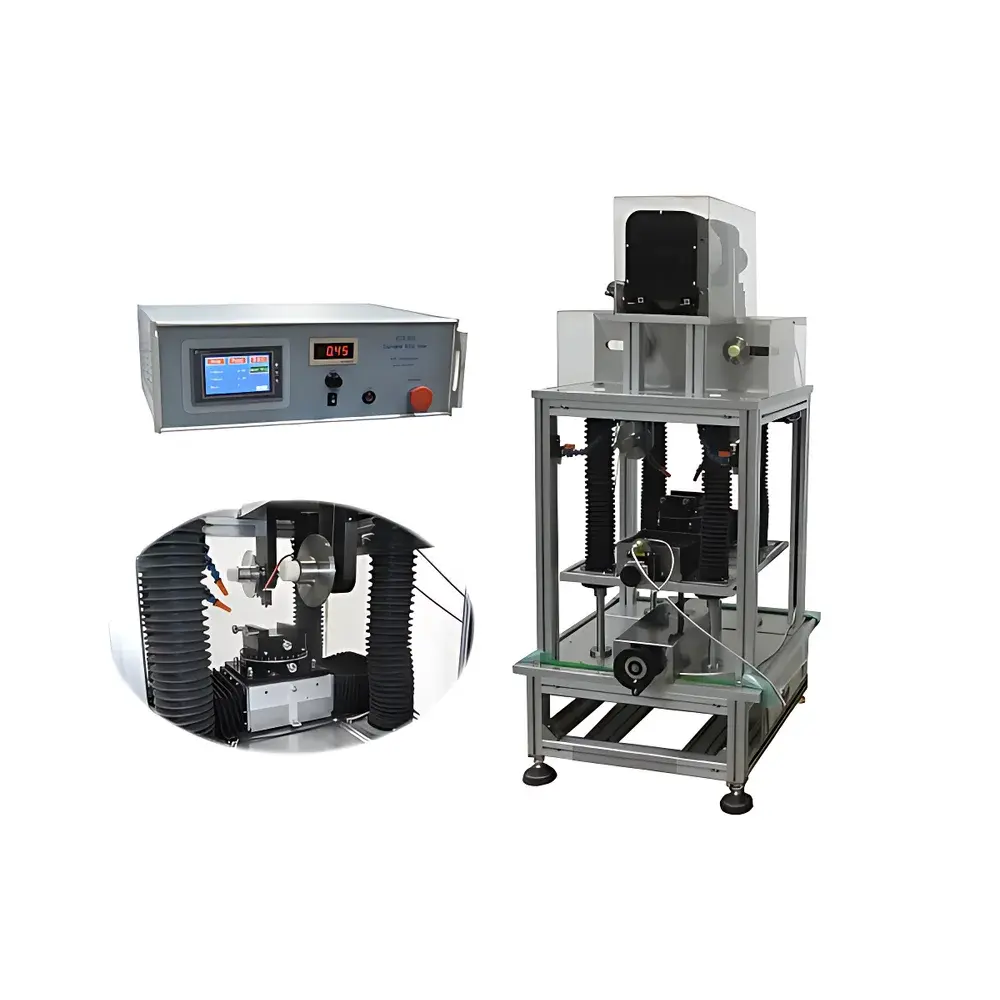
Hefei Kejing STX-603 Precision Diamond Wire Saw
| Brand | Hefei Kejing |
|---|---|
| Origin | Anhui, China |
| Model | STX-603 |
| Instrument Type | Precision Diamond Wire Saw |
| Cutting Wire Total Length | 80 m |
| Wire Speed | 0–3 m/s (adjustable) |
| Horizontal Rotation Range | 0–360° |
| Tilt Angle | ±10° |
| Positioning Accuracy | 5 arcminutes |
| Y-axis Travel | ≤180 mm |
| Z-axis Travel | ≤165 mm |
| Y/Z-axis Resolution | 0.01 mm |
| Max Sample Dimensions | Φ150 mm × 150 mm |
| Dimensions (W×D×H) | 617 mm × 620 mm × 1451 mm |
| Weight | 110 kg |
| Standard Accessories | 2 tension pulleys, 2 guide pulleys, 2 rolls diamond wire, 1 water pump, 2 resin-ceramic blocks, 4 wax rods |
| Optional Accessories | Diamond wire (Φ0.14 mm, Φ0.2 mm, Φ0.3 mm, Φ0.4 mm), recirculating coolant pump, oil-based coolant |
Overview
The Hefei Kejing STX-603 Precision Diamond Wire Saw is a CE-certified, laboratory-grade wire saw engineered for high-fidelity sectioning of brittle and anisotropic materials. It operates on the principle of abrasive cutting using electroplated or resin-bonded diamond-impregnated wire under controlled tension and linear motion. Unlike rotary or abrasive-wheel cutters, the STX-603 minimizes mechanical stress, thermal distortion, and subsurface damage—critical for preserving crystallographic integrity in single crystals, cleavable ceramics, and layered composites. Its design targets applications where dimensional accuracy, surface finish, and minimal kerf loss are prerequisites—particularly for preparing specimens for X-ray diffraction (XRD), electron backscatter diffraction (EBSD), transmission electron microscopy (TEM), and thin-film epitaxy studies. The machine supports both wet and dry cutting modalities, with integrated water-cooling capability to suppress heat generation and extend wire life during prolonged operation.
Key Features
- Adjustable wire speed (0–3 m/s) enables optimization for material hardness and desired surface roughness—slower speeds enhance precision for fragile crystals; higher speeds improve throughput for dense ceramics or metals.
- Two-axis rotational and tilting sample stage (0–360° horizontal rotation, ±10° tilt) with 5 arcminute angular resolution facilitates orientation-specific sectioning aligned to crystallographic planes (e.g., basal vs. prismatic cuts in hexagonal lattices).
- High-resolution linear motion system delivers 0.01 mm positional repeatability along both Y- and Z-axes, ensuring consistent slice thickness control down to 0.2 mm—validated via calibrated micrometer measurement and optical profilometry.
- Modular aluminum extrusion frame provides structural rigidity while maintaining low mass and corrosion resistance—suitable for cleanroom and vibration-sensitive environments when mounted on passive isolation tables.
- Integrated water circulation system (pump + reservoir) ensures uniform coolant delivery across the cutting interface, mitigating thermal cracking in glasses, sintered oxides, and bioceramics.
Sample Compatibility & Compliance
The STX-603 accommodates a broad spectrum of inorganic and organic solids, including but not limited to silicon carbide (SiC), lithium niobate (LiNbO₃), fused quartz, alumina (Al₂O₃), zirconia (ZrO₂), granite, basalt, stainless steel (304/316), PCB laminates, polyimide films, hydroxyapatite scaffolds, and polymer-ceramic composites. Its cutting performance has been empirically validated against ASTM C1327-22 (Standard Test Method for Vickers Indentation Hardness of Advanced Ceramics) and ISO 6474-1:2016 (Dentistry — Ceramic materials — Part 1: Powder-liquid systems), supporting compliance workflows in quality control labs operating under GLP or ISO/IEC 17025 frameworks. CE marking confirms conformity with EU Machinery Directive 2006/42/EC and Electromagnetic Compatibility Directive 2014/30/EU.
Software & Data Management
While the STX-603 operates via intuitive manual controls and analog dials, its motion parameters—including wire speed, feed rate, and angular position—are fully documentable via external logging tools. Users may integrate digital calipers, laser displacement sensors, or USB-connected encoders to record real-time positional data for traceability. For laboratories requiring audit-ready records, the system supports integration with LabArchives ELN or Benchling via CSV export of operator logs and calibration certificates. All firmware updates and maintenance documentation adhere to ISO 9001:2015 revision control protocols, with version-stamped release notes archived for regulatory review.
Applications
- Preparation of <0.3 mm wafers from photovoltaic-grade silicon ingots for minority carrier lifetime mapping.
- Cutting oriented sections of geological core samples (e.g., shale, schist) for microstructural analysis without inducing cleavage-induced artifacts.
- Sectioning of additively manufactured metal parts (Inconel 718, Ti-6Al-4V) for grain boundary characterization via EBSD.
- Fabrication of TEM lamellae from battery electrode cross-sections (NMC cathodes, graphite anodes) with minimized ion-beam damage.
- Serial sectioning of bioactive glass scaffolds for 3D reconstruction of pore interconnectivity using micro-CT.
FAQ
What diamond wire diameters are compatible with the STX-603?
The system accepts standard diamond wires with outer diameters of 0.14 mm, 0.2 mm, 0.3 mm, and 0.4 mm—each selected based on required kerf width, material hardness, and surface finish specifications.
Is oil-based coolant supported?
Yes—optional oil-based coolants can be used with the recirculating pump accessory; however, water-based coolants are recommended for routine operation to avoid residue buildup on optical components and wire guides.
Does the STX-603 meet FDA 21 CFR Part 11 requirements?
The base unit does not include electronic audit trails or user authentication; however, it can be deployed within a Part 11-compliant environment when paired with validated third-party data acquisition software and procedural SOPs.
What is the expected service life of the diamond wire under typical usage conditions?
Wire longevity varies with material hardness and cutting parameters: approximately 15–25 linear meters for SiC; 40–60 meters for soda-lime glass; and up to 100 meters for polymers—monitored via visual inspection and tensile load testing.
Can the STX-603 be integrated into automated sample preparation workflows?
Yes—the machine’s mechanical interface allows mounting on XY translation stages and synchronization with programmable logic controllers (PLCs) via 0–10 V analog I/O signals for feed rate and wire speed modulation.



