
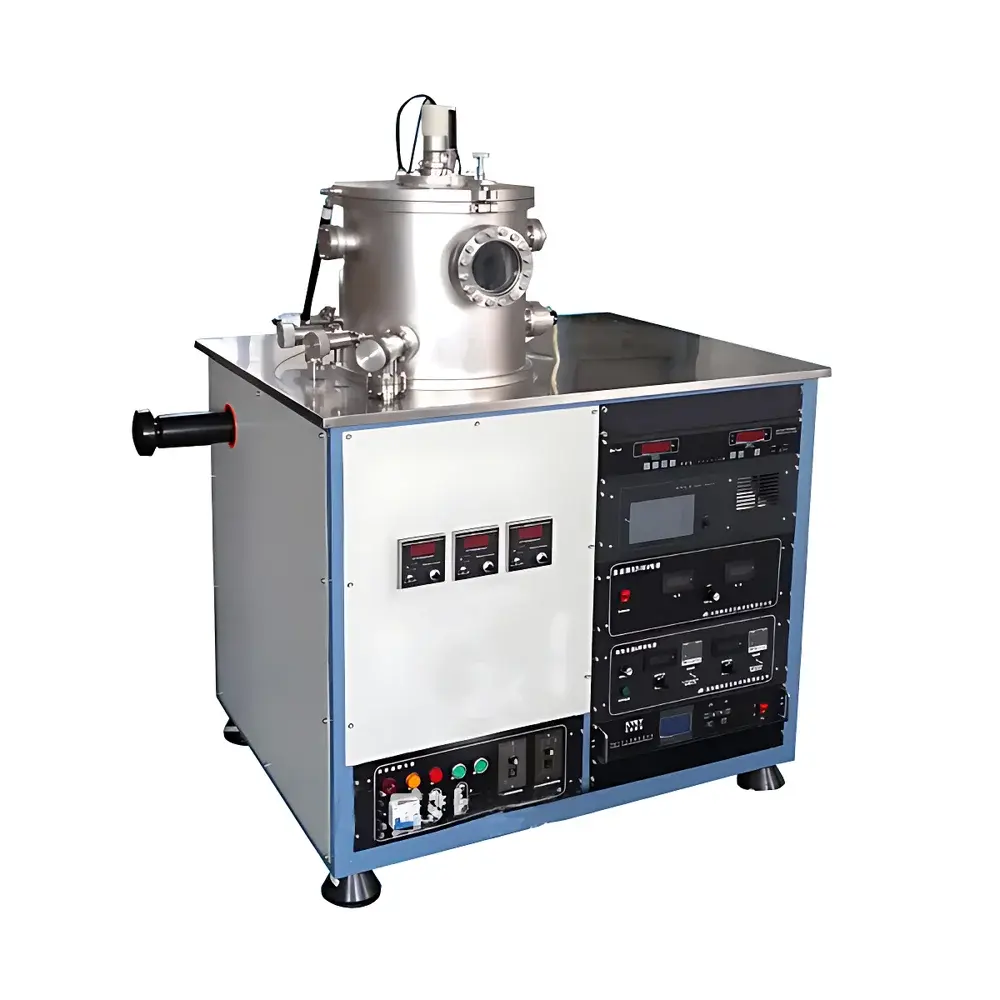
Hefei University of Technology Tri-Target High-Vacuum Magnetron Sputtering System
| Origin | Liaoning, China |
|---|---|
| Manufacturer Type | Authorized Distributor |
| Origin Category | Domestic (China) |
| Model | Tri-Target High-Vacuum |
| Pricing | Upon Request |
| Ultimate Vacuum | ≤5.0×10⁻⁵ Pa (after bake-out) |
| Leak Rate | <2.0×10⁻⁸ Pa·L/s |
| Pump-Down Time to 6.0×10⁻⁴ Pa | ≤40 min (after brief air exposure + dry N₂ purge) |
| Chamber Dimensions | Ø300 × 350 mm |
| Target Diameter | Ø50 mm (3 targets |
| Substrate Heating Range | RT–600 °C ±1 °C |
| Substrate Rotation Speed | ≤30 rpm |
| Target-to-Substrate Distance | Adjustable from 90–110 mm |
| Base Pressure Recovery (12 h idle) | ≤5 Pa |
Overview
The Hefei University of Technology Tri-Target High-Vacuum Magnetron Sputtering System is a compact, modular thin-film deposition platform engineered for precision research and advanced teaching applications in materials science, solid-state physics, and surface engineering laboratories. It operates on the principle of magnetron sputtering—where energetic argon ions, accelerated in a low-pressure plasma environment, bombard solid target materials, ejecting atoms that subsequently condense as uniform, adherent thin films on thermally controlled substrates. The system integrates three independently configurable magnetron sources within a single-chamber ultra-high vacuum (UHV) architecture, enabling sequential, co-sputtering, and reactive sputtering modes under tightly regulated gas composition (Ar, N₂, O₂, or mixtures). Its design emphasizes reproducibility, operational flexibility, and compliance with fundamental UHV engineering standards—including metal-sealed flanges, electrolytically polished 304 stainless steel chamber construction, and bake-out capability—ensuring stable base pressures below 5.0×10⁻⁵ Pa and minimal outgassing during extended deposition cycles.
Key Features
- Modular tri-target configuration: Three Ø50 mm magnetron cathodes—including one high-field permanent-magnet source and one enhanced-strength electromagnet source—support DC, RF, and reactive sputtering protocols; one target is optimized for ferromagnetic materials (e.g., Fe, Ni, Co alloys).
- Dual-pump vacuum architecture: A 6 L/s direct-drive rotary vane pump paired with a 600 L/s turbomolecular pump achieves rapid pump-down and robust base pressure stability; KF25 electromagnetic valves and a CF100 gate valve enable precise process sequencing and isolation.
- Thermally regulated rotating substrate stage: Equipped with an armored heating element covering Ø100 × 100 mm area, closed-loop thermocouple feedback control (±1 °C accuracy), and motor-driven rotation (<30 rpm) to ensure film thickness uniformity across wafers up to 4 inches.
- Reactive gas compatibility: Integrated mass flow controllers (MFCs) and digital pressure regulation support stoichiometric oxide (e.g., TiO₂, ITO), nitride (e.g., TiN, Si₃N₄), and carbide compound synthesis via controlled introduction of O₂, N₂, or CH₄ into the Ar plasma.
- UHV-grade mechanical design: Chamber fabricated from electropolished 304 stainless steel, welded via TIG process, sealed with oxygen-free copper gaskets or fluorosilicone elastomers, and fitted with RF100 viewport for real-time process monitoring.
Sample Compatibility & Compliance
The system accommodates rigid planar substrates including silicon wafers (up to 100 mm), glass slides, quartz crystals, ceramic tiles, and metallic foils. All internal surfaces are UHV-compatible, minimizing hydrocarbon contamination and enabling deposition of optically transparent, electrically insulating, or highly conductive films without interfacial oxidation artifacts. The vacuum architecture meets ISO 27893:2017 requirements for residual gas analysis readiness and supports GLP-compliant operation when integrated with audit-trail-capable data logging (via optional RS485/Modbus interface). Leak integrity testing per ASTM E499-17 is validated at <2.0×10⁻⁸ Pa·L/s, confirming suitability for studies requiring low defect density and high interfacial purity—such as tunnel junction fabrication or epitaxial seed layer development.
Software & Data Management
While the base configuration features analog-digital hybrid control (including dedicated power supplies for DC/RF sputtering, heater regulation, and vacuum sequencing), optional PC-based supervisory software enables full recipe management, real-time parameter logging (pressure, power, temperature, gas flow), and automated process scripting. Data export complies with ASTM E1447-21 for materials characterization metadata, and time-stamped logs include operator ID, session start/end timestamps, and hardware state flags—supporting traceability under FDA 21 CFR Part 11 when deployed in regulated R&D environments. All firmware updates follow IEC 62443-3-3 security guidelines for industrial control systems.
Applications
This system serves core thin-film research functions across academia and industry: synthesis of transparent conducting oxides (TCOs) for photovoltaic device prototyping; preparation of hard wear-resistant coatings (e.g., CrN, AlTiN) on microelectromechanical systems (MEMS) components; fabrication of magnetic multilayers (e.g., Co/Pt, Fe/Cr) for spintronics investigations; growth of dielectric buffer layers (e.g., Al₂O₃, SiO₂) for gate-stack integration; and development of catalytic nanostructured films (e.g., Pt/TiO₂) for electrochemical sensor platforms. Its modular targeting and reactive gas handling also facilitate combinatorial library deposition for high-throughput materials screening.
FAQ
What vacuum level can be achieved after chamber bake-out?
Ultimate pressure reaches ≤5.0×10⁻⁵ Pa following standardized 150 °C/12 h bake-out procedure.
Is the system compatible with RF sputtering of insulating targets?
Yes—two of the three magnetron sources support dual-mode (DC/RF) operation up to 500 W RF power, enabling deposition from Al₂O₃, SiO₂, and other dielectric targets.
Can substrate temperature be ramped programmatically?
Yes—the integrated Japanese-made temperature controller supports multi-step ramp-soak profiles with ±1 °C thermal stability over 600 °C maximum.
What safety interlocks are implemented?
Hardware-enforced interlocks prevent RF power activation unless chamber pressure is below 5×10⁻³ Pa, and halt heating if cooling water flow drops below threshold.
Are calibration certificates provided for vacuum gauges and thermocouples?
Factory calibration reports per ISO/IEC 17025 are included; NIST-traceable recalibration services available upon request.



