
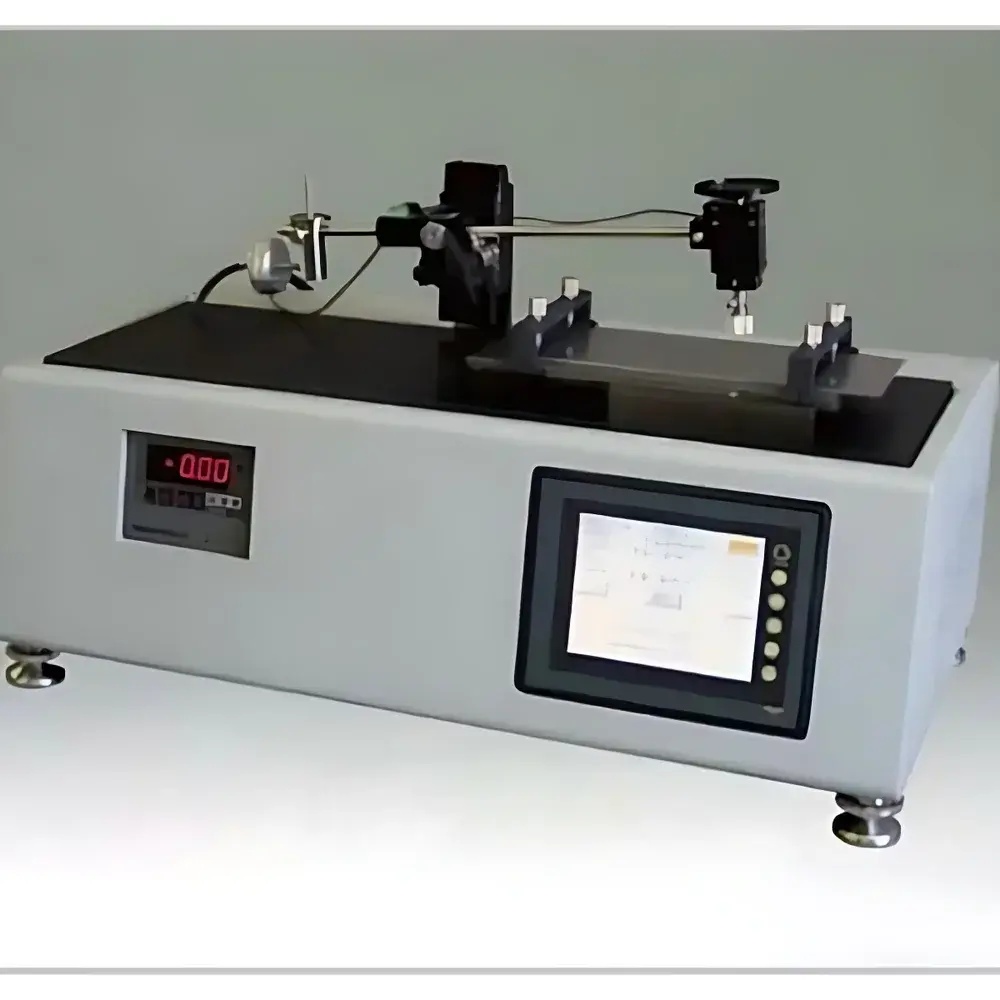
HEIDON TYPE38 Surface Performance Tester
| Brand | HEIDON (Shintō) |
|---|---|
| Origin | Japan |
| Model | TYPE38 |
| Drive Motor | AC Servo Motor |
| Drive Mechanism | Rack & Pinion |
| Traverse Speed | 5–6000 mm/min |
| Stroke Range | 1–100 mm |
| Motion Modes | Single-Stroke (auto-stop after preset distance) / Reciprocating (up to 99,999,999 cycles) |
| Load Measurement Range | 0–1000 gf |
| Load Cell Output | ±0.01% FS linearity (0 to ±5 V), Zero Drift: ≤0.01% FS/°C, Temperature Coefficient of Zero: ≤0.01% FS/°C |
| Low-Pass Filter | ~500 Hz |
| Overload Protection | Integrated safety circuit |
| EMI Suppression | High-frequency noise suppression circuit |
| Strain Amplifier | Manual and auto zero adjustment (±0.5 mV/V max) |
| Operating Environment | 0–50°C, ≤85% RH (non-condensing) |
| Power Supply | AC 100 V, 50/60 Hz |
| Dimensions (Main Unit) | W630 × D350 × H390 mm (H460 mm with pickup unit) |
| Standard Accessories | One load cell, one scratch stylus, one Φ10 mm ball indenter, one ASTM flat indenter, 2-m 3-pin power cord, acrylic safety cover, parts case, instruction manual, tool set |
Overview
The HEIDON TYPE38 Surface Performance Tester is a precision-engineered tribological evaluation system designed for controlled friction, wear, and scratch resistance characterization of solid surfaces under laboratory conditions. Based on the well-established Coulomb–Archard framework for sliding contact mechanics, the instrument employs a servo-driven linear traverse mechanism coupled with high-stability load sensing to quantify tangential force, normal load, and displacement in real time. Its rack-and-pinion actuation ensures repeatable stroke positioning and consistent velocity control across the full operational range (5–6000 mm/min), enabling both quasi-static and dynamic surface interaction studies. Developed by HEIDON Co., Ltd. (Japan), the TYPE38 maintains metrological fidelity comparable to higher-tier tribometers while optimizing cost-efficiency—making it suitable for routine QC testing, material development labs, and academic tribology research where reproducibility, ease of operation, and regulatory traceability are essential.
Key Features
- AC servo motor-driven linear motion system with rack-and-pinion transmission for high positional accuracy and minimal backlash
- Programmable motion profiles: single-stroke (stop-on-distance) and fully configurable reciprocating mode (up to 99,999,999 cycles)
- Integrated overload protection circuit and high-frequency noise suppression to ensure signal integrity during extended testing
- Dual-mode zero calibration: manual and automatic, with zero stability maintained at ≤±0.5 mV/V and drift ≤0.01% FS/°C
- Low-pass filtering (~500 Hz) for effective suppression of mechanical vibration artifacts without compromising response dynamics
- Modular indenter compatibility: includes ASTM-compliant flat tip, Φ10 mm steel ball, and customizable scratch stylus for standardized and application-specific protocols
- Full acrylic safety enclosure compliant with IEC 61000-6-2 and ISO 12100 basic safeguarding requirements
Sample Compatibility & Compliance
The TYPE38 accommodates planar or low-curvature specimens up to 240 mm × 120 mm in footprint, including polymer films, coated papers, hydrophobic membranes, metallic foils, and composite laminates. Its open-stage architecture allows direct integration with environmental chambers (optional), humidity control units, or in-situ optical microscopes. All electrical subsystems conform to JIS C 61000-6-3 (EMI emission) and JIS C 61000-6-2 (immunity) standards. Load cell electronics meet ISO 376 Class 0.5 accuracy requirements for static force measurement. The system supports GLP-compliant documentation when used with optional TRIANGLE software (data timestamping, user authentication, audit trail generation), and its analog output interface (±5 V) enables seamless integration into SCADA or LIMS environments meeting FDA 21 CFR Part 11 data integrity expectations.
Software & Data Management
While the base TYPE38 operates via intuitive front-panel touchscreen controls with color graphical feedback, the optional TRIANGLE software suite extends functionality significantly. TRIANGLE provides real-time synchronized acquisition of normal load, frictional force, displacement, and cycle count; supports multi-curve overlay, statistical trend analysis (mean, SD, CV%), and automated pass/fail threshold evaluation per ASTM D1894, ISO 8295, or internal SOPs. Raw data exports in CSV and Excel-compatible formats include metadata (operator ID, test date/time, environmental log, calibration certificate ID). Audit trails record all parameter changes, file modifications, and user logins—fully compliant with ALCOA+ principles for regulated industries.
Applications
- Quantitative assessment of coefficient of friction (COF) for packaging films, label stocks, and release liners per ASTM D1894
- Scratch resistance evaluation of anti-fingerprint coatings on consumer electronics displays
- Wear depth profiling of biomedical polymer coatings under simulated articulation conditions
- Adhesion durability testing of printed conductive inks on flexible substrates
- Comparative lubricity screening of aqueous and silicone-based topical formulations on synthetic skin models
- Quality conformance verification of roll-to-roll coated materials prior to slitting or lamination
FAQ
Is the TYPE38 compatible with non-Japanese power grids?
The standard unit is configured for AC 100 V, 50/60 Hz input. For international deployment, a certified step-down transformer or factory-configured 230 V variant must be specified at order entry.
Can the system perform ASTM D3363 (pencil hardness) testing?
Not natively—the TYPE38 does not include angular force vector control or standardized pencil holders. However, custom fixtures can be engineered for semi-quantitative scratch initiation studies using calibrated pencils.
What is the recommended recalibration interval for the load cell?
HEIDON recommends annual traceable recalibration against NIST-traceable deadweight standards, or more frequently if subjected to shock loading or environmental extremes beyond specification limits.
Does the included strain amplifier support bridge completion for third-party load cells?
No—the amplifier is optimized exclusively for HEIDON’s proprietary 350 Ω quarter-bridge load cells. External sensors require separate signal conditioning hardware.
Is remote monitoring or network connectivity supported?
The base model offers only analog voltage outputs and local USB storage. Ethernet or Wi-Fi capability requires the TRIANGLE Pro software package with optional industrial gateway module.



