
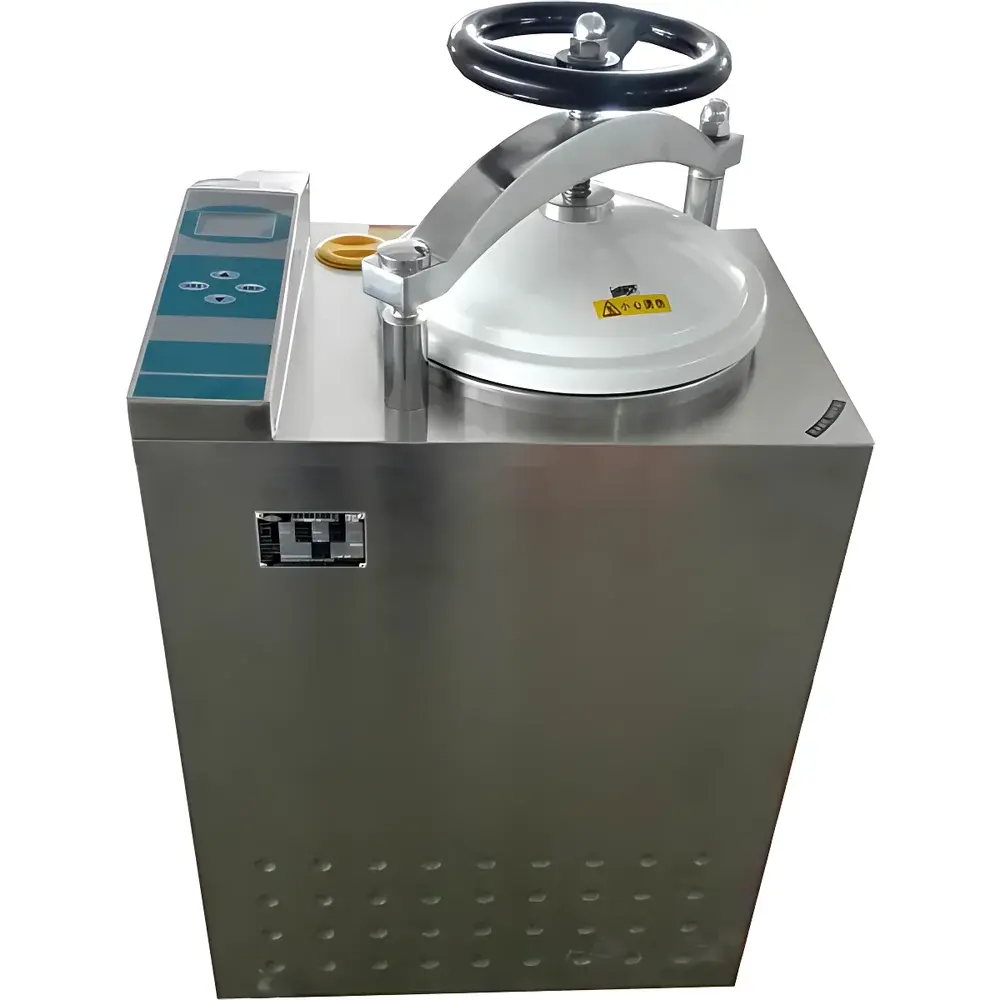
Heineu LS-100HG Vertical Steam Sterilizer
| Brand | Heineu (Jihepu) |
|---|---|
| Origin | Shandong, China |
| Model | LS-100HG |
| Sterilization Chamber Volume | 100 L (Φ440 × 650 mm) |
| Maximum Operating Temperature | 134 °C |
| Maximum Working Pressure | 0.22 MPa |
| Temperature Uniformity | ≤ ±1 °C |
| Timer Range | 0–99 min or 0–99 h 59 min |
| Temperature Setpoint Range | 0–134 °C (sterilization), 50–101 °C (boiling) |
| Power Supply | 4500 W / AC 220 V, 50 Hz |
| External Dimensions | 730 × 510 × 1270 mm |
| Net Weight | 110 kg |
| Safety Interlock | Door lock activated at >0.027 MPa internal pressure |
| Heating Method | External steam generator with dry-heating element |
| Steam Cycle | Internal recirculation (no external venting) |
| Compliance | Designed to meet ISO 17665-1:2019 (Moist heat sterilization), EN 285:2015 (Large steam sterilizers), and GLP/GMP-relevant operational safeguards |
Overview
The Heineu LS-100HG Vertical Steam Sterilizer is a fully automated, microprocessor-controlled Class B gravity-displacement and pre-vacuum capable sterilization system engineered for consistent, traceable, and repeatable moist-heat sterilization of heat-stable medical devices, laboratory glassware, culture media, textiles, and porous loads. It operates on the fundamental principle of saturated steam under controlled pressure and temperature—leveraging the lethal effect of moist heat on microbial DNA, proteins, and cellular membranes. With a validated chamber volume of 100 L and maximum operating parameters of 134 °C at 0.22 MPa, the LS-100HG meets the minimum requirements for accelerated sterilization cycles per ISO 17665-1:2019 Annex A, supporting both standard gravity and extended drying phases. Its vertical configuration optimizes floor space in compact labs while maintaining ergonomic loading/unloading access.
Key Features
- Microprocessor-based control system with backlit LCD interface providing real-time display of temperature, pressure, elapsed time, phase status (pre-heat, sterilize, dry, cool), and fault diagnostics.
- Dual-mode operation: programmable gravity displacement (for non-porous items) and optional pre-vacuum-assisted air removal (for wrapped or porous loads), ensuring complete steam penetration.
- Integrated steam generator with external dry-heating element—improves thermal efficiency, reduces condensate formation, and eliminates dependency on external boiler supply.
- Internal steam recirculation design prevents ambient humidity increase and eliminates need for external exhaust ducting—ideal for shared lab environments and ISO Class 7/8 cleanrooms.
- Multi-level safety architecture: mechanical door interlock (engaged at >0.027 MPa), overtemperature cutoff (<140 °C), overpressure relief valve (set at 0.25 MPa), dry-run protection, current overload interruption, and ground-fault circuit interruption (GFCI).
- Seven preconfigured cycle profiles: Instrument, Dressing, Liquid, Culture Medium, Boil, Custom A, Custom B—with editable setpoints for temperature (0–134 °C), exposure time (0–99 h 59 min), drying duration (0–60 min), and exhaust rate.
Sample Compatibility & Compliance
The LS-100HG accommodates a broad range of load types—including stainless-steel surgical instruments, cotton gauze packs, borosilicate glassware, PET/PP plastic containers, agar-based culture media in sealed bottles, and autoclavable polymer tubing. Chamber geometry (Φ440 × 650 mm) allows upright loading of tall flasks and stacked trays without compromising steam flow dynamics. All wetted surfaces are constructed from AISI 304 stainless steel, complying with EN 13485 biocompatibility guidelines for repeated sterilization exposure. The unit supports validation documentation per ISO 13485:2016 and includes built-in data logging (time-stamped temperature/pressure traces) compatible with FDA 21 CFR Part 11 audit trail requirements when paired with compliant software export protocols. Routine biological indicator testing (e.g., Geobacillus stearothermophilus spores) confirms log6 microbial reduction across all cycle modes.
Software & Data Management
While the LS-100HG operates autonomously via its onboard controller, it features an RS-232 serial port for optional connection to PC-based monitoring software (sold separately). Logged cycle data—including start/end timestamps, peak temperature/pressure values, dwell time compliance, and alarm events—is stored in non-volatile memory for ≥1,000 cycles. Export formats include CSV and PDF reports suitable for internal QA review or regulatory submission. The system supports manual calibration verification of temperature sensors (PT100 class B) and pressure transducers (±0.5% FS), with calibration logs retained alongside operational records. For GxP environments, optional password-protected user roles (Operator, Technician, Administrator) enable segregation of duties and prevent unauthorized parameter modification.
Applications
This sterilizer serves core functions across clinical, academic, and industrial laboratories: terminal sterilization of reusable surgical kits prior to OR deployment; depyrogenation of glass vials and syringes in pharmaceutical QC labs; preparation of sterile microbiological growth media for ISO 11137-compliant validation studies; decontamination of biohazardous waste in BSL-2 facilities; and routine sanitization of pipette tips, centrifuge rotors, and electrophoresis equipment. Its ability to hold stable temperature uniformity (≤ ±1 °C across chamber volume) ensures reproducible results for ASTM F1055-20 (steam sterilization of thermoplastics) and USP sterility assurance level (SAL) verification.
FAQ
What is the maximum recommended load weight for optimal sterilization performance?
The chamber is rated for up to 35 kg of typical instrument load or 25 kg of dense textile packs. Overloading compromises steam penetration and extends cycle times beyond validated parameters.
Does the LS-100HG support vacuum-assisted air removal?
Yes—via programmable pre-vacuum pulses (up to 3 cycles), enabling effective air evacuation from wrapped or lumened devices per EN 285:2015 Clause 5.4.
Can liquid cycles be validated for full-volume bottles?
Yes—provided bottles are placed upright with caps loosened and chamber loading density does not exceed 70% capacity. Cycle validation must include thermocouple mapping per ISO 17665-2.
Is third-party IQ/OQ/PQ documentation available?
Factory-supplied qualification templates (IQ/OQ checklists) are included. PQ protocols require site-specific thermocouple mapping and biological challenge testing performed by qualified personnel.
What maintenance intervals are recommended for long-term reliability?
Daily: chamber drain inspection and gasket cleaning. Monthly: safety valve functional test and door seal integrity check. Annually: PT100 sensor calibration and steam generator descaling using approved citric acid solution.



