
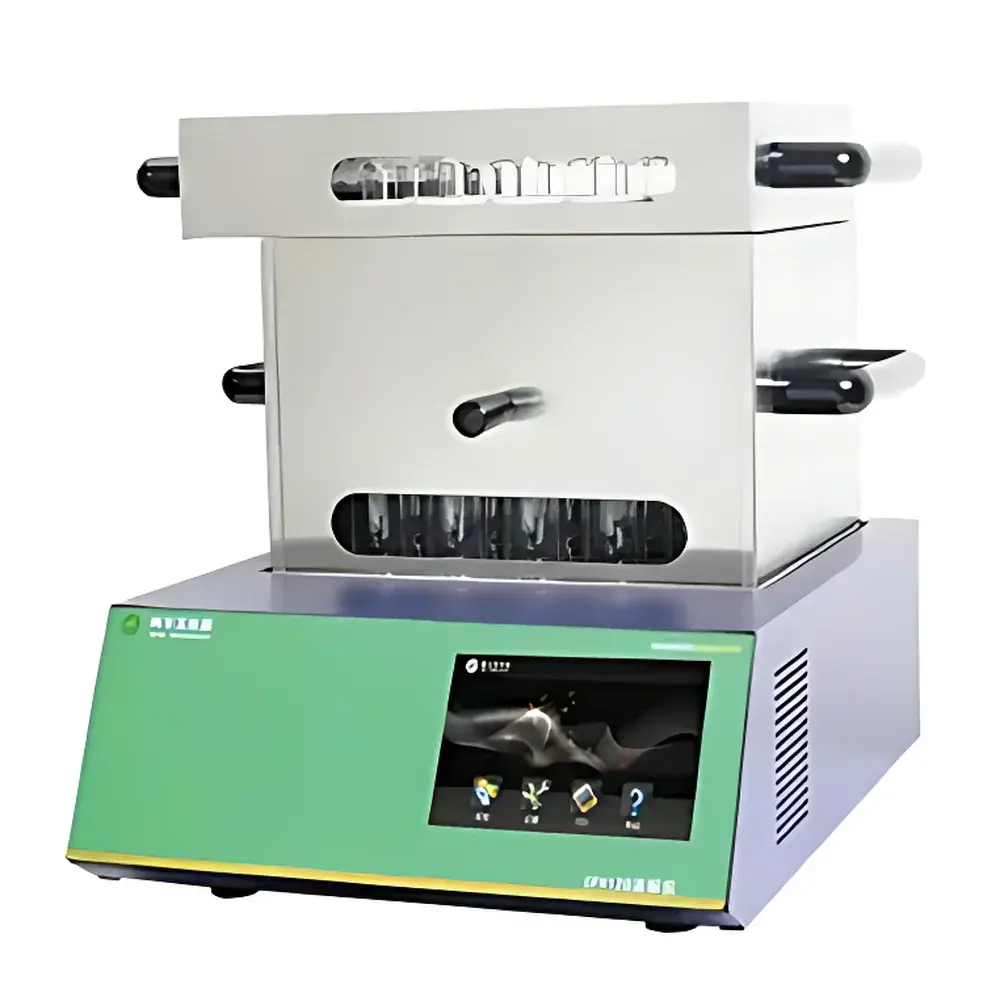
Heipu SPH620G COD Digestion System
| Brand | Heipu |
|---|---|
| Origin | Shandong, China |
| Model | SPH620G |
| Digestion Method | Reflux Digestion |
| Heating Module | Single Graphite or Aluminum Block (Optional) |
| Batch Capacity | 20 samples |
| Temperature Range | Ambient to 450 °C |
| Temperature Accuracy | ±0.1 °C |
| Temperature Stability | ±1 °C at 100 °C |
| Digestion Vessel Capacity | 300 mL |
| Sample Load | Up to 5 g solid or 20 mL liquid per vessel |
| Programmable Ramp Segments | Up to 100 segments per method, 100 methods stored |
| Segment Duration Range | 1–999 min |
| Timer Accuracy | ±2 s/h |
| Dimensions (W×L×H) | 400 × 510 × 600 mm |
| Safety Features | Over-temperature alarm, non-ceramic fiber insulation (high-density alumina-silicate + air-gap), acid gas exhaust with activated carbon filtration |
| Compliance | Designed for ASTM D1252, ISO 6060, and EPA 410.4 wastewater COD determination protocols |
Overview
The Heipu SPH620G COD Digestion System is a laboratory-grade, programmable reflux digestion instrument engineered for precise and reproducible chemical oxygen demand (COD) analysis in wastewater, surface water, and industrial effluent samples. It operates on the principle of closed-reflux, high-temperature acidic oxidation—typically using potassium dichromate (K2Cr2O7) in concentrated sulfuric acid under controlled thermal conditions—to convert organic matter into CO2, enabling quantification via titrimetric or spectrophotometric endpoint detection. Unlike open-digestion systems, the SPH620G employs an integrated reflux condenser design that minimizes reagent loss, prevents sample cross-contamination, and ensures stoichiometric completeness of oxidation—critical for compliance with standardized methods including ISO 6060:2021, ASTM D1252–22 (Method B), and U.S. EPA Method 410.4.
Key Features
- Programmable Multi-Stage Thermal Profiles: Supports up to 100 user-defined digestion methods, each containing up to 100 independent temperature ramp/hold segments. Each segment allows time setting from 1 to 999 minutes, enabling full alignment with method-specific heating sequences (e.g., initial ramp to 150 °C, hold at 300 °C for 120 min, final cool-down).
- High-Uniformity Heating Block: Available with either graphite or aluminum heating modules (user-selectable), both engineered for ≤±0.5 °C inter-hole temperature uniformity across all 20 positions at 300 °C—verified per IEC 61000-4-30 thermal mapping protocols.
- Non-Hazardous Thermal Insulation: Utilizes layered high-density alumina-silicate insulation combined with an engineered air-gap barrier—zero ceramic fiber, zero asbestos—meeting OSHA 1910.132 and EU Directive 2009/148/EC requirements for lab personnel safety and long-term exposure risk mitigation.
- Integrated Acid Gas Management: Built-in fume extraction channel directs evolved H2SO4, Cl2, and NOx vapors through a replaceable activated carbon filter cartridge (HEPA-class particulate retention), reducing ambient acid concentration below NIOSH REL limits (1 mg/m³ H2SO4 TWA).
- Touchscreen Human-Machine Interface (HMI): 7-inch capacitive LCD panel with intuitive icon-based navigation, real-time temperature/time graphing, and password-protected method editing—designed for GLP-compliant operation with audit trail-ready event logging (start/stop, setpoint changes, alarms).
Sample Compatibility & Compliance
The SPH620G accommodates standard 300 mL borosilicate glass digestion tubes (DIN 12777 compliant), supporting both solid-phase (≤5 g suspended solids) and liquid-phase (≤20 mL aqueous matrix) samples without dilution artifacts. Its thermal performance meets the stability criteria specified in ISO/IEC 17025:2017 Clause 6.4.3 for calibration traceability, and its operational parameters are validated against reference materials (e.g., potassium hydrogen phthalate CRM, NIST SRM 1096a). The system supports full documentation generation required for regulatory submissions under EPA NPDES permits, EU Water Framework Directive reporting, and ISO 14001 environmental management system audits.
Software & Data Management
While the SPH620G operates as a standalone instrument, its embedded firmware logs timestamped thermal profiles, method IDs, operator codes, and alarm events to internal flash memory (16 GB). Optional USB export enables transfer of CSV-formatted logs—including actual vs. setpoint temperature deviations, dwell times, and fault codes—for integration into LIMS platforms (e.g., LabWare LIMS, Thermo Fisher SampleManager). All data fields comply with ALCOA+ principles (Attributable, Legible, Contemporaneous, Original, Accurate, Complete, Consistent, Enduring, Available), satisfying FDA 21 CFR Part 11 requirements when used with validated electronic signature workflows.
Applications
- Regulatory COD testing in municipal wastewater treatment plants (WWTPs) per EPA 410.4 and ISO 6060
- Industrial pretreatment monitoring for textile, pharmaceutical, and food processing effluents
- Research-scale oxidation kinetics studies requiring precise thermal ramp control
- Validation of alternative oxidants (e.g., MnO4−, Ce4+) under standardized reflux conditions
- Method development for high-chloride matrices using mercury-free digestion protocols
FAQ
What digestion standards does the SPH620G support?
It is fully compatible with ISO 6060:2021, ASTM D1252–22 (Method B), and U.S. EPA Method 410.4 for COD determination.
Can the heating block be replaced or upgraded in the field?
Yes—the graphite and aluminum modules are mechanically interchangeable using standard hex tools; no recalibration is required post-swap.
Is the activated carbon filter replaceable, and what is its service life?
The filter cartridge is user-replaceable and rated for ≥500 digestion cycles under typical municipal wastewater loads (COD 15% pressure drop across the housing.
Does the system provide temperature calibration traceability?
Each unit ships with a factory calibration certificate referencing NIST-traceable RTD standards (±0.05 °C uncertainty at 200 °C), and users may perform in-house verification using Class A PTFE-sheathed thermocouples per ISO/IEC 17025 Annex A.3.
How is data integrity ensured during power interruption?
The device features non-volatile memory with automatic save-on-failover; all active method steps, timestamps, and thermal history are retained even after unexpected shutdown.







