
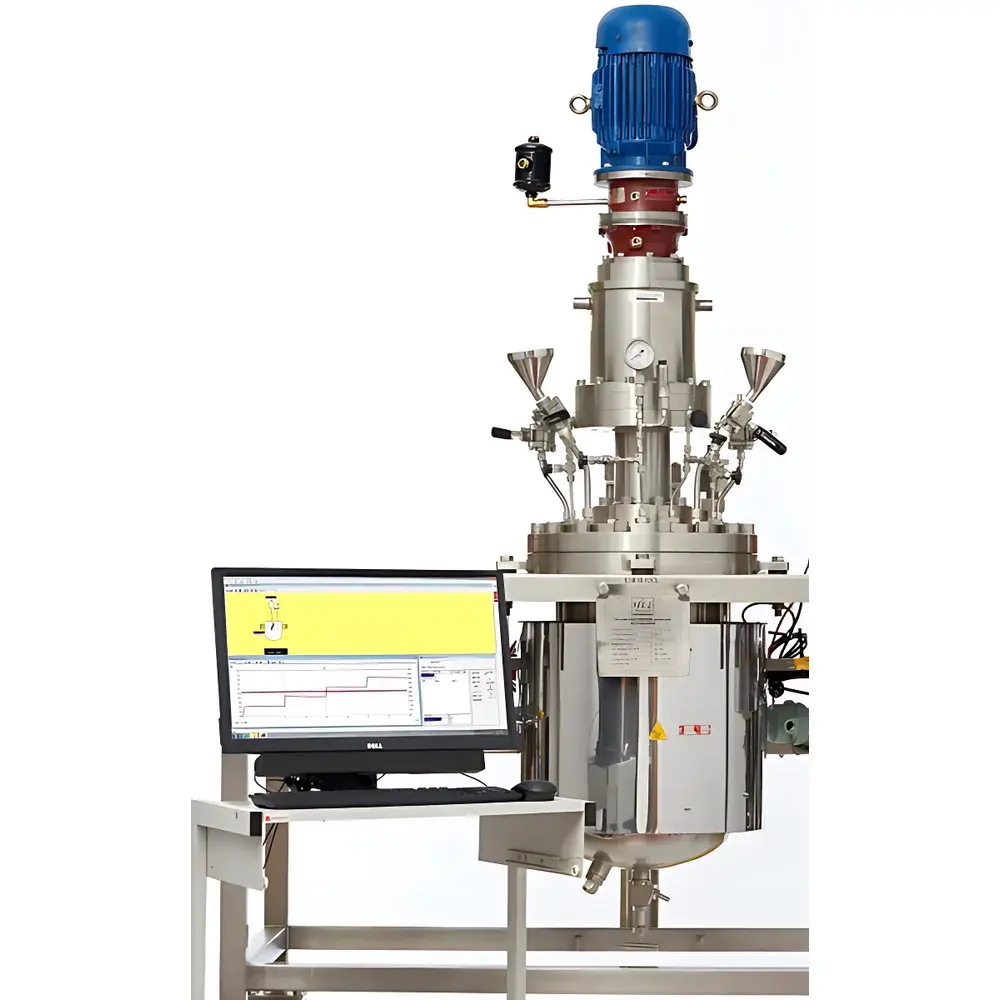
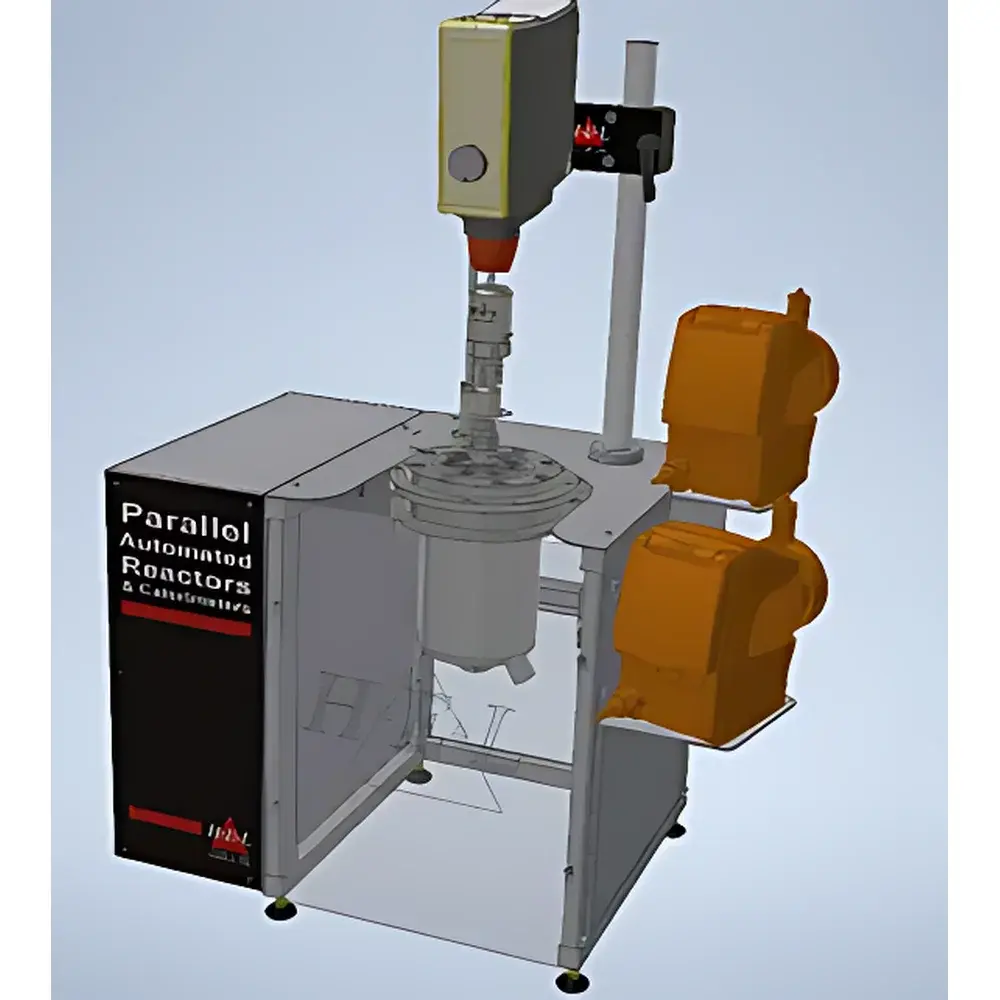
HEL AutoLAB High Pressure Automated Chemical Synthesis System
| Brand | HEL |
|---|---|
| Origin | United Kingdom |
| Model | AutoLAB High Pressure |
| Reactor Volume | 500 mL – 5 L |
| Maximum Pressure | 200 bar |
| Maximum Temperature | 500 °C |
| Construction Materials | Stainless Steel (316 SS), Hastelloy, Pyrex® Borosilicate Glass |
| Reactor Configuration | Modular Parallel Reactors (1–8 stations) |
| Control Software | WinISO v7.x (FDA 21 CFR Part 11 compliant with audit trail, electronic signatures, and user access levels) |
| Stirring | Integrated overhead mechanical stirring with torque monitoring |
| Temperature Control | PID-controlled heating/cooling jackets or internal coils |
| Optional Modules | Automated liquid/gas/solid dosing, in-situ PAT (FTIR, Raman, FBRM, turbidity, pH, reaction calorimetry) |
Overview
The HEL AutoLAB High Pressure Automated Chemical Synthesis System is an engineered platform for precise, reproducible, and scalable reaction development under controlled high-pressure and high-temperature conditions. Built upon Couette-flow reactor dynamics and closed-loop process control architecture, the system enables rigorous investigation of reaction kinetics, catalyst screening, thermal hazard assessment, and process intensification—particularly where gas–liquid–solid phase interactions, exothermicity, or volatile reagent handling are critical. Designed by practicing chemists for laboratory-scale process research, AutoLAB integrates robust mechanical construction (ASME BPVC Section VIII Div. 1 compliant pressure vessels), real-time parameter logging, and deterministic event sequencing to support GLP-compliant experimental workflows. Its modular topology allows deployment as a single-reactor high-fidelity testbed or as an 8-station parallel array—each station independently programmable for temperature, pressure, agitation rate, dosing profile, and sampling schedule.
Key Features
- Modular parallel architecture supporting 1–8 independent reaction zones with full parameter decoupling: individual setpoints for temperature (−40 °C to 500 °C), pressure (vacuum to 200 bar), agitation (0–1000 rpm with torque feedback), and dosing timing.
- Pressure-rated reactors constructed from electropolished 316 stainless steel, Hastelloy C-276, or Pyrex® borosilicate glass—validated per ISO 14040 for material compatibility across acidic, basic, and halogenated media.
- WinISO v7.x control software certified for FDA 21 CFR Part 11 compliance: featuring role-based user permissions, time-stamped audit trails, electronic signatures, and data integrity validation (ALCOA+ principles).
- Automated solid feeding via HEL’s proprietary helical gravimetric feeder—capable of metering powders, granules, or slurries with ±0.5% mass accuracy over 0.1–50 g/min range.
- Multi-modal dosing options: high-pressure piston pumps (up to 350 bar), HPLC-grade syringe pumps, mass-flow-controlled gas injection (0–500 sccm, N₂/Ar/H₂/CO₂), and vapor-phase delivery for low-boiling solvents.
- Integrated safety interlocks: pressure relief valves with rupture disc assemblies, thermal runaway detection (dT/dt > 2 K/min triggers emergency cooling), and real-time torque anomaly alerts.
Sample Compatibility & Compliance
AutoLAB accommodates heterogeneous catalytic systems, organometallic syntheses, hydrogenations, polymerizations, and continuous-flow hybrid batch operations. Reactor linings and wetted materials conform to ASTM G155 (corrosion resistance) and USP (extractables profiling). All pressure components meet PED 2014/68/EU requirements; electrical subsystems comply with IEC 61000-6-4 (EMC) and IEC 61010-1 (safety). The system supports ISO/IEC 17025 method validation protocols and is routinely deployed in API route scouting per ICH Q5A and Q8(R2) guidelines.
Software & Data Management
WinISO provides deterministic experiment scripting (XML-based protocol definition), synchronized multi-channel data acquisition (100 Hz sampling), and native export to CSV, MATLAB (.mat), and Ansys Twin Builder-compatible formats. Raw sensor streams—including RTD temperature, strain-gauge torque, capacitive pressure, and IR thermography—are time-aligned and annotated with metadata (operator ID, calibration status, environmental log). Data archives are encrypted at rest (AES-256) and support automated backup to network-attached storage or validated cloud repositories (e.g., AWS GovCloud with HIPAA/BAA).
Applications
- Kinetic modeling of catalytic cycles using sequential isothermal/isobaric runs with in-situ FTIR endpoint detection.
- Safety-critical screening of nitration or diazotization reactions under adiabatic calorimetry mode (Phi-factor corrected).
- DOE-driven optimization of asymmetric epoxidation—varying Ti(OiPr)₄ loading, TBHP concentration, and chiral ligand stoichiometry across 8 parallel vessels.
- Crystallization polymorph screening via controlled antisolvent addition with inline FBRM particle count and turbidity correlation.
- Hydrogenation reaction mapping across H₂ partial pressures (1–100 bar), Pd/C loadings (0.5–5 wt%), and mass transfer regimes (impeller Reynolds number 10³–10⁵).
FAQ
What pressure and temperature ranges are validated for routine operation?
Standard configurations operate continuously from −40 °C to 500 °C and vacuum to 200 bar. Extended-range variants (up to 600 °C / 300 bar) require Hastelloy C-22 vessels and custom thermal insulation—subject to engineering review.
Can AutoLAB integrate with third-party analytical instruments?
Yes—via Ethernet/IP or RS-485 Modbus TCP, the system synchronizes triggers and timestamps with HPLC autosamplers, GC-MS injectors, and Raman spectrometers (e.g., Kaiser Optical RXN series). Digital I/O ports support TTL-level start/stop signals.
Is remote monitoring supported during unattended overnight runs?
WinISO includes secure web-based dashboard access (HTTPS/TLS 1.3) with live trend plots, alarm push notifications (SMS/email), and real-time video feed integration from optional reactor-viewing ports.
How is calibration traceability maintained across sensors?
Each temperature sensor ships with NIST-traceable certificate (±0.1 °C at 100 °C); pressure transducers are calibrated annually per ISO/IEC 17025 accredited lab reports. WinISO logs all calibration events with operator signature and validity expiry.
What training and documentation packages are provided?
Installation qualification (IQ), operational qualification (OQ), and performance qualification (PQ) protocols are included. On-site operator certification (2-day course) covers SOP development, failure mode analysis, and 21 CFR Part 11 workflow validation.



